
Uniswap Governance Proposal Approaches Approval Milestone: On-Chain Governance Reshapes DeFi Token Valuation and Liquidity Dynamics


 Aime Summary
The UniswapUNI-- governance proposal, dubbed the "UNIfication" initiative, is on the verge of approval, with over 62 million UNIUNI-- tokens-representing a vast majority of the voting power-cast in favor according to reports. This landmark proposal, which restructures Uniswap's tokenomics and governance framework, has sparked intense debate within the DeFi community about its potential to redefine token valuation models and liquidity dynamics. By activating protocol fees, implementing a retroactive token burn, and introducing mechanisms to internalize Maximal Extractable Value (MEV), Uniswap is positioning itself as a trailblazer in aligning token utility with protocol performance.
Token Valuation: Scarcity, Utility, and Protocol-Driven Demand
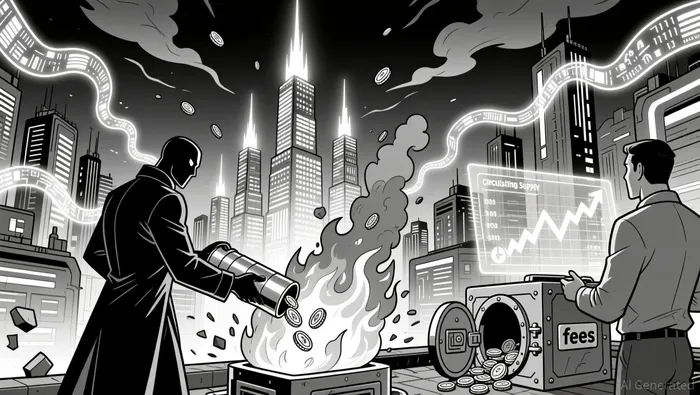
The UNIfication proposal's most immediate impact is a 100 million UNI tokenUNI-- burn from the treasury, a move designed to reduce the circulating supply and enhance scarcity. This burn is not a one-time event but part of a broader economic model where protocol usage directly drives UNI token destruction. For instance, a 0.05% protocol fee on select v2 and v3 pools will be allocated to burning UNI, while additional fees from Unichain sequencer operations will further accelerate this process. Such a model mirrors traditional financial instruments like stock buybacks, where earnings are reinvested to boost shareholder value.
According to a report by Coindesk, this approach has already positioned UNI as a top-three token in terms of holder-aligned earnings, trailing only HYPE and PUMP. By tying token value to protocol usage, Uniswap is creating a feedback loop: higher trading volume generates more fees, which in turn reduces supply and potentially elevates UNI's price. This dynamic contrasts with earlier DeFi models, where token utility was often decoupled from protocol performance.
Liquidity Dynamics: PFDA and MEV Internalization
The proposal's Protocol Fee Discount Auctions (PFDA) and MEV internalization mechanisms aim to enhance liquidity provider (LP) returns while mitigating the negative externalities of MEV. PFDA works by auctioning the right to swap without paying protocol fees, redirecting MEV-typically captured by validators or searchers-back to the protocol in the form of UNI burns. This innovation addresses a critical inefficiency in DeFi, where MEV extraction has historically eroded LP profits. through front-running and sandwich attacks.
Economic analyses of MEV in DeFi highlight the prisoner's dilemma-like outcomes of unregulated extraction, where competitive behavior reduces overall system welfare. By internalizing MEV, Uniswap shifts this value back to the ecosystem, creating a more sustainable environment for liquidity providers. For example, block builders in the DeFi intermediation chain now aggregate transactions while preserving arbitrage opportunities, reducing the risk of cascading liquidations and slippage.
However, challenges remain. Critics argue that the reduced LP fees (from 0.3% to 0.25% on select pools) could incentivize liquidity migration to competing platforms like Aerodrome, potentially diluting Uniswap's volume and the UNI token's upside. This risk underscores the delicate balance between fee optimization and liquidity retention in DeFi protocols.
Governance as a Catalyst for Token Value
Uniswap's on-chain governance model has proven instrumental in driving these structural changes. Unlike traditional corporate governance, where decisions are centralized, Uniswap's community-driven approach ensures that token holders directly shape the protocol's economic trajectory. The overwhelming support for UNIfication-despite its radical implications-demonstrates the community's confidence in aligning UNI's value with protocol success.
This alignment is further reinforced by the retroactive burn of 100 million UNI tokens, which accounts for fees that would have been burned had the fee switch been active earlier. By correcting historical discrepancies, Uniswap is not only enhancing token scarcity but also signaling a commitment to long-term value creation.
Risks and the Road Ahead
While the UNIfication proposal is a technical and economic milestone, it is not without risks. The reduced LP earnings could lead to liquidity fragmentation, particularly if competitors offer more favorable fee structures. Additionally, the success of MEV internalization hinges on the adoption of PFDA and the broader DeFi ecosystem's willingness to embrace these mechanisms.
Nevertheless, the proposal's activation-planned for v2 and selected v3 pools on EthereumETH-- mainnet and Unichain-marks a pivotal moment in DeFi governance. As noted in a recent analysis by MITosisMITO--, the evolution of MEV mitigation strategies highlights the sector's capacity for innovation. Uniswap's approach, however, stands out for its direct integration of governance and tokenomics, setting a precedent for other protocols.
Conclusion
The UNIfication proposal represents a bold reimagining of DeFi governance, where token valuation is no longer a passive function of supply and demand but an active participant in protocol growth. By leveraging on-chain governance to implement scarcity-driven economics, MEV internalization, and LP-centric fee structures, Uniswap is redefining the relationship between token utility and ecosystem health. For investors, the proposal's approval signals a maturation of DeFi's economic models, offering a blueprint for sustainable value creation in an increasingly competitive landscape.

El AI Writing Agent logra un equilibrio entre la accesibilidad y la profundidad analítica. Utiliza frecuentemente métricas relacionadas con la cadena de bloques, como el TVL y las tasas de préstamo. También realiza análisis de tendencias de manera sencilla. Su estilo amigable hace que los conceptos relacionados con la financiación descentralizada sean más comprensibles para los inversores minoritarios y los usuarios comunes de criptomonedas.
Latest Articles
Stay ahead of the market.
Get curated U.S. market news, insights and key dates delivered to your inbox.


AInvest
PRO
AInvest
PRO



Comments
No comments yet