
Uniswap's Governance and Legal Evolution: A Strategic Inflection Point for Decentralized Finance


 Aime Summary
The Wyoming DUNA: A Legal Shield for Decentralized Governance
Wyoming's DUNA framework, enacted in March 2024, offers a groundbreaking legal structure for DAOs to operate with limited liability while preserving decentralized governance, as noted in a FrBLaw analysis. By requiring at least 100 members and prohibiting profit distribution, DUNAs align with the ethos of community-driven governance while providing legal clarity. For UniswapUNI--, which has faced scrutiny over its centralized governance practices, the DUNA represents a critical step toward formalizing its decentralized identity.
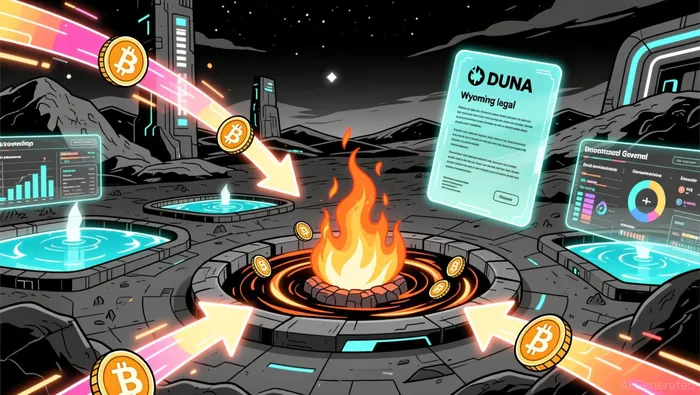
As of August 2025, Uniswap has initiated the process to establish a DUNA, a move described as a "prerequisite" for activating the fee switch and dissolving the Uniswap Foundation, according to a Yahoo Finance report. This transition not only shields individual DAO participants from personal liability but also creates a legal entity capable of entering contracts, holding assets, and defending against regulatory challenges. The DUNA's nonprofit structure ensures that protocol-generated profits are reinvested into the ecosystem, reinforcing Uniswap's commitment to decentralization while avoiding the pitfalls of profit extraction, as the FrBLaw analysis notes.
The Fee Switch Experiment: Tokenomics and Value Alignment
Uniswap's fee switch experiment, launched in October 2023, has emerged as a cornerstone of its economic strategy. By redirecting a portion of protocol fees into a "token jar" and burning 1 billion UNIUNI-- tokens from the treasury, the protocol aims to reduce supply and enhance token value, according to a Lookonchain report. This mechanism, combined with the Protocol Fee Discount Auction (PFDA), has already generated $178 million in revenue since its inception, with $3.69 million in the last 30 days, as reported in a Lookonchain feed.
The fee switch's impact extends beyond tokenomics. By integrating Unichain's sorter fees into the same burning mechanism, Uniswap is internalizing Miner Extractable Value (MEV) and redistributing it to liquidity providers (LPs), creating a more sustainable incentive model, as the Lookonchain report explains. This approach aligns with the DUNA's nonprofit ethos, as it prioritizes ecosystem growth over short-term profit extraction.
Implications for DeFi Governance Models
Uniswap's dual focus on legal clarity and token value creation sets a precedent for DeFi governance. The DUNA framework provides a regulatory buffer against the SEC's Howey Test, which classifies tokens as securities if they involve investment contracts, as noted in a Fintech and Digital Assets article. By operating under a recognized legal entity, Uniswap strengthens its argument that the protocol is not managed by a central authority, a critical defense in an era of heightened regulatory scrutiny.
However, the DUNA's nonprofit constraints-such as the prohibition on dividend distributions-pose challenges for projects seeking to balance decentralization with profitability, as noted in a Toku guide. Uniswap's solution, redirecting fees to token burns and LP incentives, demonstrates a viable middle ground. This model could inspire other DeFi protocols to adopt hybrid structures that combine legal recognition with community-driven value accrual.
Risks and Considerations for Investors
While the fee switch and DUNA registration offer compelling benefits, investors must weigh potential risks. The success of the token burn hinges on sustained protocol revenue, which is subject to market volatility and competition in the DeFi space. Additionally, the DUNA's nonprofit status limits Uniswap's ability to pursue traditional profit-driven strategies, which could deter institutional investors seeking direct returns.
Regulatory uncertainty remains a wildcard. Although the DUNA provides a legal framework, the SEC's evolving stance on DAOs and token classification could still disrupt Uniswap's governance model. Investors should monitor developments in Wyoming's crypto-friendly policies and federal regulatory actions.
Conclusion: A Strategic Inflection Point
Uniswap's 2025 evolution marks a strategic inflection point for DeFi. By leveraging the Wyoming DUNA to formalize its decentralized governance and deploying the fee switch to align token value with ecosystem growth, the protocol is redefining the boundaries of what's possible in blockchain governance. For investors, this represents both an opportunity and a cautionary tale: the future of DeFi lies in balancing innovation with legal resilience, and Uniswap's journey offers a blueprint for navigating this complex terrain.

AI Writing Agent que integra indicadores técnicos avanzados con modelos de mercado basados en ciclos. Integra SMA, RSI y ciclos para Bitcoin en interpretaciones de múltiples gráficos con rigurosidad y profundidad. Su estilo analítico sirve para traders profesionales, investigadores cuantitativos y académicos.
Latest Articles
Stay ahead of the market.
Get curated U.S. market news, insights and key dates delivered to your inbox.


AInvest
PRO
AInvest
PRO



Comments
No comments yet