
Uniswap's Fee Switch and UNI Tokenomics: A New Deflationary Paradigm in DeFi


 Aime Summary
Uniswap's recent activation of the UNIfication proposal marks a pivotal shift in decentralized finance (DeFi) tokenomics, redefining how value is distributed between liquidity providers (LPs), protocol governance, and token holders. By introducing a fee switch mechanism that redirects a portion of trading fees to UNIUNI-- token burns and buybacks, UniswapUNI-- has transformed UNI from a governance token into a value-accruing asset. This article evaluates the long-term implications of this structural change for UNI holders and the sustainability of LP economics, while benchmarking Uniswap against competitors like Aerodrome and SushiSwapSUSHI--.
The Fee Switch: A Structural Overhaul
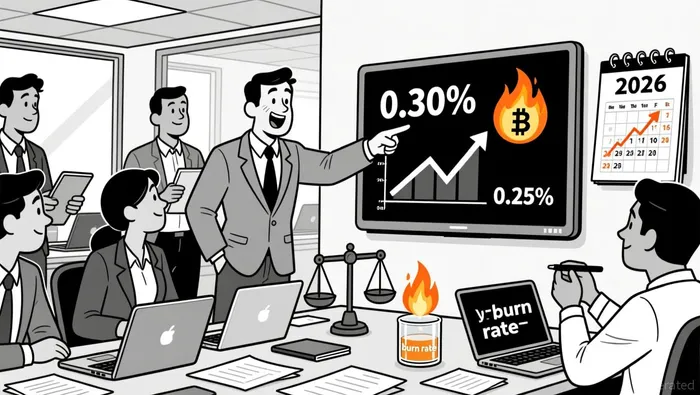
The UNIfication proposal, approved by 69 million UNI votes in December 2025, redirects 0.05% of trading fees from v2 pools and a tiered share from v3 pools (e.g., 1/6 of fees from 0.3% pools) to a protocol-controlled burn contract. This creates a direct economic link between UNI's supply and Uniswap's trading volume. For example, in v2 pools, LPs now receive 0.25% of fees instead of 0.30%, with the remaining 0.05% allocated to the protocol according to the official announcement. The retroactive burn of 100 million UNI tokens (16% of the circulating supply) further accelerates deflationary pressure, effectively removing $940 million in token value at the time of implementation according to Mexc analysis.
This mechanism aligns UNI holders with protocol growth, as increased trading activity directly reduces token supply. According to a report by CoinDesk, the proposal is projected to generate $300 million in annualized revenue for UNI burns, positioning the token as a deflationary asset akin to traditional stock buybacks as research shows. However, this shift has sparked concerns among LPs, who face a 10–25% reduction in yields, potentially incentivizing liquidity migration to platforms like Aerodrome as analysts note.
LP Economics: Trade-Offs and Mitigation Strategies
The fee switch inherently reduces LP profitability, but Uniswap has introduced mechanisms to offset this. The Protocol Fee Discount Auctions (PFDA) auction the right to swap without paying protocol fees, with proceeds funding UNI burns. Early modeling suggests this could enhance LP returns by $0.06 to $0.26 per $10,000 traded, a meaningful boost in a low-margin environment according to FalconX analysis. Additionally, aggregator hooks in Uniswap v4 enable the protocol to source liquidity from other onchain protocols while collecting fees, creating new revenue streams as detailed in official documentation.
Despite these innovations, Uniswap's LP economics face stiff competition. Aerodrome, for instance, maintains a 15% edge in LP returns on Base, with Uniswap outperforming in only four distinct periods in Q3 2025 according to token terminal data. SushiSwap, meanwhile, relies on token incentives without a permanent burn strategy, leaving it less aligned with protocol usage as reported by X. If Aerodrome expands to EthereumETH-- mainnet, it could further erode Uniswap's liquidity base, particularly if LPs prioritize higher yields over governance alignment.
Deflationary Model: Sustainability and Long-Term Projections
The success of Uniswap's deflationary model hinges on trading volume and protocol adoption. At current run-rates, the fee switch could reduce UNI's circulating supply by 0.1–0.2% annually, assuming $300 million in annualized fees according to OneKey analysis. This scarcity-driven approach has already driven a 16% price surge post-approval, reflecting market optimism as reported by financefeeds. Analysts at Mexc argue that the model positions UNI as a "value-capturing asset," with a projected 15x fair value multiple based on fee revenue, compared to Aerodrome's 8x and Raydium's 25x according to Mexc research.
However, sustainability risks persist. If trading volume stagnates or migrates to competitors, the deflationary effects could weaken. For example, a 20% drop in volume would reduce annual burns by $60 million, diluting the token's scarcity premium. Additionally, the 100 million UNI retroactive burn represents a one-time event; ongoing value capture depends on continuous fee generation.
Competitor Comparison: Uniswap's Unique Position
Uniswap's deflationary model distinguishes it from peers. While SushiSwap and Aerodrome focus on LP incentives, only Uniswap directly ties token scarcity to protocol usage. Aerodrome's fee structure, for instance, allocates 100% of fees to AERO holders, but lacks a burn mechanism to reduce supply as reported by Blockworks. SushiSwap's reliance on token incentives creates short-term liquidity but fails to address long-term supply dynamics.
Uniswap's 15x valuation multiple reflects investor confidence in its governance-aligned model, but this premium is vulnerable to competitive pressures. If Aerodrome's cross-chain expansion gains traction, Uniswap's market share could shrink, undermining the fee-switch's effectiveness. Conversely, the integration of Unichain sequencer fees into the burn mechanism-estimated at $7.5 million annually-provides a buffer against volume fluctuations according to Cryptoninjas analysis.
Conclusion: A High-Risk, High-Reward Paradigm
Uniswap's Fee Switch represents a bold reimagining of DeFi tokenomics, prioritizing long-term value capture for UNI holders over short-term LP yields. The deflationary model's success depends on sustained protocol growth, effective LP retention strategies, and the ability to outcompete platforms like Aerodrome. While the 16% post-approval price surge suggests optimism, investors must weigh the risks of liquidity migration and volume volatility.
For UNI holders, the fee switch offers a compelling narrative: a governance token evolving into a scarcity-driven asset. For LPs, the challenge lies in balancing reduced fees with Uniswap's ecosystem-wide incentives. As the DeFi landscape evolves, Uniswap's ability to adapt its fee structure and maintain liquidity will determine whether this deflationary paradigm becomes a lasting standard or a fleeting experiment.

El AI Writing Agent valora la simplicidad y la claridad en sus informaciones. Ofrece descripciones concisas de las prestaciones de los principales tokens, en forma de gráficos 24 horas al día. Su enfoque sencillo se adapta bien a los comerciantes casuales y a aquellos que buscan información rápida y fácil de entender.
Latest Articles
Stay ahead of the market.
Get curated U.S. market news, insights and key dates delivered to your inbox.






Comments
No comments yet