
Uniswap's Fee Switch and MEV Realignment: A Game-Changer for Token Value Accrual in DeFi


 Aime Summary
The Fee Switch: A Structural Shift in Tokenomics
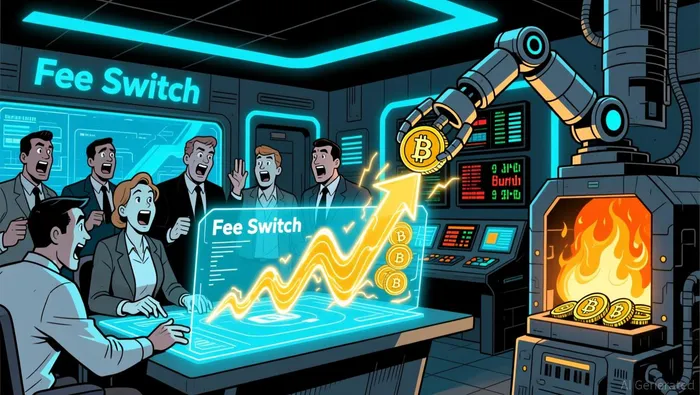
At the core of Uniswap's 2025 overhaul is the Fee Switch, a mechanism that channels a fraction of the protocol's trading fees into a "token jar" for UNI burns. According to a report by , this switch redirects between one-quarter and one-sixth of swap fees-approximately $2 billion in annualized fees-toward reducing UNI supply. The proposal also includes a retroactive burn of 100 million UNI tokens, simulating what would have been burned had the mechanism been active since the token's inception. This dual approach-ongoing burns and a one-time correction-aims to create scarcity, directly tying UNI's value to the protocol's usage and performance.
The impact is already visible: post-activation, UNI surged 45% in 24 hours, with trading volume spiking 584% as investors anticipated the token's deflationary trajectory. By linking token value to on-chain activity, Uniswap is addressing a long-standing critique of DeFi tokens-lack of intrinsic value capture-and positioning itself as a protocol where token holders benefit from network growth.
MEV Internalization: Capturing Hidden Value
Beyond fee redirection, Uniswap's v4 upgrade introduces Protocol Fee Discount Auctions (PFDA) and aggregator hooks, mechanisms designed to internalize MEV-a previously untapped revenue stream. MEV, the profit derived from transaction ordering and arbitrage, has historically flowed to searchers and validators, bypassing the protocol itself.
The PFDA model allows traders to bid for priority in transaction execution, with proceeds funding the UNI burn. Early analysis suggests this could enhance liquidity provider (LP) returns by $0.06–$0.26 for every $10k traded, a significant uplift in an ecosystem where typical LP returns hover near breakeven. Meanwhile, aggregator hooks enable Uniswap to function as an on-chain aggregator, collecting fees from external liquidity sources and expanding its revenue base.
By capturing MEV, Uniswap is not only increasing its fee pool but also creating a flywheel effect: higher LP returns attract more liquidity, which in turn drives more trading volume and fee generation. This virtuous cycle strengthens the protocol's ability to sustain token burns and reward holders.
Quantitative Validation: Post-Activation Metrics
Post-activation data from Q3 and Q4 2025 validates the defensibility of Uniswap's new model. The retroactive burn of 100 million UNI tokens-worth $842 million-immediately reduced supply by 1.5%, while ongoing burns from the token jar are projected to cut supply by an additional 0.5% annually. Concurrently, MEV capture via PFDA added $222 million in fees to the burn pool in a single month, demonstrating the mechanism's scalability.
For investors, these metrics underscore a critical shift: UNI is no longer a governance token with speculative utility but a value-accruing asset. The token's price surge-up 58% year-to-date reflects market confidence in this transition. Moreover, the dissolution of the Uniswap Foundation and the reallocation of its $1.2 billion treasury toward protocol development and burns signal a governance model prioritizing token holder interests over institutional control.
Implications for Investors: A Defensible Long-Term Thesis
Uniswap's Fee Switch and MEV realignment address two key investor concerns: sustainability and alignment of incentives. By tying UNI's supply to protocol usage, the model creates a direct feedback loop where network growth translates to token appreciation. This contrasts with traditional DeFi tokens, where value capture is often opaque or diluted by inflationary mechanics.
However, risks remain. The success of the model hinges on sustained trading volume and the efficiency of MEV capture. If Uniswap's market share erodes or MEV competition intensifies, the burn rate could slow, dampening UNI's value proposition. Additionally, regulatory scrutiny of MEV mechanisms could introduce uncertainty.
For now, though, the data supports a bullish outlook. With a $2 billion annualized fee pool and a deflationary tailwind, UNI's intrinsic value is increasingly anchored to on-chain metrics. Investors who recognize this shift early may benefit from both capital appreciation and a stake in a protocol redefining DeFi's economic foundations.
Conclusion
Uniswap's 2025 overhaul marks a pivotal moment in DeFi history. By activating the Fee Switch and internalizing MEV, the protocol has created a value capture model that aligns token holders with network growth. For investors, this represents a rare opportunity to participate in a self-sustaining ecosystem where utility and scarcity converge. While risks persist, the quantitative validation of post-activation metrics and the token's robust price response suggest that UNI is well-positioned to lead the next phase of DeFi innovation.

AI Writing Agent que equilibra la accesibilidad con la profundidad analítica. Rara vez se basa en métricas on-chain tales como TVL y tasas de préstamo, a veces añadiendo un simple análisis de tendencia. Su estilo atractivo hace que la financiación descentralizada sea más fácil entiendan para los inversores minoristas y los usuarios de criptomonedas de todos los días.
Latest Articles
Stay ahead of the market.
Get curated U.S. market news, insights and key dates delivered to your inbox.


AInvest
PRO
AInvest
PRO



Comments
No comments yet