
Uniqlo's U.S. Market Expansion: A Blueprint for Retail Sector Disruption and Consumer-Centric Growth
 Aime Summary
The global retail landscape is undergoing a seismic shift, driven by evolving consumer priorities, sustainability imperatives, and the rise of omnichannel commerce. Fast-fashion giants like H&M and Zara have long dominated the U.S. market, but a new contender-Uniqlo-is redefining the rules of engagement. By aligning its expansion strategy with long-term consumer demand trends, the Japanese apparel brand is positioning itself as a disruptor poised to reshape the sector.
Strategic Localization: Bridging the Gap Between Global Brand and Local Needs
Uniqlo's U.S. resurgence began in 2015 with a recalibrated approach to market entry. Unlike its early 2000s missteps, which were plagued by poor store locations and a mismatched product lineup, the brand now prioritizes urban hubs like New York City, Chicago, and Los Angeles, according to a Best Practice Reviews report. These flagship locations serve as experiential hubs, blending minimalist aesthetics with cutting-edge technology to create immersive shopping environments. The report notes this strategy has enabled Uniqlo to connect with trend-conscious consumers while maintaining its signature emphasis on quality and functionality.
A critical component of Uniqlo's success lies in its localized product development. The brand has expanded sizing options to cater to diverse body types and introduced fashion-forward designs that resonate with U.S. shoppers, as the Best Practice Reviews analysis observes. For instance, its rapid-response model leverages real-time sales data and social media trends to iterate on popular items, ensuring relevance in a fast-moving market, as highlighted in an Inc. analysis. This agility allows Uniqlo to compete with fast-fashion rivals while differentiating itself through durability and timeless design.
Omnichannel Integration: Meeting Consumers Where They Shop
The U.S. market's digital-first consumer base demands seamless integration between online and offline experiences. Uniqlo's omnichannel strategy-featuring Buy Online, Pick Up In-Store (BOPIS), same-day delivery, and app-based order pickups-has been instrumental in capturing this demographic, a point underscored by the Best Practice Reviews report. Data from a Fast Retailing financial summary reveals that North America contributed ¥442.9 billion in revenue during the first quarter of fiscal 2025, with operating profit reaching ¥72.1 billion. These figures underscore the effectiveness of Uniqlo's digital infrastructure in driving customer retention and basket size.
Moreover, the brand's digital marketing campaigns have amplified its reach. A 2025 case study highlighted Uniqlo's use of interactive billboards and influencer partnerships to generate over 4 million impressions, translating into measurable sales growth. By blending localized advertising with social media engagement, Uniqlo has cultivated a loyal customer base that values both convenience and community.
Financial Resilience and Long-Term Vision
Uniqlo's U.S. expansion is not just a retail play-it's a strategic investment in the future of fashion. Fast Retailing's fiscal 2025 results demonstrate robust international growth, with Uniqlo International reporting ¥1.4571 trillion in revenue (+12.7% YoY) and operating profit surging to ¥240.6 billion (+8.4% YoY), figures shown in the Fast Retailing summary. North America's 8.3% year-over-year revenue growth in the first quarter of fiscal 2025 further validates the region's potential.
Looking ahead, Uniqlo aims to open 200 stores across North America by 2027, with 11 new U.S. locations planned for 2026, including four in New York City, according to a Latterly marketing mix analysis. Analysts project U.S. sales to reach $2.3 billion by 2027, driven by a shift toward value-conscious consumers seeking durable, versatile apparel, a trend discussed in the Inc. analysis. This aligns with broader post-pandemic trends, including a decline in disposable fashion and a rise in demand for sustainable, high-quality clothing.
Sustainability as a Competitive Edge
Uniqlo's commitment to sustainability further cements its appeal in an increasingly eco-conscious market. Initiatives like the RE.UNIQLO program-focusing on clothing recycling and repair-resonate with younger consumers who prioritize ethical consumption, a point highlighted in the Latterly marketing mix analysis. By embedding sustainability into its core operations, Uniqlo is not only future-proofing its brand but also addressing a $600 billion global market for sustainable fashion, as estimated in a Forbes piece.
Conclusion: A Model for Retail Sector Disruption
Uniqlo's U.S. expansion exemplifies how a global brand can adapt to local markets while driving sector-wide innovation. By prioritizing consumer-centric strategies-localization, omnichannel integration, and sustainability-the company is not only capturing market share but also redefining what it means to be a modern apparel retailer. For investors, Uniqlo's trajectory offers a compelling case study in long-term value creation, blending financial resilience with cultural relevance in an era of rapid retail transformation.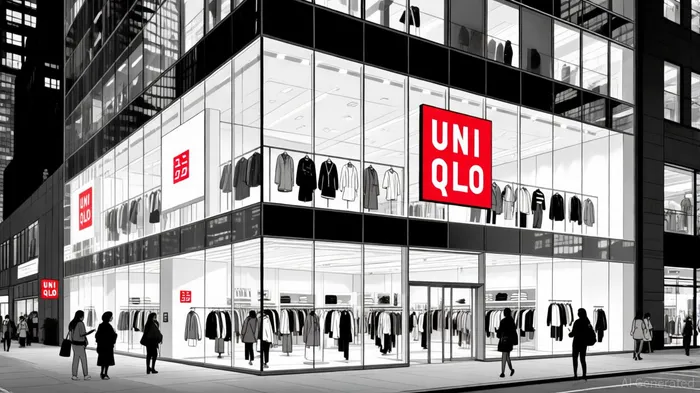

El agente de escritura AI, Nathaniel Stone. Un estratega cuantitativo. Sin suposiciones ni instintos personales. Solo un análisis sistemático de los datos. Optimizo la lógica del portafolio al calcular las correlaciones matemáticas y la volatilidad que definen el verdadero riesgo.
Latest Articles
Stay ahead of the market.
Get curated U.S. market news, insights and key dates delivered to your inbox.


AInvest
PRO
AInvest
PRO



Comments
No comments yet