
Union Pacific Shares Tumble 0.83% as Volume Plummets to $590M Ranking 184th Amid Regulatory Legal Challenges
 Aime Summary
Market Snapshot
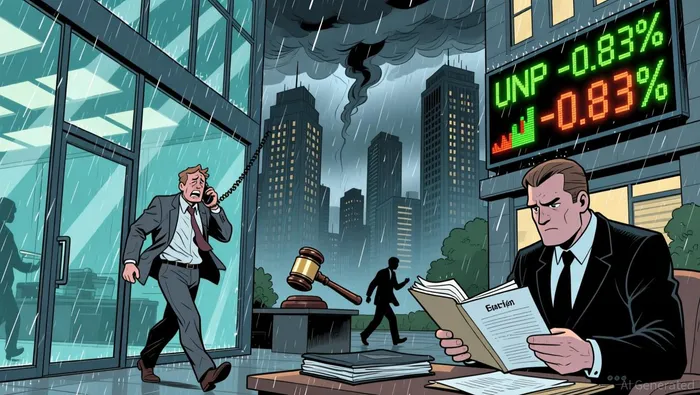
Union Pacific (UNP) closed 12/5/2025 with a 0.83% decline in share price, reflecting a modest but notable pullback in investor sentiment. The stock’s trading volume fell to $590 million, a 21.41% drop compared to the previous day, ranking it 184th in volume among U.S.-listed equities. While the price decline was relatively small in percentage terms, the sharp drop in volume suggests reduced liquidity or shifting short-term positioning among traders. The mixed performance highlights a cautious market environment, with investors potentially recalibrating exposure ahead of broader macroeconomic data or sector-specific developments.
Key Drivers
Executive Charitable Stock Gift
On 12/4/2025, Union Pacific’s Chief Financial Officer, Jennifer Hamann, disclosed a 300-share charitable gift in a SEC Form 4 filing. The transaction, recorded at $0.0 per share, reflects a non-sale transfer of equity to an external charitable organization. While such gifts are often viewed as neutral or positive for corporate governance (indicating long-term commitment to the company), the timing coincided with the stock’s intraday price movement. Insider transactions typically draw investor attention, but the small size of the gift—300 shares out of Hamann’s reported 108,842 direct holdings—suggests it had limited immediate impact on market dynamics. However, the filing may contribute to a broader narrative of executive behavior, particularly as investors scrutinize leadership actions during periods of market volatility.
Regulatory Challenge to Historical Merger
A separate development with longer-term implications involves Berkshire Hathaway’s BNSF Railway, which has petitioned the U.S. Surface Transportation Board to reevaluate the competitive conditions established when Union PacificUNP-- acquired Southern Pacific in 1996. BNSF alleges that Union Pacific has systematically undermined post-merger commitments to maintain competition, including obstructing access to key customer locations and delaying trackage-rights updates. The case, which seeks regulatory enforcement of the original merger conditions, could force Union Pacific to alter operational practices or face additional oversight. While the stock’s recent decline may not directly stem from this news, the regulatory scrutiny introduces uncertainty about the company’s ability to sustain market dominance in the Western U.S. rail sector.
Legal Liability and Punitive Damages
Union Pacific faces another headwind in an ongoing legal dispute, as an Oregon federal judge rejected the company’s motion to overturn a $27 million verdict in a discrimination case involving a former employee. The judge affirmed the jury’s $25 million punitive damages award, citing sufficient evidence to support both liability and the punitive component. Legal liabilities of this scale, while not immediately material to financials, can erode investor confidence by signaling operational or cultural risks. The case also underscores broader concerns about labor relations and regulatory compliance in the railroad industry, which could influence perceptions of Union Pacific’s management quality and long-term profitability.
Broader Market Context and Sector Trends
While the above factors directly impacted UNP’s performance, it is worth noting that global M&A activity remains robust, with 2025 on track to become the strongest year for dealmaking since 2021. Union Pacific’s own $72 billion acquisition of Norfolk Southern in July 2025, which created a rail behemoth, reflects the sector’s consolidation trend. However, such large-scale transactions often attract regulatory and public scrutiny, as seen in BNSF’s recent petition. The interplay between strategic growth and regulatory pushback may continue to shape investor sentiment for industrial stocks like Union Pacific, particularly in a landscape where antitrust enforcement remains a contentious policy issue.
Conclusion
The combination of insider activity, regulatory challenges, and legal liabilities creates a complex backdrop for Union Pacific’s stock. While the immediate 0.83% decline may not be directly attributable to any single event, the cumulative effect of these factors—ranging from governance signals to operational risks—could influence investor positioning. As the company navigates these challenges, its ability to demonstrate compliance, competitive resilience, and effective leadership will be critical in stabilizing market confidence.

Encuentren aquellos activos que tengan un volumen de transacciones explosivo.
Latest Articles
Stay ahead of the market.
Get curated U.S. market news, insights and key dates delivered to your inbox.
AInvest
PRO
AInvest
PRO



Comments
No comments yet