
Union Pacific Shares Fall 0.91% with $650M Volume Ranking 168th as Labor Pacts Bolster Merger Push
 Aime Summary
Market Snapshot
Union Pacific (UNP) closed 2025-11-17 with a 0.91% decline in share price, reflecting a modest pullback despite maintaining a strong trading volume of $650 million—the 168th highest in the market that day. The stock’s performance suggests mixed investor sentiment, balancing optimism over the company’s robust financial metrics against caution around short-term volatility. While the volume indicates active trading, the negative price movement contrasts with its broader financial health, including a $132.06 billion market capitalization and 2024 revenue of $24 billion.
Key Drivers
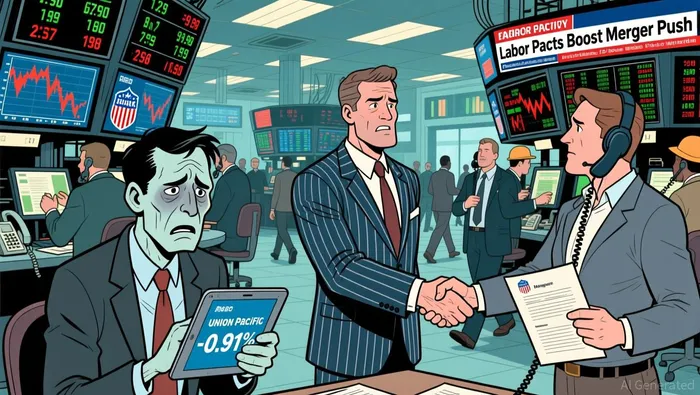
Union Pacific’s recent job protection agreement with the Brotherhood of Railway Carmen (BRC) represents a pivotal development in its ongoing efforts to stabilize its workforce during the proposed $85 billion merger with Norfolk SouthernNSC--. The agreement guarantees lifelong employment for BRC members employed at both companies at the time of the merger, contingent on adherence to standard employment conditions. This marks the third such agreement with a national union, following similar deals with SMART-TD and NCFO, and underscores Union Pacific’s commitment to mitigating labor disruptions during the integration process. The move is likely to bolster employee morale and reduce the risk of strikes or operational delays, which are common concerns in large-scale railroad mergers.
The strategic implications of the merger itself are significant. Union PacificUNP-- and Norfolk Southern aim to create the first coast-to-coast railroad network in the U.S., streamlining freight routes and eliminating inefficiencies in intermodal operations. By reducing unnecessary touchpoints and cutting 24–48 hours from interchanges, the merger promises enhanced operational efficiency and cost savings. For Union Pacific, this aligns with its broader goal of expanding market reach, particularly in underserved regions, while reinforcing its position as the largest public railroad in North America. The company’s extensive network—spanning over 30,000 miles of track and transporting diverse goods—positions it to capitalize on increased freight demand, particularly in sectors like industrial products and intermodal containers.
Financially, Union Pacific’s strong profitability metrics provide a buffer against potential merger-related costs. With a 40.62% operating margin, 28.73% net margin, and 52.07% EBITDA margin, the company demonstrates exceptional operational efficiency. Its $24.55 billion revenue in 2024, coupled with a $132.06 billion market capitalization, highlights its scale and resilience. However, the debt-to-equity ratio of 1.9 and liquidity ratios (current ratio of 0.75, quick ratio of 0.6) suggest a need for careful capital management as it navigates the merger’s financial complexities. The Altman Z-Score of 3.77 and Piotroski F-Score of 7 further affirm its financial stability, though investors should remain vigilant about sector-specific risks, including regulatory scrutiny and cyclical economic pressures on transportation demand.
The union agreements also signal a broader trend in labor relations within the railroad industry. By securing job protections, Union Pacific is addressing a critical stakeholder concern while aligning with its leadership’s public commitment to workforce stability. CEO Jim Vena emphasized that these agreements “underscore the promise” to protect unionized employees, a stance that could enhance the company’s reputation as a responsible employer. This approach contrasts with historical tensions in the sector and may set a precedent for other railroads navigating mergers or labor negotiations. The BRC’s leadership, including General President Don Grissom, has publicly praised the agreements, framing them as a “huge accomplishment” that provides peace of mind to employees. Such positive labor relations could reduce operational risks and attract institutional investors prioritizing ESG (Environmental, Social, and Governance) criteria.
Despite these positives, the stock’s 0.91% decline on 11/17 may reflect short-term uncertainty around the merger’s regulatory approval and execution risks. The Department of Justice and other regulators will scrutinize the deal for antitrust concerns, and any delays could impact market confidence. Additionally, the company’s exposure to Mexican freight via its stake in Ferromex—accounting for roughly 10% of revenue—introduces geopolitical risks, particularly amid shifting trade dynamics between the U.S. and Mexico. Investors are also monitoring technical indicators such as the RSI (14) of 50.75 and moving averages, which suggest a neutral trading momentum. While the P/E ratio of 18.92 and analyst target price of $261.6 indicate potential upside, the stock’s volatility (19.71) and beta (0.89) highlight moderate market risks that could influence near-term performance.
In summary, Union Pacific’s recent developments—centered on labor agreements and merger strategy—position it for long-term growth but require careful navigation of regulatory, financial, and operational challenges. The company’s ability to balance workforce stability with shareholder value will be critical in determining its trajectory in the coming months.

Stay ahead of the market.
Get curated U.S. market news, insights and key dates delivered to your inbox.
AInvest
PRO
AInvest
PRO



Comments
No comments yet