
Union Pacific Railroad Merger Creates $250 Billion Transcontinental Freight Giant
 Aime Summary
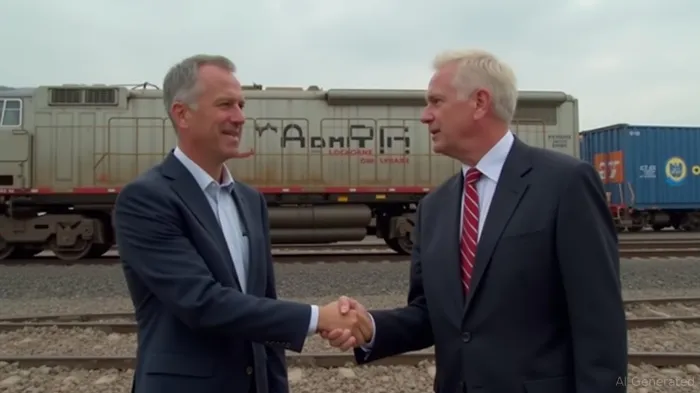
Union Pacific Corporation and Norfolk Southern CorporationNSC-- have announced a historic merger, setting the stage for the United States' first coast-to-coast freight railroad. With an acquisition deal valued at $85 billion, this merger will connect an expansive 50,000 miles of track, integrating Union Pacific’s western U.S. freight network with Norfolk Southern's operations in the east. This union is set to reshape the logistics landscape of the nation, creating a $250 billion entity capable of transporting goods seamlessly from the Pacific to the Atlantic.
The merger agreement, a combination of cash and stock, offers Norfolk SouthernNSC-- shareholders $320 per share, a 25% premium over the recent trading average. Although the merger is subject to the approval of various regulatory bodies, including the Surface Transportation Board, and must meet customary closing conditions, both companies’ boards have unanimously given their blessing. The anticipated timeline sees the deal closing by early 2027.
This transcontinental line not only offers the promise of efficiency by eliminating interchange delays and opening new routes, but it is also expected to boost the overall competitiveness of U.S. rail against other modes of transportation, notably Canadian railroads. This ambition is driven by the potential to reclaim freight volume lost to Canada, with an eye to revitalize and expand American manufacturing and related jobs.
Union Pacific's CEO Jim Vena has confidently portrayed the merger as transformational in the industry’s history. He highlights the merger’s capacity to not only improve service for existing customers but also open up new opportunities for transportation, which could take pressure off roads and highways, thereby benefiting the wider economy and environment.
In terms of industry rivalry, there is speculation that this move could push competitors such as Burlington Northern Santa Fe (BNSF) Railroad, owned by Berkshire Hathaway, and CSX CorporationCSX-- towards consolidation, potentially leaving the U.S. with two major transcontinental freight corridors.
One significant outcome of the merger will be the reduced transit time across key rail corridors, aligning major U.S. ports, and enhancing intermodal services. This will increase operational efficiency, which the merging entities argue will lead to broader economic benefits, including enhanced service quality and competitive pricing for shippers.
Despite the advantageous outlooks, some stakeholders express concerns. Historically, rail mergers have sometimes led to service disruptions and price hikes due to complexities in integration. The Southern region in particular, having experienced significant service issues in past rail mergers, watches warily. However, the companies assert they are committed to detailed planning to mitigate such risks.
The executives of both companies emphasize the job security for union workers. The merger agreement explicitly assures that no union jobs will be lost; instead, it forecasts employment growth spurred by increased rail traffic and network expansion.
In recent years, regulatory environments have posed significant challenges for such large-scale mergers. While the Surface Transportation Board’s past major approval was the Canadian Pacific takeover of Kansas City Southern, the absence of overlapping routes in that merger might play in favor of the Union PacificUNP-- and Norfolk Southern deal as well.
As the industry watches, analysts predict that the approval of this merger may set a precedent and thus anticipate further consolidation within the sector. Union Pacific and Norfolk Southern's confidence in the merger’s approval is partly influenced by the economic landscape favorable to such logistical endeavors, aiming to enhance transport efficiencies across North America.
The strategic shift in combining Union Pacific's and Norfolk Southern's routes serves as a significant development towards a unified, robust, and streamlined freight service—a monumental step in fulfilling a vision that traces back to the nation's early rail days.

Stay ahead of the market.
Get curated U.S. market news, insights and key dates delivered to your inbox.
AInvest
PRO
AInvest
PRO



Comments
No comments yet