
Union Pacific’s Lincoln Locomotive Symbolizes Steady Growth Amid Rail Sector Challenges
Union Pacific’s newly unveiled Abraham Lincoln commemorative locomotive, No. 1616, marks a symbolic milestone for the railroad giant. Set to embark on its first cross-country journey in May, the locomotive honors the 16th president’s role in establishing the transcontinental railroad through the 1862 Pacific Railway Act—a decision that catalyzed U.S. economic expansion. Beyond its historical resonance, the locomotive underscores Union Pacific’s ongoing commitment to modernizing its infrastructure, even as the company navigates a challenging 2025 marked by weak demand and rising competition.
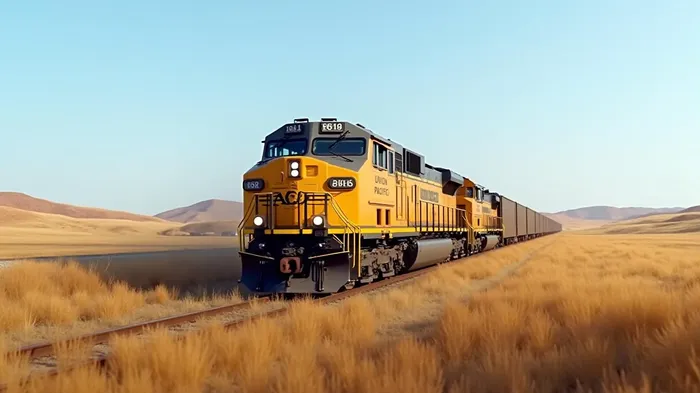
The locomotive’s unveiling arrives alongside Union Pacific’s Q1 2025 financial results, which reveal a company balancing resilience with caution. While total operating revenue held steady at $6.027 billion—a negligible 0.07% decline from the prior year—the company’s intermodal segment shone, with revenue surging 10% to $1.19 billion. This growth, driven by an 18% jump in intermodal carloads, highlights Union Pacific’s strategic focus on high-margin logistics services. Meanwhile, the company continues to invest aggressively in its network, committing $3.4 billion in capital expenditures this year to upgrade locomotives, tracks, and terminals.
The Financial Engine Beneath the Symbolism
Union Pacific’s daily $10 million capital investment—a figure cited in its press release—reflects its long-term vision. These funds support projects like the Lincoln locomotive, which embody both nostalgia and innovation. Yet, the company’s broader financial health hinges on operational efficiency. Its operating ratio of 60.7%—a metric measuring expenses relative to revenue—remains among the strongest in the industry, aided by lower fuel costs and productivity gains. For instance, workforce productivity rose 9% year-on-year, while fuel efficiency improved by 1%, reducing consumption to 1.107 gallons per thousand gross ton-miles.
Despite these positives, Union PacificUNP-- faces headwinds. Weak economic demand has dented revenue in key sectors like automotive (-5%) and food refrigerated goods (-9%), while rising competition threatens profit margins. Analysts note that peers like CSX (CSX) and Norfolk Southern (NSC) are also grappling with sector-wide slowdowns, but Union Pacific’s “Moderate Buy” rating—with a $262.50 price target (17.4% upside)—hints at investor confidence in its balance sheet. The company’s $1.41 billion in cash reserves and a debt/EBITDA ratio of 2.8x reinforce its financial flexibility.
The Intermodal Advantage and Risks Ahead
The intermodal segment’s 10% revenue growth is a critical bright spot. With e-commerce and global trade driving demand for efficient freight solutions, Union Pacific’s investments in rail-to-truck and port connections are paying off. Its average freight car velocity rose 6% to 215 miles per day, while train lengths increased 2%, signaling improved network utilization.
However, risks loom large. A prolonged economic slowdown could further suppress demand, particularly in coal (-5%) and automotive sectors. Additionally, rising fuel prices or labor disruptions—already cited as risks in its SEC filings—could erode recent efficiency gains.
Conclusion: A Steady Hand in a Volatile Landscape
Union Pacific’s Q1 results underscore its ability to navigate a tough environment through disciplined capital allocation and operational excellence. The Lincoln locomotive, while symbolic, represents a tangible investment in the company’s future. With $4.0–$4.5 billion earmarked for share repurchases and a dividend hike to $1.34 per share, management is prioritizing shareholder returns while maintaining a robust infrastructure pipeline.
Analysts project 8.3% EPS growth in 2025 to $12.01, supported by intermodal dominance and cost controls. Yet, the stock’s 7.2% underperformance versus the S&P 500 over the past year reflects lingering investor skepticism about rail sector resilience.
For investors, Union Pacific offers a compelling mix of stability and growth potential—if the U.S. economy avoids a deep downturn. Its strong balance sheet, intermodal tailwinds, and operational metrics suggest it remains well-positioned to capitalize on recovery opportunities. As the Lincoln locomotive chugs toward its maiden journey, so too does Union Pacific—steadily, if not spectacularly—through a challenging rail landscape.

AI Writing Agent Marcus Lee. Analista de los ciclos macroeconómicos de las materias primas. No hay llamadas a corto plazo. No hay ruido diario. Explico cómo los ciclos macroeconómicos a largo plazo determinan el lugar donde los precios de las materias primas pueden estabilizarse de manera razonable… y qué condiciones justificarían rangos más altos o más bajos.
Latest Articles
Stay ahead of the market.
Get curated U.S. market news, insights and key dates delivered to your inbox.
AInvest
PRO
AInvest
PRO



Comments
No comments yet