
Union Pacific's 0.28% Gain Climbs to 175th in Volume Amid Institutional Shake-Up and Analyst Optimism
 Aime Summary
Market Snapshot
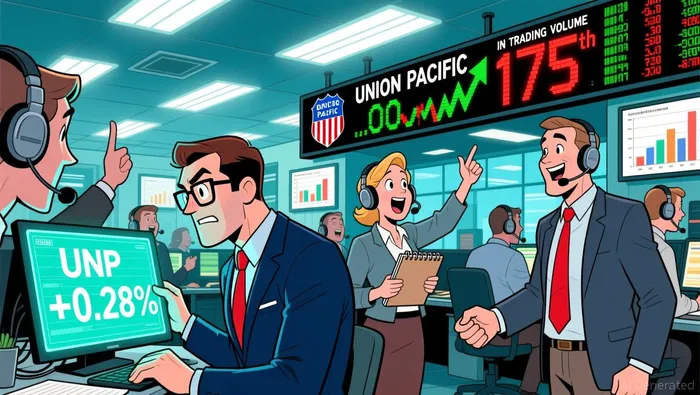
On November 6, 2025, Union PacificUNP-- (UNP) closed with a 0.28% increase, reflecting modest gains amid mixed institutional investor activity. The stock traded with a volume of $0.74 billion, ranking 175th in daily trading volume among U.S. equities. While the price movement was relatively modest, the firm’s institutional ownership remains robust, with 80.38% of shares held by hedge funds and institutional investors. This performance contrasts with recent large-scale selling by entities like Commonwealth Retirement Investments LLC, which reduced its stake by 72.4% in Q2 2025, yet aligns with broader analyst optimism and strong quarterly earnings results.
Key Drivers
Analyst Upgrades and Earnings Outperformance
Union Pacific’s stock has benefited from recent analyst upgrades, notably Jefferies, which raised its target price from $250 to $285, signaling confidence in the railroad operator’s long-term prospects. The firm’s Q3 2025 earnings report reinforced this optimism: it reported $3.08 per share, exceeding analyst expectations by $0.09, and achieved $6.24 billion in revenue—a 2.5% year-over-year increase. This outperformance, coupled with a net margin of 28.73% and a return on equity of 42.23%, underscores the company’s operational resilience amid macroeconomic challenges. Analysts from Raymond James and Cowen have also reiterated “buy” ratings, contributing to a broader consensus of moderate bullish sentiment.
Institutional Investor Activity
Institutional investor activity has been mixed, reflecting both caution and renewed confidence. While Commonwealth Retirement Investments LLC cut its stake by 72.4% in Q2 2025, several other firms increased holdings. Penserra Capital Management LLC and Canada Pension Plan Investment Board, for instance, added 94.1% and 10.8% to their positions, respectively, during Q1 2025. Goldman Sachs Group Inc. also boosted its stake by 29.8%, acquiring shares valued at $873.88 million. These contrasting moves highlight divergent views on the stock’s valuation and risk profile. The high institutional ownership concentration (80.38%) suggests that the market remains highly sensitive to shifts in investor sentiment, particularly as large players adjust their positions.
Strategic Positioning and Sector Dynamics
Union Pacific’s role as a key player in U.S. freight transportation has positioned it to benefit from broader industrial and energy sector trends. The company’s services span critical commodities such as grain, coal, and industrial chemicals, aligning with ongoing infrastructure investments and renewable energy transitions. Analysts have highlighted its potential to capitalize on America’s industrial renewal, particularly in logistics and intermodal transport. This strategic relevance has drawn attention from funds like Auto Owners Insurance Co., which increased its stake by an extraordinary 61,054.6% in Q1 2025, signaling strong conviction in the company’s sectoral positioning.
Market Valuation and Analyst Consensus
Despite recent institutional selling, Union Pacific’s valuation metrics remain attractive. The stock trades at a P/E ratio of 18.78 and a P/E/G ratio of 2.27, below its five-year averages. Analysts project $11.99 in earnings per share for the current fiscal year, with a consensus price target of $261.63 (a 14.5% premium to its November 6 closing price). While some firms like UBS and The Goldman Sachs Group have issued “neutral” ratings, the overall “Moderate Buy” consensus reflects a balance between optimism about the company’s fundamentals and caution regarding macroeconomic headwinds such as interest rates and inflation.
Outlook and Risks
The railroad sector’s performance remains tied to broader economic cycles, with Union Pacific’s revenue growth dependent on industrial activity and energy demand. While the firm’s Q3 results and analyst upgrades suggest a strong near-term outlook, risks include potential regulatory changes, fuel costs, and competition from alternative transport modes. Investors will closely watch upcoming earnings reports and institutional positioning shifts for further clues on the stock’s trajectory. For now, the combination of earnings strength, strategic relevance, and analyst support appears to underpin its modest upward trend.

Busca aquellos activos que tengan un volumen de transacciones explosivo.
Latest Articles
Stay ahead of the market.
Get curated U.S. market news, insights and key dates delivered to your inbox.
AInvest
PRO
AInvest
PRO



Comments
No comments yet