
The Unintended Consequences of Tariff Hikes: How U.S. Consumers Are Paying the Price for Trump's Trade Policies
 Aime Summary
The U.S. tariff policies enacted under President Trump's 2025 trade agenda have created a complex web of economic consequences, reshaping supply chains, corporate pricing strategies, and consumer behavior. While the stated goal of these tariffs was to protect domestic industries and reduce trade deficits, the reality has been a surge in costs for businesses and households alike. By analyzing the interplay between supply chain economics and consumer sentiment, we uncover a landscape where corporate resilience is tested, inflationary pressures persist, and retail demand faces structural shifts.
Supply Chain Economics: A Costly Reconfiguration
The Trump administration's 2025 tariff regime—averaging 22.5%, the highest since 1909—has forced corporations to reevaluate their global sourcing strategies. Tariffs on steel, aluminum, autos, and electronics have directly increased input costs, with cascading effects on pricing. For instance, the automotive sector saw a 8.4% rise in vehicle prices due to combined tariffs on steel, aluminum, and autos, adding an average of $4,000 to the cost of a new car. This has compelled automakers to either absorb costs (reducing margins) or pass them on to consumers, who are now grappling with higher prices for essential goods.
The ripple effects extend beyond individual sectors. The Yale Budget Lab estimates that the full 2025 tariff regime reduced real GDP growth by 0.9 percentage points and imposed a $180 billion annual economic loss. These tariffs have also disrupted global trade flows, with retaliatory measures from Canada, the EU, and China further complicating supply chains. For example, U.S. exports declined by 18.1% under the full tariff regime, as foreign partners imposed countermeasures on American goods like agricultural products and machinery.
Consumer Sentiment: A Divided Landscape
The human cost of these policies is evident in shifting consumer sentiment. By July 2025, the University of Michigan's Consumer Sentiment Index had fallen 16% from December 2024 levels, with inflation expectations rising to 4.4% for the year ahead. This anxiety is not evenly distributed. Lower-income households, which allocate a larger share of their budgets to essentials like transportation and housing, have been hit hardest. For example, used car prices surged 7% year-over-year, forcing many to delay replacements or opt for pricier alternatives.
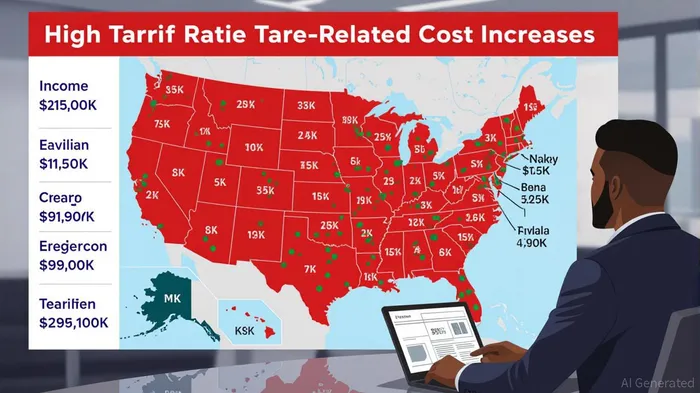
Regional disparities further amplify the impact. Industrial heartlands like the Midwest, reliant on manufacturing and construction, face higher costs for steel and aluminum, driving up housing and infrastructure expenses. Meanwhile, coastal regions with high housing demand see exacerbated affordability crises, compounded by the Federal Reserve's high interest rates to combat inflation. A Morning Consult survey found that 60% of Americans blame Trump's policies for rising living costs, with 75% fearing a recession.
Long-Term Risks: Inflation and Retail Demand
The long-term risks of these policies are twofold: persistent inflation and a structural slowdown in retail demand. Tariffs act as a regressive tax, disproportionately affecting price-sensitive consumers. The Federal Reserve's reluctance to cut rates—despite low unemployment—reflects concerns that inflationary pressures from tariffs could outlast the initial shock. For instance, the 20% broad tariff on Chinese imports and 25% tariffs on autos and steel have embedded higher costs into the economy, with corporations passing these on to consumers through price hikes.
Retail demand is also shifting. Discretionary spending, particularly in electronics and automotive sectors, has softened as consumers delay purchases. The S&P 500's consumer discretionary sector fell nearly 3% in the first half of 2025, contrasting with gains in 2023-2024. Meanwhile, essential spending remains resilient, supported by wage growth (3.7% year-over-year) outpacing inflation (2.7%). This bifurcation suggests a long-term realignment of consumer priorities, with households prioritizing necessities over luxuries.
Sectoral Exposure and Investment Strategies
Certain sectors are more vulnerable to these shifts. The Oxford Economics Tariff Sector Vulnerability Index identifies electronics, automotive, and energy as the most exposed, due to their reliance on global supply chains and import-intensive inputs. Conversely, the food and beverage sector, with shorter, more localized supply chains, remains less affected.
For investors, hedging against these risks requires a nuanced approach:
1. Sector Rotation: Overweight sectors less sensitive to tariffs, such as utilities and consumer staples, while underweighting exposed industries like automotive and electronics.
2. Geographic Diversification: Target emerging markets like India and Mexico, which are benefiting from U.S.-China trade reallocation and nearshoring trends.
3. Active Management: Focus on companies with flexible supply chains and pricing power to absorb cost shocks. For example, firms leveraging automation or regional sourcing may outperform peers.
Conclusion: Navigating a Fractured Trade Landscape
The unintended consequences of Trump's 2025 tariffs underscore the fragility of global supply chains and the uneven impact of protectionist policies. While corporations adapt through localized production and price adjustments, consumers bear the brunt of higher costs and uncertainty. For investors, the path forward lies in identifying structural tailwinds—such as deglobalization and nearshoring—while mitigating exposure to sectors facing margin compression. As the U.S. economy navigates this new reality, a disciplined, data-driven approach will be critical to capitalizing on opportunities amid the turbulence.

Stay ahead of the market.
Get curated U.S. market news, insights and key dates delivered to your inbox.


AInvest
PRO
AInvest
PRO



Comments
No comments yet