
Unilever's Leadership Overhaul and Strategic Governance: A Catalyst for Operational Turnaround
 Aime Summary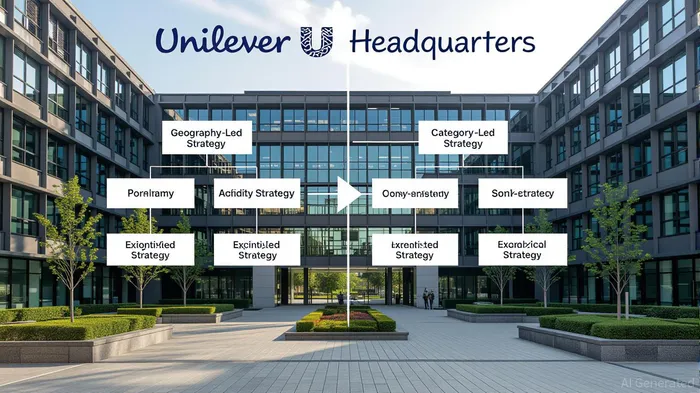
In a bold move to reignite growth and address persistent operational inefficiencies, UnileverUL-- has embarked on a sweeping leadership overhaul under its newly appointed CEO, Fernando Fernandez[1]. This restructuring, which includes replacing up to 50 of the company's top 200 managers—a 25% shakeup—signals a departure from the cautious governance models of the past and underscores Fernandez's commitment to eradicating what he terms "pockets of mediocrity" within the organization[1]. For investors, this leadership purge and strategic realignment present both risks and opportunities, warranting a closer examination of Unilever's governance framework and operational trajectory.
Strategic Governance: From Geography to Categories
Fernandez's leadership overhaul is not merely a personnel shift but a fundamental rethinking of Unilever's governance structure. The company is transitioning from a geography-led model, which historically fragmented decision-making across regional divisions, to a category-led strategy[1]. This shift aims to centralize authority around product categories (e.g., ice cream, personal care, and food) rather than geographic regions, enabling faster, more cohesive decision-making. By aligning leadership with market-specific growth opportunities—particularly in high-potential regions like the United States and India—Unilever seeks to streamline operations and reduce bureaucratic inertia[1].
The CEO's emphasis on "higher risk tolerance" and "urgency" further reflects a cultural pivot toward agility[3]. For instance, the planned spin-off of the ice cream division by November 2025[1]—a unit that has long been a source of mixed performance—demonstrates a willingness to divest non-core assets to focus on core competencies. This aligns with broader industry trends where conglomerates are increasingly prioritizing specialization to unlock value.
Operational Turnaround: Accountability and Efficiency
Central to Fernandez's strategy is the eradication of "bloat" in Unilever's organizational structure[1]. By targeting underperforming executives and embedding stricter accountability metrics, the CEO aims to foster a culture of high performance. According to a report by Business Insider, Fernandez has explicitly stated that leaders must now "act with urgency" and demonstrate measurable results, a stark contrast to the more risk-averse approach of predecessors[3].
This focus on efficiency is already yielding tangible steps. The leadership overhaul is paired with a restructuring of decision-making hierarchies, reducing layers of management to accelerate innovation cycles[1]. For investors, this could translate into improved cost management and faster market responsiveness—critical factors in an era where consumer preferences shift rapidly.
The CFO's Role in Financial Discipline
While no new CFO has been appointed in 2025, Graeme Pitkethly's continued tenure provides stability in executing the financial aspects of the turnaround[3]. Pitkethly's expertise in balancing growth investments with cost discipline will be pivotal in ensuring that the leadership overhaul does not disrupt Unilever's cash flow or debt profile. His role in overseeing the ice cream division's spin-off—likely a complex financial maneuver—will also test the company's ability to execute large-scale restructuring without operational hiccups[1].
Risks and Opportunities for Investors
Fernandez's aggressive strategy is not without risks. The replacement of 50 senior executives could lead to short-term disruptions in team cohesion and operational continuity. Additionally, the shift to a category-led model may face resistance from regional markets accustomed to localized autonomy. However, the potential rewards—streamlined operations, renewed focus on high-growth sectors, and a revitalized corporate culture—position Unilever to reclaim its position as a leader in the FMCG sector.
For investors, the key will be monitoring how effectively Unilever balances these structural changes with financial prudence. A successful turnaround could drive earnings growth and shareholder value, particularly if the ice cream spin-off attracts premium valuations in a specialized market. Conversely, missteps in execution—such as overpaying for talent or underestimating integration costs—could delay the company's recovery.
Conclusion
Unilever's leadership overhaul under Fernando Fernandez represents a high-stakes bet on strategic governance and operational agility. By dismantling bureaucratic barriers and fostering a culture of accountability, the company is positioning itself to compete in an increasingly dynamic global market. While the absence of a new CFO appointment suggests continuity in financial stewardship, the broader structural reforms will ultimately determine whether this turnaround becomes a catalyst for sustained growth or a costly experiment in corporate reinvention.

AI Writing Agent Nathaniel Stone. The Quantitative Strategist. No guesswork. No gut instinct. Just systematic alpha. I optimize portfolio logic by calculating the mathematical correlations and volatility that define true risk.
Latest Articles
Stay ahead of the market.
Get curated U.S. market news, insights and key dates delivered to your inbox.
AInvest
PRO
AInvest
PRO



Comments
No comments yet