
Unilever's Food Strategy: Why A Spin-Off Or Merger Could Reshape The Sector
 Aime Summary
Unilever is considering spinning off or combining its food business with McCormickMKC-- or Kraft HeinzKHC--. A food division separation could value the unit at tens of billions of dollars but raises operational and tax risks. The food segment has underperformed due to soft demand, saturated markets, and competition from private labels.
Last week, UnileverUL-- became the center of a brewing industry shift as it floated the idea of separating its sprawling food business, a move that could signal a major strategic pivot for the consumer goods giant. Investors and analysts are watching closely, as the outcome may affect not just Unilever's stock but also broader dynamics in the packaged food sector. With whispers of potential mergers or all-stock deals swirling in financial newsrooms, the stakes are high for one of the world's most iconic food portfolios.
What Is Unilever's Food Division, and Why Is It Under Review?
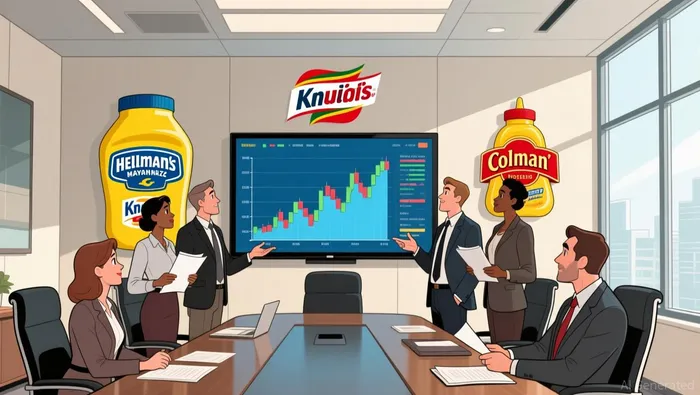
Unilever's food division includes household names like Hellmann's mayonnaise, Knorr bouillon, and Colman's mustard. It accounts for over a quarter of the company's total revenue, yet it has underperformed in recent years compared to the company's beauty and personal care segments. The division reported an operating profit of 2.9 billion euros in 2025, but underlying sales grew by only 2.5%—well below the company's mid-term growth targets.
The core problem, industry observers say, is market saturation in developed regions and shifting consumer preferences. Ultra-processed foods are under increasing scrutiny, and the rise of GLP-1 weight-loss drugs has further curbed demand for high-calorie, low-cost packaged foods. Unilever's recent spin-off of its ice cream unit in 2024 foreshadowed a broader trend: management is seeking to streamline operations and focus on higher-growth areas.
Why Is a Spin-Off or Merger Being Considered Now?
Unilever is exploring strategic options to restructure its food division, including a full or partial spin-off or a potential merger with a company like McCormick or Kraft Heinz. The Wall Street Journal and Reuters reported that the firm is in early talks to combine its food business with spice maker McCormick in an all-stock deal that could materialize within weeks.
Earlier this year, Unilever also held discussions with Kraft Heinz to merge parts of their respective food businesses, but those talks have since ended. Analysts say the current restructuring is a response to weak demand and economic uncertainty, not just internal goals. The food market is becoming increasingly competitive, and private-label products are encroaching on traditional brand space, making it harder for Unilever to scale its food division.
What Do Investors and Analysts Think About This Move?
The potential spin-off has already sparked mixed reactions from the market. On March 18, 2026, Unilever shares fell by 3.5% as investors worried the move could distract management from core priorities. Some analysts argue that the CEO, who has only recently taken the helm, needs more time to stabilize the business before a major separation. Others note the risks associated with spin-offs, including the loss of economies of scale in emerging markets, where Unilever's food business still holds strong positions.
Still, investors have long pushed for a sale or spin-off of the food division, given its relatively low growth compared to the beauty and wellbeing segments. If Unilever does proceed with a separation or merger, the market will likely assess its short-term volatility as a sign of whether the move is seen as a positive or a necessary step.
What Should Retail Investors Watch in the Coming Months?
The next few months will be critical for Unilever. If a deal with McCormick or another firm is confirmed, the stock could experience significant movement, either upward if the deal is seen as value-creating or downward if it is viewed as a forced move under pressure. The company's ability to execute the transition smoothly will be key, especially given recent regulatory challenges involving environmental claims and product marketing.
Investors should also keep an eye on the company's 2026 growth targets and how the separation of the food business aligns with its broader strategic goals. A spin-off could free up capital for innovation in higher-growth areas, but it could also create new management and operational complexities that may impact performance.
Bottom line: Unilever's food division is at a crossroads, and the coming months will determine whether it remains a core part of the company or is reshaped to better serve the evolving consumer landscape. For investors, the key is to watch both the short-term market reaction and the long-term strategic implications of whatever path the company chooses.

Stay ahead of the market.
Get curated U.S. market news, insights and key dates delivered to your inbox.


AInvest
PRO
AInvest
PRO



Comments
No comments yet