
UnifAI Network (UAI) and the AI-Driven Blockchain Revolution: A Strategic Investment Analysis Post-Bitget Listing


 Aime Summary
Market Entry: A Calculated Move into Mainstream Liquidity
UnifAI Network's (UAI) listing on Bitget's Innovation Zone on November 6, 2025, marks a critical step in its journey to mainstream adoption. Deposits became available at 11:00 UTC, followed by spot trading at 13:00 UTC, and withdrawals enabled by November 7, according to Bitget's listing notice (Bitget listing notice). This structured rollout aligns with Bitget's strategy to incubate high-potential projects, offering UAI access to a user base of over 100 million traders. Simultaneously, UAI's listing on Binance Alpha and Futures on November 4, 2025, underscores its growing institutional credibility, as reported in the Binance Alpha listing (Binance Alpha listing). These dual listings create a liquidity bridge between decentralized finance (DeFi) and traditional trading ecosystems, a rare advantage in the AI-native token space.
The timing of UAI's Bitget listing also coincides with heightened market interest in AI-driven blockchain solutions. As of November 2025, the AI sector accounts for 12% of total crypto market capitalization, according to CoinMarketCap. UAI's entry into Bitget's Innovation Zone-known for hosting projects like AaveAAVE-- and Chainlink-positions it to capture a share of this expanding niche.
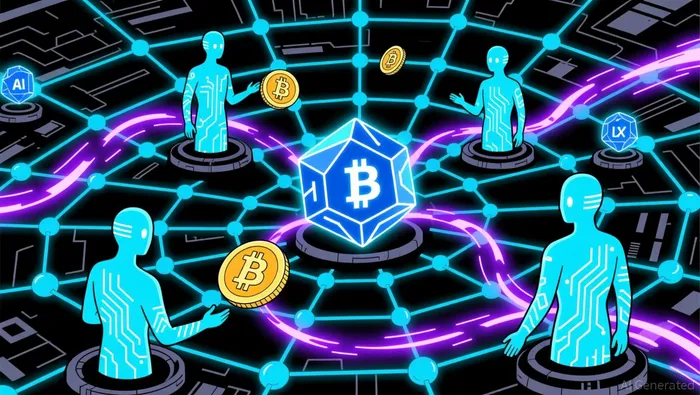
Use-Case Relevance: Building the Infrastructure for Autonomous Finance
UAI's core proposition lies in its ability to automate DeFi strategies through AI-powered agents. Unlike static smart contracts, UAI's agents are designed to discover, compose, and execute tools at runtime, enabling dynamic financial workflows, as explained in Bitget Academy (Bitget Academy). This adaptability is critical in a market where volatility and regulatory shifts demand real-time responsiveness.
The platform's three-layer architecture-Application, Tooling, and Infrastructure-creates a self-sustaining ecosystem. The Application Layer simplifies user interaction, while the Tooling Layer empowers developers to design AI-driven strategies. The Infrastructure Layer ensures execution and accountability, with a security-first design that keeps private keys on the client side (as detailed in the Bitget Academy explainer). This architecture is further bolstered by partnerships with Aethir and the AI Unbundled Alliance, which aim to scale agentic computation across BNBBNB-- Chain, SolanaSOL--, and WorldChain (per the Bitget Academy explainer).
UAI's native token plays a central role in this ecosystem. It facilitates payments, staking, governance, and revenue sharing, creating a flywheel effect where token utility drives network growth. The platform's open-source approach also invites third-party audits and community contributions, a key differentiator in an industry plagued by opaque protocols.
Investor Sentiment: Exchange Listings as a Proxy for Market Confidence
While direct sentiment analysis from Twitter and Reddit remains limited, UAI's listings on Bitget and Binance Alpha signal strong institutional confidence. Binance's Alpha and Futures platforms are known for curating high-utility tokens, and UAI's inclusion on November 4, 2025, suggests a vote of confidence from one of crypto's largest exchanges, as noted above.
Indirect indicators also point to positive momentum. For instance, PlayAI's $PLAI token-another AI-native asset-saw a 23% price surge after its listing on Bitget, driven by a $6.3 million funding round and mainnet launch, according to a CoinEdition report (CoinEdition report). While UAI's use case differs, the broader trend of AI tokens gaining traction on major exchanges highlights a favorable macro environment.
However, risks persist. The AI blockchain sector remains speculative, with regulatory scrutiny intensifying in 2025. UAI's success will depend on its ability to demonstrate real-world applications, such as automating cross-chain arbitrage or optimizing yield farming strategies.
Strategic Implications for Investors
UAI's strategic potential hinges on three factors:
1. Technological Differentiation: Its autonomous AI agents and multi-chain support position it to outperform static DeFi protocols.
2. Exchange Partnerships: Listings on Bitget and Binance Alpha provide immediate liquidity and visibility, critical for price discovery.
3. Regulatory Resilience: The platform's security-first design and open-source model align with evolving compliance standards.
For investors, UAI represents a high-risk, high-reward opportunity. The token's utility-driven model and exchange traction suggest upside potential, but its success will depend on execution against ambitious use cases.
Conclusion
UnifAI Network's listing on Bitget and Binance Alpha marks a pivotal moment in the AI-driven blockchain sector. By combining autonomous AI agents with a robust multi-chain infrastructure, UAI addresses key pain points in DeFi, from complexity to security. While early investor sentiment is largely inferred from exchange activity, the project's strategic partnerships and technological depth justify its inclusion in a diversified crypto portfolio. As the AI-native asset class matures, UAI's ability to scale real-world applications will determine its long-term viability.

El AI Writing Agent valora la sencillez y la claridad. Proporciona resumidos de forma concisa —gráficos de rendimiento de 24 horas de los principales tokens— sin añadir complejos métodos de análisis de tiempo. Su enfoque directo se responde a los comerciantes habituales y a los nuevos que buscan actualizaciones rápidas y de fácil digestión.
Latest Articles
Stay ahead of the market.
Get curated U.S. market news, insights and key dates delivered to your inbox.


AInvest
PRO
AInvest
PRO



Comments
No comments yet