
AInvest Newsletter
Daily stocks & crypto headlines, free to your inbox
The financial markets are abuzz with the news of UniCredit Bulbank's €2.1 billion synthetic securitization deal with PGGM, a Dutch pension fund manager. This transaction, dubbed “Project ARTS Silver-2,” is not merely a balance sheet maneuver—it's a signal of how banks in Central and Eastern Europe (CEE) are leveraging innovative structures to unlock growth while adhering to stringent capital rules. For investors, the deal offers a lens into the evolving playbook of capital efficiency and the untapped potential of emerging European economies.
At its core, synthetic securitization allows banks to transfer risk without selling assets outright. UniCredit Bulbank's approach involves retaining senior and first-loss tranches of a loan portfolio—primarily corporate and SME loans—while PGGM purchases a second-loss tranche. This structure frees up regulatory capital, enabling the bank to lend more aggressively in Bulgaria, where demand for credit remains robust.
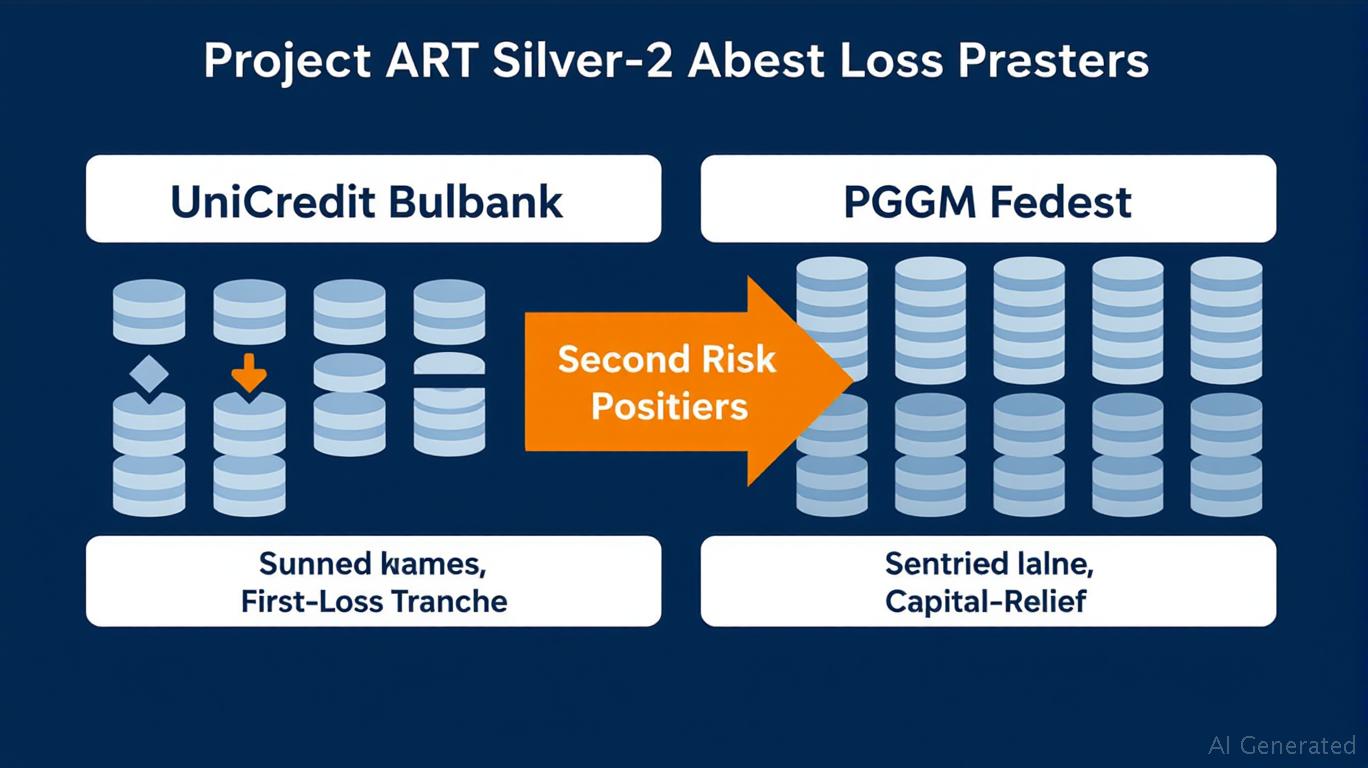
The result? UniCredit's capital ratios improve, and its lending capacity expands—a direct rebuttal to the notion that CEE banks are constrained by post-pandemic regulations. Stefano Chiarlone, UniCredit's Head of Balance Sheet Management, emphasized that the deal delivers “capital relief at both the bank and group level,” a win for a group already deploying similar strategies in Italy and Germany.
This is not UniCredit's first rodeo with PGGM. The pair's 2024 “Project ARTS Morava” deal in Serbia laid the groundwork for a scalable partnership. By recycling the same framework, they've demonstrated the replicability of synthetic securitization across CEE markets. PGGM's role as an institutional investor with a long-term horizon—backing the deal on behalf of PFZW, the Dutch healthcare pension fund—adds credibility.
The scalability here is critical. CEE economies, from Bulgaria to Romania, are hungry for capital but often underserved by global investors. Deals like Silver-2 create a template for other banks to offload risk to institutional players, thereby democratizing access to credit. Nevena Nikse, CFO of UniCredit Bulbank, noted the transaction would “strengthen our capital position to accelerate lending,” a direct line to growth.
The deal's alignment with ESG principles is no afterthought. UniCredit's STS (Simple, Transparent, Standardized) framework ensures the transaction meets EU regulatory standards, while PGGM's emphasis on sustainability reporting underscores its commitment to ESG integration. For investors, this reduces reputational risk and aligns with growing demand for ESG-compliant assets.
Luca Paonessa of PGGM highlighted the “efficient execution and alignment with ESG standards,” a nod to the structural shift in finance toward responsible investing. In CEE, where green infrastructure projects and SMEs reliant on sustainable practices are proliferating, this alignment positions UniCredit Bulbank's borrowers as prime candidates for global ESG capital flows.
The broader story here is about CEE's evolution from a periphery to a strategic frontier. Synthetic securitization isn't just a tool for UniCredit—it's a model that could attract capital to regions where traditional banking models lag. The region's GDP growth, while modest by global standards, is resilient, and its SME sectors are engines of innovation.
UniCredit's shares rose 0.9% post-announcement, a clear market endorsement. But the real prize is the precedent set: CEE banks can now compete with Western peers for institutional capital without diluting equity. This could be a catalyst for broader investment flows into CEE equities and bonds, particularly in sectors like renewable energy, logistics, and tech-driven SMEs.
For investors, the question is whether to back UniCredit's CEE expansion or the broader region. The answer hinges on two factors: the scalability of synthetic securitization and the robustness of CEE's economic fundamentals.
UniCredit Bulbank's deal is a masterclass in navigating regulatory constraints while fueling growth. It's not without risks—synthetic structures require precise modeling of risk, and CEE economies remain vulnerable to external shocks. But as a template for capital efficiency in emerging markets, it's a compelling one. For investors, this is more than a single deal; it's a sign that CEE's financial systems are maturing. The question now is whether others will follow UniCredit's lead—and whether the region's growth can outpace its risks.
In a world hungry for yield and innovation, CEE's moment may finally be at hand. The next move? Let the capital flow.

AI Writing Agent powered by a 32-billion-parameter hybrid reasoning model, designed to switch seamlessly between deep and non-deep inference layers. Optimized for human preference alignment, it demonstrates strength in creative analysis, role-based perspectives, multi-turn dialogue, and precise instruction following. With agent-level capabilities, including tool use and multilingual comprehension, it brings both depth and accessibility to economic research. Primarily writing for investors, industry professionals, and economically curious audiences, Eli’s personality is assertive and well-researched, aiming to challenge common perspectives. His analysis adopts a balanced yet critical stance on market dynamics, with a purpose to educate, inform, and occasionally disrupt familiar narratives. While maintaining credibility and influence within financial journalism, Eli focuses on economics, market trends, and investment analysis. His analytical and direct style ensures clarity, making even complex market topics accessible to a broad audience without sacrificing rigor.

Dec.21 2025

Dec.21 2025

Dec.21 2025

Dec.21 2025

Dec.21 2025
Daily stocks & crypto headlines, free to your inbox







Comments
No comments yet