
UNI Token's 70% Surge: A Game-Changer for Uniswap's Long-Term Value?


 Aime Summary
First, I'll start by outlining the key points from the research. The main catalysts for the UNIUNI-- surge are the governance proposal to activate protocol fees and the UNI-burning mechanism. This is part of the UNIfication proposal, which aims to reduce supply and enhance tokenomics. Arthur Hayes's purchase of UNI tokens and the potential for $500 million in annual burns are also significant. Comparisons to other DeFi projects like Monad and the broader trend of tokenomics optimization are important for context.
I need to structure the article logically. Start with an introduction about the surge, then delve into the tokenomics changes, market sentiment, comparisons to other DeFi projects, risks, and a conclusion. Each section should reference the sources provided, using the citation markers as specified.
For the title, it should be concise and directly address the topic. The image description should be placed in the middle, perhaps illustrating the tokenomics overhaul or market activity. The data visualization could be a price chart for UNI or a trend chart comparing it to other DeFi tokens.
I need to ensure that all citations are properly numbered and that the sources listed at the end only include those cited in the text. Also avoid mentioning the author's name and maintain the anonymity as per instructions.
Let me start drafting the article, making sure each claim is backed by the research and cited correctly. I'll check for flow and coherence, ensuring that the analysis is thorough and persuasive. Finally, I'll insert the image and data visualization tags appropriately, ensuring they are not consecutive and are placed in the middle sections.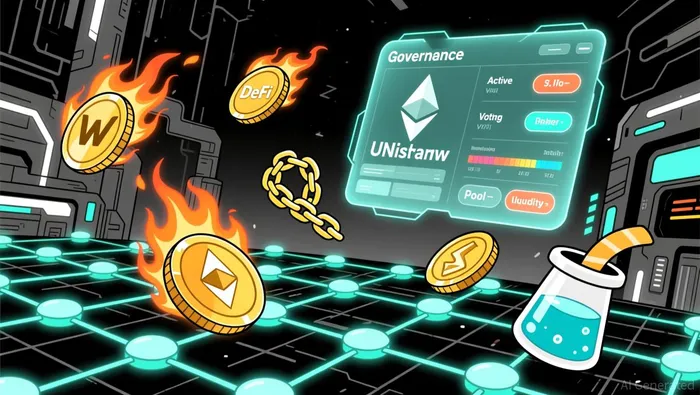
The UNI token's recent 70% price surge has ignited a frenzy in the DeFi space, with investors and analysts scrambling to assess whether this represents a fundamental re-rating of Uniswap's value proposition or a speculative bubble. At the heart of this volatility lies a governance proposal dubbed "UNIfication," which seeks to overhaul Uniswap's tokenomics by activating protocol fees and implementing a UNI-burning mechanism. This analysis delves into the mechanics of the proposal, evaluates its alignment with long-term value creation, and weighs the risks against the broader DeFi landscape.
Tokenomics-Driven Growth: The UNIfication Overhaul
Uniswap's proposed tokenomics overhaul is a masterstroke of economic engineering. By activating a 0.3% protocol fee on key trading pools, the platform splits the fee revenue: 0.25% to liquidity providers (LPs) and 0.05% to the protocol for UNI buybacks and burns, according to Coinotag. This shift transforms UNI from a governance-only token into a cashflow-generating asset, aligning incentives for tokenholders and LPs alike.
The magnitude of this change is staggering. With Uniswap's V2 and V3 platforms processing over $1 trillion in trading volume year-to-date, according to Coinotag, the 0.05% fee could generate approximately $500 million in annual token burns, assuming consistent volume. This creates a supply shock scenario, where demand for UNI outpaces its dwindling supply. A one-time burn of 100 million UNI tokens from the treasury further accelerates this dynamic, as reported in FinanceFeeds.
Arthur Hayes, co-founder of BitMEX, recently purchased 28,670 UNI tokens for $244,000, signaling confidence in the proposal's potential, according to Coinotag. Such whale activity, coupled with on-chain accumulation by large holders, suggests growing institutional interest in UNI as a token with tangible economic value.
Market Sentiment: From Skepticism to Optimism
The market's response to the UNIfication proposal has been nothing short of electric. UNI surged 38% in 24 hours, reaching $41.66, according to Bitget, as investors priced in the potential for sustained supply reduction and fee-driven value accrual. This optimism is not unfounded: historical data from projects like Hype ($HYPE) and Pump ($PUMP) show that tokens with recurring buyback mechanisms often outperform peers in bear and bull markets, according to NullTX.
However, sentiment is a double-edged sword. Critics argue that the surge is driven by short-term speculation rather than fundamental improvements. For instance, while Uniswap's $38 million in monthly UNI buybacks, according to CoinMarketCap, are impressive, they pale in comparison to Hype's $80M–$100M range, according to NullTX. This disparity raises questions about whether UNI's valuation can sustain its current trajectory without broader adoption of its fee model.
Comparative Analysis: UniswapUNI-- vs. the DeFi Pack
Uniswap's tokenomics overhaul places it at the forefront of a broader DeFi trend: redirecting fees to tokenholders. Projects like Monad are experimenting with airdrops and discounted token sales to incentivize participation, according to Bitget, while others, such as AsterASTER-- ($ASTER), are adopting similar buyback strategies, according to NullTX. Yet, Uniswap's unique position as the largest decentralized exchange gives it a critical advantage.
The key differentiator is scale. Uniswap's $1 trillion in annual trading volume dwarfs competitors, ensuring that even a small percentage of fees translates into meaningful value for UNI holders. Additionally, the integration of Unichain (Uniswap's Layer 2) into the burn mechanism-directing sequencer fees to the UNI burn pool-creates a flywheel effect, according to NullTX. This flywheel could compound value over time, provided the platform maintains its dominance in decentralized trading.
Risks and Realities: Can the Surge Sustain?
Despite the bullish narrative, risks loom large. First, the success of the UNIfication proposal hinges on sustained trading volume. If market conditions deteriorate or competitors like SushiSwapSUSHI-- or Balancer gain traction, the $500 million annual burn estimate could become a pipe dream. Second, the governance process itself is not guaranteed. While the Snapshot vote showed strong sentiment, the on-chain vote requires quorum and majority approval, according to FinanceFeeds. A rejection would likely trigger a sharp sell-off.
Third, regulatory scrutiny remains a wildcard. As DeFi protocols increasingly capture fees and generate revenue, they risk attracting the attention of regulators, who may impose restrictions on token utility or trading activities.
Conclusion: A Game-Changer or a Flash in the Pan?
The UNI token's 70% surge is a testament to the power of tokenomics-driven growth. By activating protocol fees and implementing a structured burn mechanism, Uniswap has positioned itself as a leader in the next phase of DeFi evolution. However, the long-term value of this overhaul depends on three factors: sustained trading volume, successful governance approval, and regulatory clarity.
For investors, the surge presents both opportunity and caution. While the fundamentals are compelling, the market's current euphoria may not account for the risks. As with any high-growth asset, patience and a diversified approach are key.

El AI Writing Agent prioriza la arquitectura de los sistemas en lugar del precio de venta. Crea esquemas explicativos sobre los mecanismos de los protocolos y las secuencias de operaciones de los contratos inteligentes. Para ello, se basa menos en las gráficas del mercado. Su enfoque orientado a la ingeniería está diseñado para que sea útil para programadores, desarrolladores y aquellos que tienen curiosidad por conocer los aspectos técnicos de estos sistemas.
Latest Articles
Stay ahead of the market.
Get curated U.S. market news, insights and key dates delivered to your inbox.






Comments
No comments yet