
UNI Hits 6-Month High as Uniswap Unveils Token Discovery Tab and Deflationary Burn Mechanics
 Aime Summary
- Uniswap launched a beta 'Launches' tab aggregating token offerings from Robinhood Chain, driving a 13% price surge to a six-month high.
- Protocol governance activated a fee switch enabling a retroactive burn of 100 million UNIUNI--, establishing a deflationary economic model.
- Founder Hayden Adams clarified that v4 protocol fees are additive, ensuring liquidity providers retain existing earnings.
- Integration of MorphoMORPHO-- lending vaults and permissioned pools expands DeFi utility and compliant asset trading.
The UniswapUNI-- decentralized exchange has executed a strategic pivot toward enhanced user acquisition and deflationary tokenomics. The native UNI tokenUNI-- surged 13% in 24 hours to $4.54, marking a significant six-month high. This rally lifted monthly gains to 60%, driven by new 'Launches' tab on Uniswap. The feature aggregates token offerings from major launchpad builders, including Bankr, Pons, and Long, into a single discoverable feed.
Robinhood Chain is currently the primary network featured in this aggregation. In July alone, over 340,000 new tokens launched via Robinhood launchpads on Uniswap, generating $3.6 billion in trading volume . The new tab allows users to filter and sort tokens by 24-hour volume, liquidity, and trending status. This infrastructure aims to improve distribution for new projects while capturing volume from the surge in new token launches .
How Does the Deflationary Burn Mechanism Work?
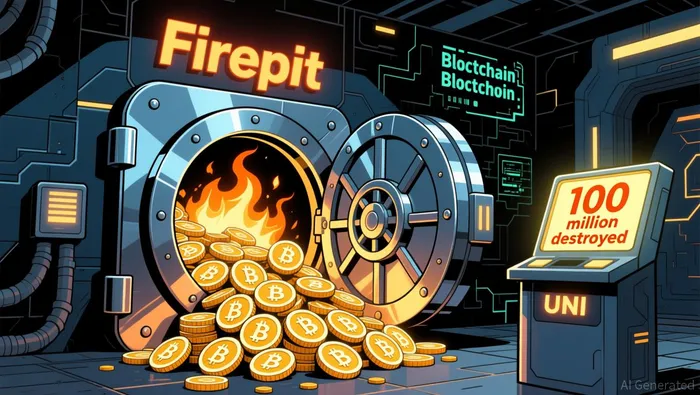
Uniswap governance passed the UNIfication proposal with overwhelming support, shifting the protocol's economics. The initiative activates the long-anticipated protocol fee switch, redirecting a portion of trading fees directly to the protocol for burning UNI tokens . Following passage, the proposal entered a two-day timelock before the protocol burned 100 million UNI tokens .
This one-time retroactive burn occurred on December 28, 2025, destroying approximately 100 million UNI valued between $590 million and $596 million. The mechanism traces back to the UNIfication governance proposal, which enabled protocol-level fee collection across Uniswap v2 and v3 pools on multiple chains . Fees flow into TokenJar contracts, which execute UNI buybacks, routing purchased tokens to the "Firepit" for permanent burning .
Combined with ongoing daily burns, total UNI destroyed has surpassed 107 million tokens. This removes north of 10% of the entire 1 billion supply from circulation . At the current pace, annualized burns are tracking roughly $170 million in value, representing the highest sustained rate during regular operations . Net sequencer fees from Unichain also route into the burn system, creating a deflationary loop where protocol usage growth reduces UNI supply .
Why Are Protocol Fees Additive Rather Than Subtractive?
The protocol faced internal debate regarding its v4 fee structure, with concerns that fees might reduce returns for liquidity providers. Uniswap founder Hayden Adams clarified that the new 5 basis point protocol fee is additive, meaning LPs retain their standard 30bp share on a 30bp pool . Adams explained that the 5bp fee represents only about 14% of total swap fees, not a deduction from existing LP earnings .
The technical implementation involves a V4FeePolicy contract that classifies pools and calculates charges, alongside a V4FeeAdapter that routes collected assets to TokenJar contracts. For static pools, the policy uses a curve tied to the LP fee, while aggregator-hook pools use fixed rates . Uniswap Labs cited data from previous fee activations on v2 and v3, noting that the largest v3 pools retained 98.5% of their pre-activation liquidity .
This structure positions Uniswap as a cost-effective alternative for traders and liquidity providers alike. The 5bp fee is significantly lower than the 100-200bp fees charged by centralized exchanges . The next phase involves monitoring whether affected pools retain liquidity and trading volume, with governance retaining the ability to adjust rates if the model is not well tolerated .
How Is Uniswap Expanding Beyond Spot Trading?
Uniswap has launched 'Earn,' a new feature integrating Morpho lending vaults to offer onchain lending capabilities directly within its swap interface. This expansion enables users to deposit stablecoins or ETH for yield without leaving the platform. The strategy aims to improve user retention by allowing seamless transitions between trading and lending, though yields remain variable .
The integration places Uniswap in direct competition with established lending platforms like AaveAAVE-- or Compound. However, the service carries specific risks, as deposits are not FDIC-insured and yields fluctuate based on lender deposits and borrowing demand . Uniswap has not announced that Earn revenue will flow to UNI token holders, making user adoption the primary metric for evaluating this strategic pivot .
Additionally, Uniswap v4 introduced Permissioned Pools to enable compliant trading of tokenized real-world assets. The system allows issuers to place tokenized funds, securities, and equities inside Uniswap v4 while controlling participation through onchain allowlist checks. This addresses a key infrastructure gap in tokenized finance, where regulatory restrictions often prevent blockchain-based assets from entering permissionless secondary markets .
The proposal also consolidates operations by transitioning Uniswap Foundation teams to Uniswap Labs as the primary development force. A reduced Foundation team will manage grant distribution, deploying the remaining $100 million budget before closing operations . This transition follows improved regulatory clarity in the United States and the adoption of the DUNI legal structure .

Blending traditional trading wisdom with cutting-edge cryptocurrency insights.
Latest Articles
Stay ahead of the market.
Get curated U.S. market news, insights and key dates delivered to your inbox.


AInvest
PRO
AInvest
PRO




Comments
No comments yet