
UNI Executes $596M Token Burn to Fuel Deflationary Loop
 Aime Summary
- Uniswap burned 100 million UNI tokens worth $596 million to create a deflationary loop.
- The UNIfication proposal passed with 99.9% support and activated protocol-level fee redirection.
- Trading fees now fund ongoing UNI burns, tying token scarcity directly to protocol usage.
- UNI's price climbed 5.2% post-implementation with trading volume jumping 52%.
- Regulatory scrutiny and liquidity provider concerns remain key challenges.
Uniswap (UNI) has executed one of DeFi's largest token burns, permanently removing 100 million UNI tokensUNI-- from circulation. This $596 million deflationary move, approved by 99.9% of governance voters, fundamentally reshapes the protocol's value capture mechanics. The activation of a fee-switch mechanism creates a self-sustaining economic loop where trading activity directly fuels token scarcity. This strategic pivot positions UNIUNI-- as a deflationary asset tied to protocol usage growth, attracting institutional interest through traditional finance principles.
How Did the UNIfication Proposal Transform Uniswap's Tokenomics?
The UNIfication proposal marked a watershed moment for Uniswap's economic design. It executed a one-time burn of 100 million UNI tokens, permanently eliminating approximately 10% of the initial supply. This $592-$596 million reduction creates immediate scarcity while establishing a new deflationary framework. Governance participation reached unprecedented levels with 125 million UNI votes cast, far exceeding the 40 million quorum requirement. 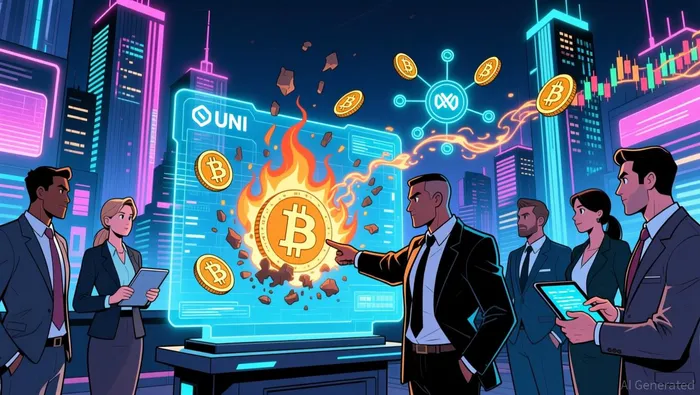 The near-unanimous 99.9% approval signals robust community alignment with this tokenomics overhaul.
This structural shift represents a retroactive correction for years of uncollected protocol fees. Beyond the initial burn, 20 million UNI were allocated for ecosystem development to sustain growth momentum. Market response proved immediately positive with UNI climbing 5.2% to $6.30 and trading volume surging 52% to $297 million. The tokenomics redesign fundamentally repositions UNI from governance utility to scarcity-driven value accrual.
What Does the Fee-Switch Mechanism Mean for UNI's Value Capture?
Activating protocol fees establishes a self-reinforcing economic loop for UNI. The fee-switch redirects 0.05% of trading fees from liquidity providers to a protocol-controlled treasury. These funds perpetually buy and burn UNI tokens, creating a direct link between trading volume and supply contraction. Liquidity provider fees consequently dropped from 0.30% to 0.25% to accommodate this value redistribution. This mechanism ensures rising protocol usage automatically increases token scarcity without additional governance intervention.
Institutional investors view this model as mirroring traditional finance's share buyback programs. The fee-redirection disables frontend monetization, reinforcing Uniswap's decentralized ethos while centralizing value capture at the protocol layer. As trading volumes grow, the deflationary pressure intensifies through the automated burn mechanism. That said, the system's efficiency depends on sustained trading activity to fund meaningful supply reduction.
What Risks Could Challenge UNI's Deflationary Model?
Regulatory uncertainty presents the most significant headwind to Uniswap's new tokenomics. The fee-redistribution mechanism creates a direct revenue stream for token holders, potentially attracting securities classification scrutiny. Liquidity providers express concern over diminished returns, which could reduce pool depth and increase slippage during volatile markets. The model's sustainability remains untested during prolonged low-volume periods when burn funding would decrease substantially.
Critics warn the changes create circular dependencies. The reduced LP rewards might push market makers toward competing platforms, potentially undermining Uniswap's liquidity dominance. On the flip side, proponents argue the alignment of holder incentives with protocol growth outweighs these transitional challenges. Market data shows initial success, but long-term viability requires navigating regulatory frameworks and maintaining liquidity depth.

Blending traditional trading wisdom with cutting-edge cryptocurrency insights.
Latest Articles
Stay ahead of the market.
Get curated U.S. market news, insights and key dates delivered to your inbox.






Comments
No comments yet