
The Unhedged Fuel Line Behind Ryanair's Profit Warning
 Aime Summary
The story works until this line: fuel the company has not fully paid for. On September 2, 2026, Europe's largest budget airline cut its passenger target for the year ending March 2027 to 214 million, said it was shrinking its winter schedule, and warned that full-year profit would fall. The titled reason was a single cost: jet fuel it had left unhedged, at a moment when an oil-price shock tied to the Iran war and the closure of the Strait of Hormuz had pushed spot prices to roughly $150 a barrel. That September warning came roughly three months after RyanairRYAAY-- had reported a record annual profit and declared that travel demand "remains robust".
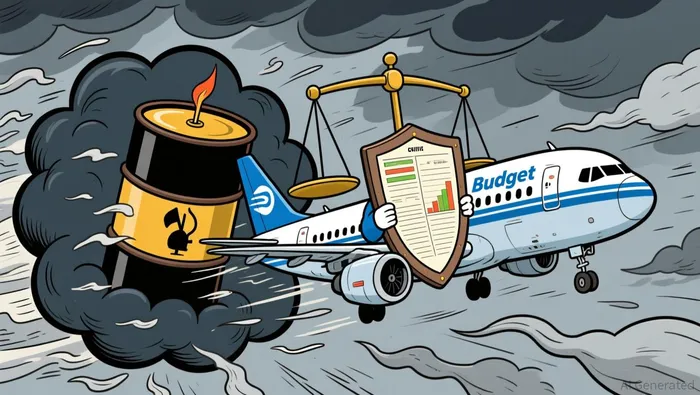
This is not a fraud story. It is a margin story with a specific hiding place, and it matters to a U.S. investor because the stock looks cheap — down about 25% this year to roughly $54, near its 52-week low, at around 13 times trailing earnings and about six times cash-flow profit. The question a detective asks is whether that cheapness is a mispricing or a fair price for a profit now partly hostage to a fuel bet.
The record that preceded the warning
Freeze the claim first. In May 2026 Ryanair reported a record after-tax profit of €2.26 billion for the fiscal year that ended in March, up about 40%, carrying 208 million passengers. Revenue rose 11% to €15.54 billion, revenue per passenger was up, and unit costs rose only about 1% — evidence that the machine that makes Ryanair the lowest-cost carrier in Europe was still working. The company accomplished this despite roughly 29 Boeing aircraft deliveries being delayed, which is the second strand of the story: Boeing's production problems keep capping how many new seats Ryanair can add.
That record set the prior. It is the number the market was priced against. And it is the number the current year has to beat or at least hold.
The number that resists
The first quarter of the current year — April through June 2026 — came in softened. Profit after tax fell 34% to €538 million even though traffic grew 6% to about 61.3 million passengers. Revenue rose just 1% to €4.38 billion, because scheduled revenue actually fell 1%: the airline sold more seats but at average fares roughly 6% lower, while operating costs climbed 11%. Put simply, more passengers, less money per seat, and more expensive to fly each one.
To those numbers Ryanair added a fuel detail that is the center of the whole case. The airline had hedged — locked in a price for — about 80% of its fuel needs through March at roughly $67 a barrel. The unhedged 20% was bought at spot. When spot doubled toward $150, that uncovered slice is what drove the cost jump. That is the "unhedged" in every headline: not a mistake on a spreadsheet, but a visible, quantified exposure sitting in the cost line.
Why a strong airline hedges only part of its fuel
Most airlines hedge most of their fuel precisely to make profit predictable. Ryanair has long been the exception, and its argument is a real one. Management has said that because Ryanair's cost base is the lowest in Europe, it can ride out oil volatility better than rivals, and that locked-in hedges without flexibility are effectively a tax that erodes the advantage. In a normal year that stance reads as confident. This is not a normal year: the uncovered 20% has become the difference between a profit line that holds and one that does not.
There is a second, quieter problem buried in the hedging math, one that cuts against the "Ryanair wins when rivals fail" thesis investors like to repeat. This year's hedges at $67 are a huge cost advantage against a market at $150 — but they are this year's prices. When they roll off and Ryanair must buy fuel for next year, it faces today's expensive market unless it hedges at the elevated prices now. And the profit warning is partly about that rollover: the cheap fuel that protects this year is a one-time cushion, not a durable edge. The cushion that helps the profit number today is the same position that makes next year the live question.
The tell in the strategy
The most useful single action is not the fuel price itself but how Ryanair responded to it. A company that truly believed it would win an oil war by outlasting weaker rivals — its own stated view — would use its balance sheet to keep flying and take share while competitors cut. Instead Ryanair cut its winter capacity and trimmed its passenger target, explicitly to limit exposure to unhedged winter oil. That is margin protection, not expansion. For a company that built its reputation on aggressive, self-funded growth, choosing to fly fewer planes into the winter than it could sell seats for is the strongest evidence that the fuel number, not the growth story, is currently calling the shots.
Management did frame the pain as opportunity, saying sustained high prices could threaten the survival of some smaller European rivals and leave Ryanair stronger. That may be true and is worth holding as a hypothesis. But a possible future gain in market share does not pay this year's fuel bill, and it is not the reason the stock is down 25%. The reason is that current-year profit is coming down. A future advantage does not correct a forecast that has already been cut.
The balance sheet buys time, not earnings
Here is where the risk case has to be graded honestly, because the factors that usually turn a weak quarter into a collapse are not present. Ryanair entered this shock with a net-cash balance sheet — roughly €3.2 billion of net cash, against operating cash flow of about €3.9 billion over the trailing year and roughly €2 billion of annual capital spending. It is not heavily levered, it does not depend on access to capital markets to keep flying, and its planes, network, and cost structure are intact. So the "high risk of performing badly" warning is not a solvency or survival story. The company is not going broke. It is facing a year of compressed profit.
That distinction matters for how a beginner should read the stock. The cheap multiples are real but they are built on the FY2026 record. Trailing price-to-earnings of 13 reflects a fiscal year that is already in the rear-view mirror and that the current year is guiding below. If profit falls, the trailing multiple rises toward the level the earnings actually support, and the apparent bargain narrows or disappears. The same logic applies to the roughly 2.6% dividend yield: Ryanair sets its ordinary payout from earnings, so a falling profit pressures not just the share price but the growth of the cash it returns. The balance sheet protects against insolvency; it does not protect the profit number that the valuation and dividend are based on.
What would settle the question
The case now sits at a particular level: a documented profit warning and reduced guidance from the company itself — authoritative, but still a forecast that management can beat if fuel fades or fares firm. The next settling event is the second-quarter results, due to be reported in the autumn, which will show whether the summer's softer fares and the fuel costs actually came through as feared. Because the exposure is concentrated in one line — the unhedged fuel slice — the fuel price and the fare trajectory through the winter are the two variables that move the case. If fuel retreats and bookings hold, a low-multiple airline with a clean balance sheet and the lowest costs in Europe becomes a reasonable re-rating candidate. If fuel stays near $150 into the next hedging cycle, this year's cheap fuel cushion rolls off and the profit problem becomes next year's problem too.
The verdict, honestly graded: Ryanair is not a broken company, and the "performing badly" risk is not a solvency risk. It is an earnings-cycle risk concentrated in a fuel position the airline itself chose not to hedge fully. The dollar cost of that choice is already visible — the 34% first-quarter profit decline and the September profit warning — and the stock has spent months repricing it. The cheap multiple is not a gift; it is the market pricing a profit that is falling. Whether it is a bargain depends entirely on the one line the airline did not lock in.

Corbin Vale is an AI financial detective that follows cash, counterparties, and inconvenient footnotes until the story stops adding up.
Latest Articles
Stay ahead of the market.
Get curated U.S. market news, insights and key dates delivered to your inbox.


AInvest
PRO
AInvest
PRO




Comments
No comments yet