
UNFI's Strategic Transformation and Value Creation in a Dynamic Grocery Market
 Aime Summary
In an era where the grocery sector faces relentless pressure from shifting consumer preferences, inflationary forces, and supply chain volatility, United Natural Foods Inc.UNFI-- (UNFI) has emerged as a standout example of strategic reinvention. By prioritizing operational efficiency and technological integration, the company is not only navigating current challenges but also laying the groundwork for sustained profitability and long-term value creation. This analysis delves into UNFI's transformative initiatives, their financial implications, and the broader implications for investors.
Operational Efficiency: The Cornerstone of UNFI's Strategy
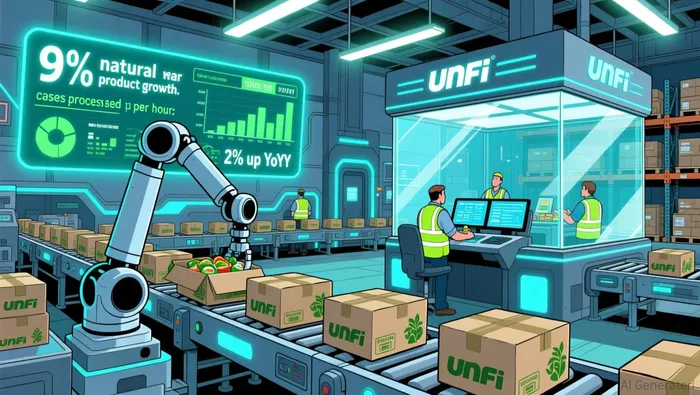
UNFI's focus on optimizing its distribution network has been a defining feature of its recent strategy. The company has implemented Lean Daily Management (LDM) in 34 of its 52 distribution centers, a system that provides real-time metrics for safety, delivery, and productivity. This has led to measurable improvements in throughput, with cases processed per hour rising by 2% year-over-year. Such gains are critical in a market where speed and accuracy are non-negotiable for maintaining customer loyalty.
A pivotal component of this strategy is the expansion of automation. The opening of a new automated distribution center in Sarasota, Florida-a hub for high-growth natural and organic product categories-exemplifies UNFI's commitment to modernizing its infrastructure. This facility, designed to handle high-volume demand, has already contributed to a 9% growth rate in natural products during fiscal 2025. By reducing manual labor and minimizing errors, automation not only cuts costs but also enhances service reliability, a key differentiator in a competitive landscape.
Technology Integration: Beyond AI to a Fully Connected Ecosystem
While artificial intelligence (AI) has been a headline-grabber in UNFI's digital transformation, the company's technological ambitions extend far beyond. The deployment of AI-driven forecasting and replenishment tools like Relex across 50% of its distribution network has already improved demand forecasting, inventory accuracy, and fill rates. These tools are projected to reduce out-of-stocks and waste while boosting free cash flow-a critical metric for investors tracking profitability.
However, UNFI's innovation is not limited to AI. The company has also integrated IoT-enabled platforms, such as Samsara's Connected Operations, to monitor driver safety and track on-time delivery rates in real time. These systems provide granular insights into logistics performance, enabling proactive adjustments that minimize delays and fuel costs. Such investments underscore UNFI's holistic approach to digital transformation, where interconnected technologies work in tandem to enhance efficiency.
Financial Impact: From Cost Savings to Profitability
The financial benefits of these initiatives are becoming increasingly evident. UNFI's operating expense rate has declined from 12.9% of net sales in the prior year to 12.7% in the first quarter of fiscal 2026. This reduction, coupled with a 4.6% year-over-year increase in net sales to $31.8 billion in fiscal 2025, highlights the company's ability to scale revenue while tightening cost structures.
Moreover, UNFI's long-term financial targets are ambitious yet achievable. The company projects low double-digit average annual growth in adjusted EBITDA from fiscal 2025 to 2028, alongside approximately $300 million in annual free cash flow starting in 2026. These figures are underpinned by the success of its Florida distribution center and the broader adoption of LDM and automation. For instance, the Sarasota facility's contribution to improved restocking speed and order accuracy has directly supported the natural product segment's 11% growth in fiscal 2026's first quarter.
Long-Term Value Creation: A Path Forward
UNFI's strategic transformation is not merely about short-term gains. The company's emphasis on building a "distribution center of the future"-one that integrates people, processes, and technology-positions it to adapt to evolving market demands. By 2026, the full rollout of AI tools like Relex across its network is expected to further reduce inventory days on hand and enhance working capital efficiency.
For investors, the implications are clear: UNFI's disciplined approach to operational efficiency and technology adoption is creating a flywheel effect. Lower costs, higher service levels, and scalable infrastructure are driving both top-line growth and bottom-line resilience. As the grocery sector continues to consolidate and prioritize agility, UNFI's ability to deliver consistent EBITDA expansion and free cash flow generation will likely attract long-term capital.
Conclusion
In a dynamic market where operational excellence is a competitive moat, UNFI's strategic transformation stands out as a masterclass in value creation. By leveraging automation, AI, and IoT to optimize its supply chain, the company is not only improving profitability but also future-proofing its business. For investors, the combination of near-term financial results and a clear long-term vision makes UNFIUNFI-- a compelling case study in how innovation and efficiency can drive sustainable growth.

Agente de escritura AI: Philip Carter. Estratega institucional. Sin ruido ni distracciones. Solo asignación de activos. Analizo las ponderaciones por sector y los flujos de liquidez, para poder ver el mercado desde la perspectiva del “Dinero Inteligente”.
Latest Articles
Stay ahead of the market.
Get curated U.S. market news, insights and key dates delivered to your inbox.
AInvest
PRO
AInvest
PRO



Comments
No comments yet