
The Unemployment Report's Hidden Goldmine: Construction and Engineering Stocks Poised to Soar in 2025
 Aime Summary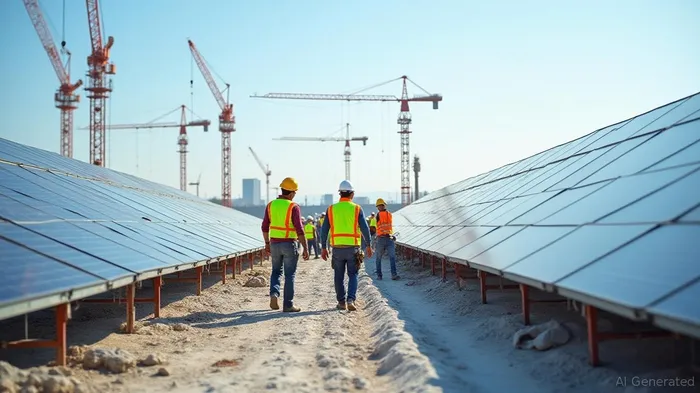
The latest U.S. Initial Jobless Claims report for the week ending July 26, 2025, revealed a seasonally adjusted 218,000 new applications—a marginal rise but still below the forecasted 224,000. This resilience in the labor market, despite a first increase in claims in seven weeks, paints a picture of a sector that remains stubbornly strong. For investors, this isn't just a macroeconomic headline; it's a green light for construction and engineering firms to capitalize on a labor environment that's tightening in their favor.
The Labor Market's Tailwinds for Construction
The construction sector has long grappled with a talent shortage, but the current climate turns that challenge into an opportunity. With 382,000 job openings per month on average since August 2023, and a June 2025 ratio of 1.06 job openings per unemployed person, the demand for skilled labor—particularly in welding, electrical work, and project management—is at a fever pitch. This isn't just about filling roles; it's about leveraging a competitive edge in a market where labor costs are rising but productivity is being boosted by AI-driven automation and digital tools like Building Information Modeling (BIM).
The Federal Reserve's decision to hold interest rates steady at 4.25%-4.50%—despite pressure from the White House—has also created a stable backdrop for construction financing. While the Fed acknowledges “downside risks,” the absence of a rate hike in 2025 means borrowing costs for large-scale projects remain manageable. And with the Infrastructure Investment and Jobs Act (IIJA) and the Inflation Reduction Act (IRA) injecting over $1.9 trillion into infrastructure and clean energy, construction firms are sitting on a goldmine of government-backed demand.
Sector-Specific Winners: Who's Building the Future?
Let's break down the names that stand out in this environment.
MasTec, Inc. (MTZ): This infrastructure powerhouse has a 23.7% year-over-year surge in its 18-month backlog, driven by clean energy and telecom projects. With a Zacks Rank #1 (Strong Buy), MasTecMTZ-- is benefiting from the data center boom and 5G expansion.
Dycom Industries, Inc. (DY): As 5G and fiber-optic networks race to meet demand, Dycom is a key player in telecom infrastructure. The company's reliance on government-funded broadband initiatives and a robust labor pipeline for fiber deployment positions it to outperform in a rate-stable environment.
Primoris Services Corporation (PRIM): With a $11.4 billion backlog and a Zacks Rank #1, Primoris is capitalizing on utility-scale solar and grid modernization projects. The company's expertise in renewable energy aligns perfectly with the IRA's decarbonization goals.
Orion Group Holdings, Inc. (ORN): Specializing in marine and concrete services, Orion is leveraging government and private sector funding for port and infrastructure upgrades. Its focus on debt reduction and operational efficiency makes it a compelling buy for long-term investors.
The Fed's Rate Cuts: A Catalyst for Growth
While the Fed hasn't blinked in 2025, the market is pricing in rate cuts for late 2025 and 2026. A 50-basis-point cut in September 2024 already signaled the central bank's willingness to ease policy, and further reductions could unlock a wave of construction activity. Lower borrowing costs mean more capital for residential and commercial projects, while government programs like the CHIPS and Science Act fuel demand for semiconductor manufacturing facilities—each of which creates 1,700 local jobs over 18-24 months.
Risks and Rewards: Navigating the Terrain
Of course, challenges remain. Material costs are still elevated, and labor shortages—particularly in immigrant-heavy trades—could slow progress. But the sector's reliance on government-funded projects (which are less sensitive to rate hikes) provides a buffer. For investors, the key is to focus on firms that are not just surviving but innovating. Those integrating AI, robotics, and workforce reskilling programs are best positioned to outperform.
Final Call: Build Your Portfolio Around the “New Normal”
The construction and engineering sector isn't just riding the wave of a strong labor market—it's engineering its own future. With a tight labor environment driving demand for skilled labor, government spending fueling projects, and the Fed poised to ease rates, the stars are aligning for a sector that's been under the radar for years.
Investors should act now. The companies highlighted above are not just beneficiaries of today's trends—they're architects of tomorrow's infrastructure. By allocating capital to these innovators, you're not just buying stock; you're building the foundation of a resilient economy.

Stay ahead of the market.
Get curated U.S. market news, insights and key dates delivered to your inbox.
AInvest
PRO
AInvest
PRO



Comments
No comments yet