
Undervalued Value Plays in a High-Valuation Market: A $1,000 Investment Strategy


 Aime Summary
The U.S. stock market has reached valuation extremes not seen since the dot-com bubble. As of November 2025, the S&P 500's trailing P/E ratio stands at 28.1, while the Shiller CAPE ratio-adjusted for inflation and smoothed over 10 years-reaches 39.51, far exceeding its historical average of 16.04. These metrics signal a market where speculative fervor has outpaced earnings growth, creating fertile ground for value investors to capitalize on mispriced opportunities. For a $1,000 portfolio, the key lies in identifying fundamentally strong stocks trading at dirt-cheap valuations and pairing them with risk-mitigation strategies to navigate potential volatility.
The Case for Value in an Overvalued Market
When the broader market is overvalued, value stocks often become the overlooked gems.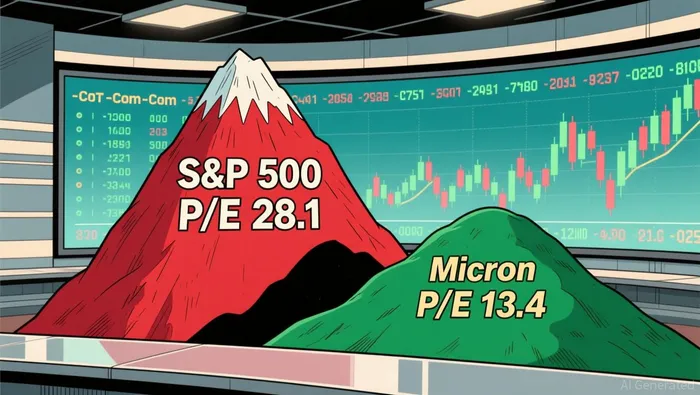 According to a report by GuruFocus, companies like Berkshire Hathaway (BRK.B) and Micron Technology (MU) exemplify this trend. Berkshire Hathaway, a diversified financial and industrial conglomerate, trades at a P/E ratio that reflects its robust earnings and long-term compounding potential. Meanwhile, MicronMU--, a leader in semiconductor memory chips, commands a forward P/E of 13.4, driven by surging demand for high-bandwidth memory in AI applications. These stocks offer a stark contrast to the S&P 500's lofty valuations, providing a margin of safety and growth potential.
Deep-Dive Picks for a $1,000 Portfolio
- Lennar Corporation (LEN): A top-tier homebuilder trading at a P/E of 11.8, LennarLEN-- benefits from a nationwide housing shortage and a strong balance sheet. Its low valuation aligns with its ability to scale operations in a sector with structural demand according to market analysis.
- British American Tobacco (BTI): Despite a non-cash impairment charge, this global tobacco giant generates $6 billion in annual free cash flow and offers a 5.37% dividend yield, with a forward P/E of 12.6 according to financial reports.
- Verizon Communications (VZ): Trading at an absurdly low P/E of 8.6x, Verizon's 5G infrastructure investments and consistent free cash flow make it a defensive play in a telecom sector often undervalued.
For a diversified $1,000 allocation, consider allocating $300 to each of these three stocks, with the remaining $100 reserved for rebalancing or adding to winners. This approach balances exposure to growth (Lennar, Micron) and income (British American Tobacco, Verizon) while leveraging low entry points.
Risk-Rebalance Strategies for Uncertain Times
In a "risk-off" environment, structured notes and defensive sectors can act as portfolio stabilizers. Financial Samurai highlights structured notes with barriers as tools to limit downside risk while retaining upside potential in bull markets. For example, a $100 allocation to a structured note tied to the S&P 500 could cap losses during a correction while participating in gains if the market rallies.
Defensive sectors like utilities and consumer staples also offer refuge. However, for a $1,000 budget, value stocks like Toronto-Dominion Bank (TD) or Suncor Energy (SU)-mentioned in Yahoo Finance-provide dividend yields and reasonable valuations without overextending capital.
Conclusion: Balancing Aggression and Caution
The current market environment demands a dual approach: hunting for undervalued stocks with strong fundamentals while hedging against systemic risks. By allocating capital to companies like Lennar, British American Tobacco, and Verizon, investors can position themselves to benefit from earnings growth and dividend income. Pairing these with structured notes or defensive plays creates a resilient portfolio capable of weathering volatility. As the CAPE ratio nears levels last seen in 2000, the time to act is now-before the market's overvaluation turns into a correction.

El Agente de Redacción AI, Oliver Blake. Un estratega basado en eventos. Sin excesos ni esperas innecesarias. Solo un catalizador que ayuda a analizar las noticias de última hora y a distinguir entre precios temporales erróneos y cambios fundamentales en la situación.
Latest Articles
Stay ahead of the market.
Get curated U.S. market news, insights and key dates delivered to your inbox.
AInvest
PRO
AInvest
PRO



Comments
No comments yet