
Undervalued Dividend-Paying Stocks: A Generational Buying Opportunity Amid Market Volatility and Interest Rate Shifts
In an era marked by persistent market volatility and shifting interest rate cycles, undervalued dividend-paying stocks have emerged as a compelling asset class for income-focused investors. As of 2025, these stocks—often trading at significant discounts to intrinsic value—offer not only attractive yields but also a historical precedent for outperforming during periods of economic uncertainty. This analysis explores how current opportunities align with recurring patterns observed during past market overcorrections, positioning them as generational buying opportunities.
The 2025 Landscape: High Yields and Defensive Fundamentals
Recent market data underscores the appeal of undervalued dividend stocks in 2025. According to Morningstar's chief US market strategist Dave Sekera, companies like Kraft Heinz (KHC), Johnson & Johnson (JNJ), and Verizon (VZ) trade at substantial discounts to intrinsic valuations, with yield rates ranging from 3.25% to over 6%, per a Morningstar list. For instance, Verizon's 6.7% yield and forward P/E of 8.3 reflect its robust cash flow and strategic investments in 5G infrastructure, making it a defensive play in a high-volatility environment, as noted in a Logic Invest post. Similarly, Energy Transfer (ET) and Altria Group (MO) stand out for their 8.0% and 8.2% yields, respectively, driven by long-term fixed-fee contracts and decades of uninterrupted dividend growth, according to a ValueSense post.
These stocks are not merely high-yield propositions; they are underpinned by strong fundamentals. Metrics such as payout ratios, debt-to-EBITDA ratios, and forward P/E ratios indicate that many of these companies are poised to sustain—and even grow—their dividends despite macroeconomic headwinds, as discussed by Making Cents Sense. For example, TotalEnergies SE and EOG Resources have maintained prudent payout ratios and operational efficiency, ensuring resilience amid commodity price swings, per a MarketClutch analysis.
Historical Precedent: Dividend Stocks as a Buffer During Overcorrections
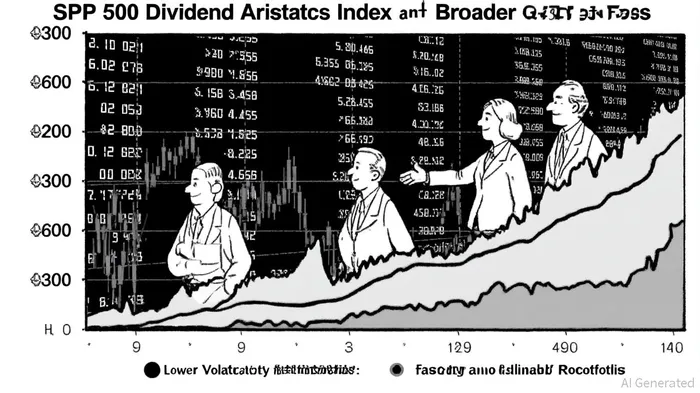
The case for undervalued dividend stocks in 2025 gains further strength when viewed through the lens of historical market overcorrections. During the 2008 financial crisis, defensive sectors like consumer staples and healthcare—home to dividend powerhouses such as Procter & Gamble (PG) and Johnson & Johnson—retained their dividend payouts and outperformed the broader market during recovery, according to a Dividend Strategy analysis. Similarly, in the 2020 pandemic-driven crash, companies like Coca-Cola (KO) and Walmart (WMT) maintained their dividend policies, while the S&P 500 Dividend Aristocrats Index (comprising companies with 25+ years of consecutive dividend growth) experienced a 23% drawdown compared to the S&P 500's 34% decline, as noted in a Dividend Investors post.
This historical resilience is not coincidental. Dividend growth stocks—those with a track record of increasing payouts—have consistently outperformed high-yield counterparts during both rising and falling rate environments. For example, during the 2015–2018 rate hike cycle, the S&P 500 Dividend Aristocrats Index outperformed the broader index, driven by companies with strong balance sheets and pricing power, as described in a ProShares insight. These firms, often in sectors like healthcare and consumer staples, demonstrated the ability to sustain dividends even as borrowing costs rose.
Interest Rate Cycles and the Case for Dividend Growth
The interplay between interest rates and dividend stocks is nuanced. While rising rates often redirect capital toward fixed-income assets, they also favor lower-duration equities—such as dividend-paying stocks—that provide immediate cash flow. Historical data reveals that dividend growth stocks, in particular, have thrived during rate hikes. For instance, during the 1980s and 1990s, companies with consistent dividend increases outperformed high-yield peers, as their strong earnings and low debt loads insulated them from inflationary pressures, according to Dividend.com data.
In 2025, this dynamic remains relevant. As central banks navigate post-pandemic inflation and potential rate cuts, investors are increasingly prioritizing quality over yield. Companies like Altria Group and Verizon, with conservative payout ratios and diversified revenue streams, exemplify this trend. Their ability to reinvest earnings into growth initiatives—such as Altria's pivot to vaping and Verizon's 5G expansion—ensures long-term sustainability, as highlighted in an Indexology post.
Generational Opportunities: Compounding and Long-Term Returns
The compounding power of reinvested dividends amplifies the case for undervalued dividend stocks. Historical analysis by RBC Global Asset Management found that dividend growers delivered 11.7% annualized returns from 1986 to 2016, compared to 9.9% for dividend payers and 6.6% for the broader market; this finding is summarized in a Planning Made Simple article. Over 50 years, this translates to generational wealth creation. For example, an investment of $1 in the U.S. stock market in 1871 grew to $30,033 by 2025, despite 19 market crashes, largely due to dividend reinvestment, according to Morningstar.
The 2025 market environment mirrors past inflection points. Companies like Kraft Heinz, trading at a 45% discount to intrinsic value, and Energy Transfer, with its 8.0% yield and fixed-fee contracts, offer similar entry points to those seen during the 2008 and 2020 downturns. By focusing on quality and sustainability—rather than chasing high yields—investors can position themselves to benefit from long-term compounding and market rebounds.
Conclusion: A Strategic Approach to 2025's Opportunities
Undervalued dividend-paying stocks in 2025 represent a unique confluence of attractive valuations, defensive characteristics, and historical precedent. As interest rate cycles and market volatility continue to shape investor behavior, these stocks offer a dual benefit: income generation and downside protection. By learning from past overcorrections and prioritizing companies with strong fundamentals and sustainable payout ratios, investors can capitalize on what may prove to be a generational buying opportunity.

Senior strategist with 20+ years experience delivering data-driven research, ETF and stock analysis, and practical investment ideas.
Latest Articles
Stay ahead of the market.
Get curated U.S. market news, insights and key dates delivered to your inbox.
AInvest
PRO
AInvest
PRO



Comments
No comments yet