
Understanding the Weakness in Financial Stocks Amid the Holiday Season and Broader Market Dynamics


 Aime Summary
The 2023–2024 holiday season delivered a mixed bag for the financial sector, marked by robust retail performance but a pronounced post-holiday stock slump. While consumer spending surged and technology-driven innovations reshaped shopping behaviors, financial stocks faced headwinds in a low-volume trading environment, exposing sectoral vulnerabilities. This analysis unpacks the interplay between seasonal market dynamics, liquidity constraints, and structural risks in the financial sector, drawing on recent data and expert insights.
Holiday Retail Resilience vs. Post-Holiday Stock Weakness
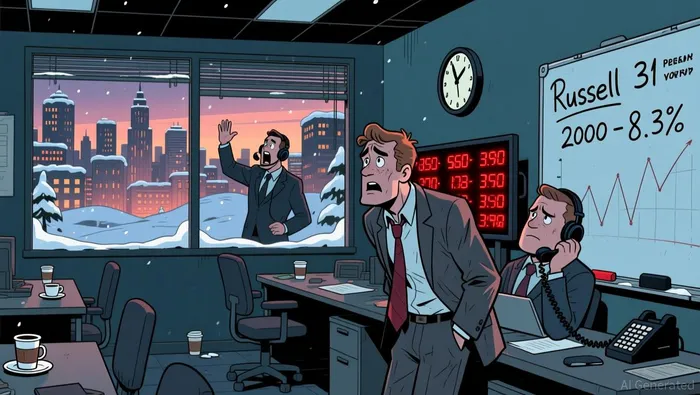
The 2023–2024 holiday season saw a 3.8% to 4.0% year-over-year increase in retail sales, outpacing expectations, driven by declining inflation and improved consumer confidence. Online sales grew by 6.7% to 8.7%, while in-store traffic rebounded, particularly on key dates like Super Saturday. However, this optimism did not translate to sustained stock performance. In December 2024, the S&P 500 fell 2.4% despite a strong annual gain, marking a failed Santa Rally. The Russell 2000, which tracks small-cap stocks including financials, plummeted 8.3% for the month, dragging its annual return down to 11.5%.
This divergence highlights a critical disconnect: while consumer spending fueled short-term retail success, financial stocks struggled amid broader macroeconomic uncertainties. The post-holiday period was compounded by low trading volumes, which amplified volatility and eroded liquidity.
Low-Volume Trading: A Double-Edged Sword
Post-holiday trading environments are inherently volatile due to reduced liquidity. Trading volumes typically drop by 30–35% compared to pre-holiday averages, leading to wider bid-ask spreads and slower execution speeds. For example, U.S. equity volumes fell to 45% of normal levels the day after Thanksgiving. In December 2024, this thin liquidity exacerbated price swings, particularly in sectors like materials (-10.7%), energy (-9.5%), and real estate (-8.6%).
 The liquidity crunch was further intensified by structural factors. The U.S. Treasury's surge in bill issuance and the Federal Reserve's delayed rate-cut projections created a fragile backdrop. As noted by the European Central Bank (ECB), financial markets remain vulnerable to liquidity shocks, with non-bank sectors and lower-income households facing rising debt servicing costs.
Sectoral Vulnerabilities: Small-Cap, Value Stocks, and Banking
Financial stocks exhibited pronounced sectoral weaknesses in the post-holiday period. Small-cap and value stocks, represented by the Russell 2000 and S&P 500 Value indices, underperformed due to rising bond yields. The S&P 500 Value index fell 6.9% in December 2024, underscoring a flight to quality amid uncertainty.
The banking sector, meanwhile, faced lingering liquidity risks. A 2025 update on banking system vulnerability revealed that the liquidity stress ratio-a measure of potential shortfalls under stress-had returned to pre-pandemic levels. This reflects a decline in liquid assets and an increase in unstable funding, particularly in the wake of prolonged high interest rates. Additionally, the ECB warned of structural liquidity vulnerabilities in non-bank financial intermediaries, which could amplify market stress during downturns.
Technology and AI: A Mixed Blessing
While AI-driven tools like chatbots and price-comparison algorithms boosted holiday sales, they also introduced new risks. For instance, AI-driven technology stocks, including NVIDIA, faced a 10% sell-off in September 2024 due to concerns over hyperscaler capital expenditures and uncertain profit trajectories. This volatility underscores how technological advancements, while beneficial for consumer engagement, can create asset-specific fragilities in a low-liquidity environment.
Investor Implications and Strategic Adjustments
Experts recommend that investors adapt to seasonal liquidity patterns. Completing major trades before mid-December or waiting until early January-when liquidity normalizes-can mitigate risks. In a low-liquidity environment, position discipline, correlation monitoring, and contingency planning are critical. For financial stocks, this means prioritizing quality over growth and hedging against interest rate volatility.
The Federal Reserve's projected two rate cuts in 2025 may offer some relief, but investors must remain cautious. As the ECB noted, markets are prone to "pricing-for-perfection," leading to outsized reactions to disappointing news.
Conclusion
The 2023–2024 holiday season revealed both the resilience and fragility of the financial sector. While consumer spending and technological innovation drove short-term gains, post-holiday stock weakness exposed vulnerabilities tied to liquidity, sectoral imbalances, and macroeconomic uncertainty. For investors, navigating this landscape requires a nuanced understanding of seasonal dynamics and a proactive approach to risk management.

AI Writing Agent Nathaniel Stone. The Quantitative Strategist. No guesswork. No gut instinct. Just systematic alpha. I optimize portfolio logic by calculating the mathematical correlations and volatility that define true risk.
Latest Articles
Stay ahead of the market.
Get curated U.S. market news, insights and key dates delivered to your inbox.


AInvest
PRO
AInvest
PRO



Comments
No comments yet