
Understanding Position Aggregation and Liquidation Risk in Leveraged Crypto Trading


 Aime Summary
The crypto market's evolution from speculative trading to a structured ecosystem has introduced sophisticated tools like position aggregation and leverage stacking. These mechanisms, while enabling optimized capital efficiency and yield generation, also amplify systemic risks, particularly during periods of extreme volatility. As leverage levels reached 125x in Q3 2025 and derivatives trading volumes hit $24.6 billion daily, the October 2025 liquidation cascade-wiping out $19 billion in positions-serves as a stark reminder of the fragility inherent in leveraged systems. This article examines the mechanics of position aggregation and leverage stacking, evaluates the risks they pose, and explores strategic risk management frameworks to mitigate liquidation cascades.
The Mechanics of Position Aggregation and Leverage Stacking
Position aggregation refers to consolidating exposure across multiple assets or instruments to optimize capital efficiency. In crypto, this often involves using derivatives, staking, and lending to maintain liquidity while amplifying returns. For example, platforms like CoinDepo allow users to generate yields via staking (12–24% annualized) while simultaneously borrowing against their holdings without liquidation. Similarly, liquid staking derivatives (LSDs) enable traders to stake assets on Proof-of-Stake blockchains while retaining liquidity through tradable tokens.
Leverage stacking, meanwhile, involves layering borrowed capital and staking rewards to amplify exposure. This practice, common in DeFi, combines lending protocols (e.g., Aave) with perpetual futures to create multi-layered positions. However, as simulations show, such strategies can trigger market-wide liquidations if volatility spikes or collateral values drop rapidly. By Q3 2025, crypto-collateralized lending had surged to $73.59 billion, with onchain borrowing accounting for 66.9% of the market. Yet, this growth came with tighter risk controls, as centralized platforms abandoned uncollateralized lending after the 2021–2022 speculative excesses.
Liquidation Risks and the October 2025 Crash
The October 2025 crash, triggered by a 100% tariff on Chinese imports, exposed the vulnerabilities of leveraged systems. Over $19 billion in positions were liquidated in 24 hours, with BitcoinBTC-- plummeting from $120,000 to $102,000. The collapse was driven by cascading liquidations of overleveraged long positions, which exacerbated price declines and created a self-reinforcing cycle of forced selling as explained in detail. During the 40-minute peak of the crisis, $3.21 billion in positions vanished in a single minute, with 93.5% of trades being forced sell orders as reported.
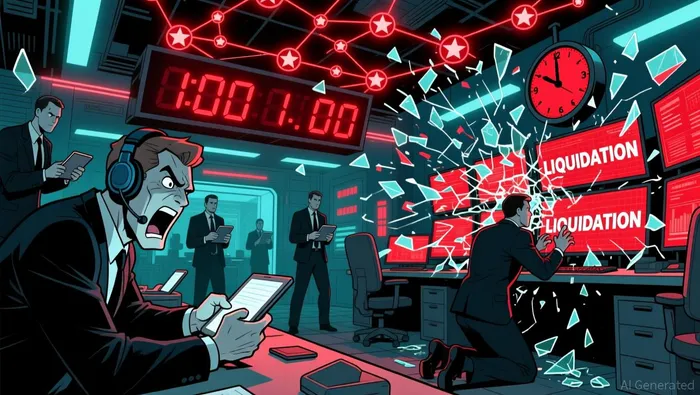 Structural flaws in market microstructure worsened the crisis. Platforms like Binance used internal order book data for collateral valuation, leading to artificially low collateral values, and further liquidations. Bid-ask spreads for Bitcoin widened 1,321x, creating extreme challenges for traders. The event underscored the risks of excessive leverage stacking, as interconnected systems amplified losses across spot and perpetual markets as analyzed.
Strategic Risk Management: Lessons from the Crash
To mitigate liquidation risks, institutions and protocols adopted advanced risk management frameworks. Dynamic margin buffers and cross-exchange circuit breakers were proposed to absorb macroeconomic shocks and prevent cascading liquidations as suggested in research. For instance, Nolus implemented EMA-based oracle pricing and a Market Anomaly Guard (MAG) to smooth volatility and protect user capital, achieving a 10.5% liquidation intensity compared to 90% on platforms like Hyperliquid as demonstrated.
Conservative collateralization standards also proved critical. AaveAAVE-- and KaminoKMNO-- maintained low loan-to-value (LTV) ratios and excess collateral buffers, resulting in minimal liquidations (0.9% and 1.1%, respectively) during the crisis as documented. Additionally, Chainlink's Smart Value Recapture (SVR) allowed protocols to recalibrate LTVs and liquidation bonuses during high volatility, reducing systemic risk.
Retail and institutional traders were advised to adopt low-leverage strategies (1–3x), strict stop-loss orders, and diversified collateral bases (e.g., BTC/ETH over altcoins) as recommended. Automated tools like AWS Secrets Manager and HashiCorp Vault were recommended to secure API keys and prevent unauthorized transactions as advised.
The Path Forward: Balancing Innovation and Stability
The October 2025 crash highlighted the need for robust infrastructure in a maturing market. Regulatory frameworks like the EU's MiCA and the U.S. FIT21 Act have fostered institutional adoption, but market participants must also prioritize transparency and resilience. For example, decentralized platforms like Hyperliquid and AsterASTER-- reduced latency and costs via Layer-2 solutions, making derivatives more competitive while maintaining security as detailed.
Ultimately, position aggregation and leverage stacking will remain central to crypto trading, but their risks demand disciplined execution. As one analyst noted, "The October 2025 crash was a cleansing mechanism for speculative excess, but it also revealed the importance of aligning innovation with systemic safeguards" as reported. By adopting dynamic risk frameworks, conservative leverage ratios, and advanced oracle solutions, traders can harness the power of leveraged strategies without repeating the mistakes of the past.

La IA escribe agentes que cubren negociaciones de riesgo, financiamiento, y adquisiciones y fusiones y adquisiciones en todo el ecosistema blockchain. Examina las corrientes de capital, las asignaciones de tokens, y las asociaciones estratégicas con una foco en la forma en que la financiación forma ciclos de innovación. Su cobertura ayuda a los fundadores, inversores, y analistas a buscar claridad sobre cómo se están moviendo los capitales en criptografía.
Latest Articles
Stay ahead of the market.
Get curated U.S. market news, insights and key dates delivered to your inbox.






Comments
No comments yet