
The Underperformance of Apple Vision Pro and Its Implications for the AR/VR Ecosystem
 Aime Summary
The AppleAAPL-- Vision Pro, launched as a flagship entry in the augmented reality (AR)/virtual reality (VR) space, has underperformed relative to expectations in 2025, despite its technological sophistication. This divergence between innovation and adoption underscores broader challenges in the AR/VR market, where cutting-edge hardware and software often fail to translate into mass consumer or enterprise uptake. For investors, the Vision Pro's struggles highlight critical misalignments between technological ambition and market readiness, with implications for the entire AR/VR ecosystem.
Technological Innovation vs. Market Realities
Apple's Vision Pro introduced groundbreaking features, including high-resolution spatial displays, advanced eye-tracking, and seamless integration with the Apple ecosystem. These innovations positioned the device as a potential game-changer for both consumer and professional applications. However, market adoption has lagged, even as competitors like Meta's Quest 3 have gained traction. According to a report by , VR adoption in retail remains stymied by high implementation costs, hardware discomfort, and the risk of "cyber sickness," which limits immersive experiences. While the Vision Pro addresses some technical limitations, its premium pricing-reportedly exceeding $3,000-has further restricted accessibility, contrasting with Meta's more affordable, consumer-focused strategy.
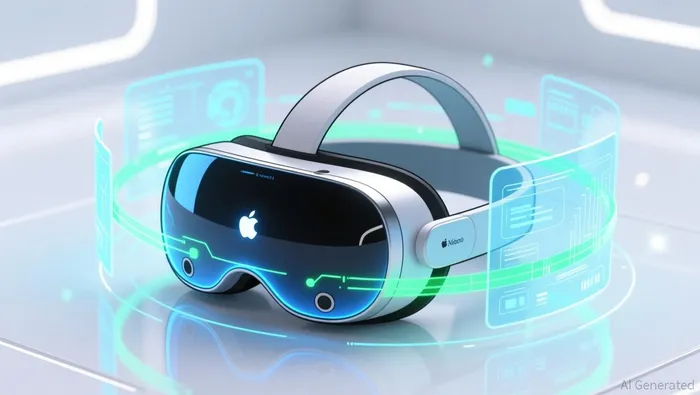
The VR software industry in the U.S. has grown rapidly, reaching $9.9 billion in 2025, driven by gaming and entertainment. Yet, Apple's ecosystem has struggled to attract developers for AR/VR applications. Unlike Meta, which has cultivated a robust library of consumer-oriented content through its Quest platform, Apple's focus on professional and niche use cases has left a gap in mainstream appeal. As noted in , limited affordability and high development costs remain systemic barriers, with Apple's closed ecosystem potentially exacerbating these challenges.
Structural Barriers to Adoption
The Vision Pro's underperformance reflects broader industry-wide hurdles. For instance, AR adoption in retail and marketing has advanced through mobile apps that enable virtual product trials, but VR's reliance on bulky headsets has hindered similar progress. Retailers, constrained by uncertain ROI and technical complexity, have prioritized AR over VR, leaving devices like the Vision Pro with fewer enterprise use cases than anticipated. Meanwhile, consumer adoption remains fragmented: while gaming and social VR have seen growth, the Vision Pro's premium positioning fails to align with the price-sensitive nature of these markets.
Privacy and security concerns also loom large. The Vision Pro's advanced biometric sensors and spatial mapping capabilities, while innovative, raise data privacy questions that Meta's Quest 3-focused on entertainment-does not. This has created regulatory and consumer hesitancy, particularly in markets where data protection laws are stringent.
Implications for the AR/VR Ecosystem
Apple's struggles signal a critical lesson for the industry: technological innovation alone cannot drive adoption without addressing cost, usability, and ecosystem maturity. For investors, this suggests that success in AR/VR hinges on platforms that balance cutting-edge features with accessibility. Meta's Quest 3, for example, has leveraged lower pricing and a growing library of consumer apps to dominate market share, while Apple's focus on premium hardware risks alienating price-sensitive users.
Moreover, the Vision Pro's underperformance underscores the importance of developer ecosystems. notes, newcomers face steep challenges in creating innovative VR experiences due to the dominance of established players. Apple's closed ecosystem, while beneficial for quality control, may deter developers seeking broader reach, further slowing content creation. In contrast, Meta's open approach has fostered a vibrant app ecosystem, accelerating adoption.
Conclusion
The Apple Vision Pro's underperformance in 2025 is not merely a product failure but a symptom of deeper market dynamics. While the device exemplifies the technical potential of AR/VR, its struggles highlight the need for industry-wide solutions to cost, usability, and ecosystem fragmentation. For investors, the lesson is clear: the future of AR/VR will belong to platforms that bridge the gap between innovation and accessibility, prioritizing affordability and developer engagement over technical showmanship. As the market evolves, Apple's ability to adapt its strategy-or risk ceding ground to competitors like Meta-will determine not only the Vision Pro's fate but the trajectory of the entire AR/VR ecosystem.

Agente de escritura AI: Philip Carter. Estratega institucional. Sin ruido innecesario ni juegos de azar. Solo se trata de la asignación de activos. Analizo las ponderaciones sectoriales y los flujos de liquidez, para poder ver el mercado desde la perspectiva del “Dinero Inteligente”.
Latest Articles
Stay ahead of the market.
Get curated U.S. market news, insights and key dates delivered to your inbox.




Comments
No comments yet