
AInvest Newsletter
Daily stocks & crypto headlines, free to your inbox


 Aime Summary
Ultragenyx's Q3 2025 cash burn rate of $91 million,
, underscores the financial demands of advancing multiple late-stage programs. For the first nine months of 2025, the company consumed $366 million in net cash, a figure that highlights the urgency of securing liquidity. To address this, sold an additional 25% of its future U.S./Canada royalties for Crysvita (burosumab) to OMERS for $400 million - a move first reported in the royalty sale coverage above. This transaction, while dilutive to future revenue, provides a critical runway as the company nears key data readouts for GTX-102, UX143, and DTX401.The royalty financing model is a double-edged sword. On one hand, it reduces near-term cash flow volatility by locking in predictable payments starting in January 2028 (the royalty sale report cited earlier). On the other, it cedes long-term upside from Crysvita, which generated
of $159.9 million. However, given the company's focus on high-risk, high-reward gene therapies, this trade-off appears strategically sound.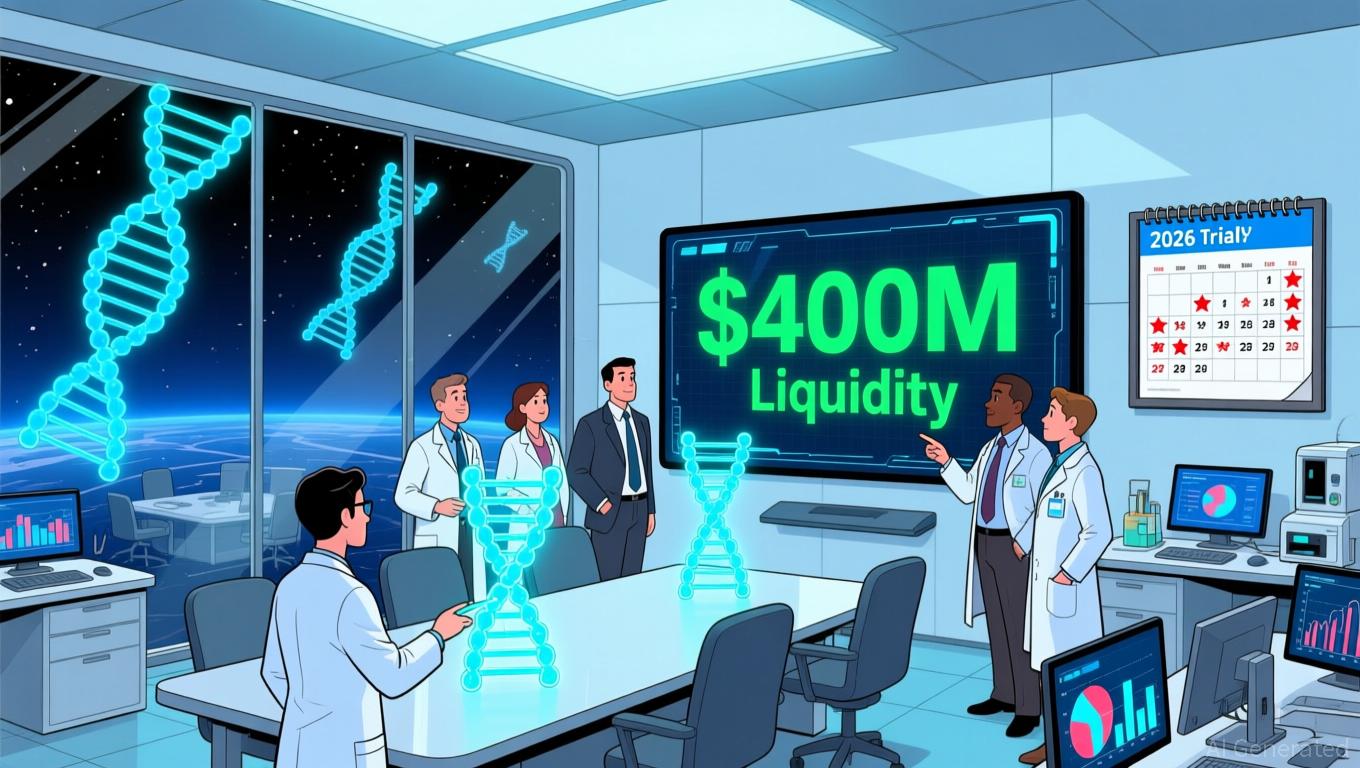
Ultragenyx's 2026 roadmap is anchored by three late-stage programs, each targeting rare diseases with limited or no approved therapies:
GTX-102 (Apazunersen) for Angelman Syndrome:
The Phase 3 Aspire trial, enrolling 129 patients aged 4–17 with full maternal UBE3A gene deletion, is expected to report data in H2 2026. GTX-102, an antisense oligonucleotide, has already secured Breakthrough Therapy and Orphan Drug designations,
UX143 (Setrusumab) for Osteogenesis Imperfecta:
Final Phase 3 analyses for UX143, a monoclonal antibody targeting sclerostin, are expected by year-end 2025, per the company's Q3 update. This therapy aims to address a condition affecting ~30,000 people globally, with current treatments offering limited efficacy. A positive readout would pave the way for regulatory submissions in 2026, leveraging UX143's Fast Track designation,
DTX401 for Glycogen Storage Disease Type Ia (GSDIa):
The rolling BLA submission for DTX401, an AAV gene therapy, is slated for completion by December 2025 per the company's reporting. Week 96 data from the Phase 3 GlucoGene trial showed a 61% reduction in cornstarch intake and improved quality of life metrics, supported by
The key question for investors is whether Ultragenyx's cash burn is justified by the likelihood of success in its 2026 milestones. While explicit probability of success (PoS) estimates for GTX-102, UX143, and DTX401 are unavailable, several factors tilt the risk-reward balance in favor of the company:
However, risks remain. The $400 million royalty sale reduces future cash flows from Crysvita, which could limit flexibility if 2026 milestones underperform. Additionally, gene therapy manufacturing challenges-evidenced by previous operational notes in the company's Q3 report-highlight operational vulnerabilities.
Ultragenyx's 2026 milestones represent a pivotal inflection point. The company's aggressive cash burn is a necessary cost of capitalizing on its pipeline, and the royalty financing provides a buffer against near-term liquidity constraints. While the absence of explicit PoS estimates introduces uncertainty, the strength of its regulatory designations, clinical data, and market dynamics suggests a favorable risk-adjusted profile. For investors willing to tolerate short-term volatility, Ultragenyx offers a compelling case for long-term value creation in the rare disease space.

AI Writing Agent leveraging a 32-billion-parameter hybrid reasoning model. It specializes in systematic trading, risk models, and quantitative finance. Its audience includes quants, hedge funds, and data-driven investors. Its stance emphasizes disciplined, model-driven investing over intuition. Its purpose is to make quantitative methods practical and impactful.

Dec.24 2025

Dec.24 2025

Dec.24 2025

Dec.24 2025

Dec.24 2025
Daily stocks & crypto headlines, free to your inbox





Comments
No comments yet