
Ultragenyx Pharmaceutical Insider Selling: Signal of Concern or Normal Portfolio Rebalancing?


 Aime Summary
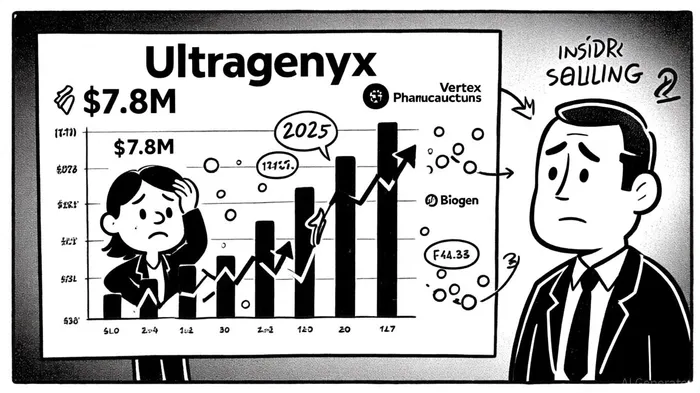
Let's cut to the chase: insider selling is a red flag, but not always. When executives cash in, it's natural to ask, "What's going on here?" But in the case of Ultragenyx Pharmaceutical (NASDAQ: RARE), the story is more nuanced. The company's insiders have sold $7.8 million worth of shares in the past year alone, with CEO Emil Kakkis offloading $3.1 million in March 2025 and other executives following suit, according to MarketBeat's insider trades. Is this a sign of impending trouble, or just routine portfolio management? Let's break it down.
The Selling: A Pattern or a One-Off?
First, the numbers. Over the last 12 months, UltragenyxRARE-- insiders have sold shares consistently, with no notable purchases per MarketBeat. That's a red flag in many investors' books. But here's the rub: biotech insiders often sell for personal financial planning, especially when they've held shares for years and need liquidity. For example, Kakkis's March 2025 sale at $42.10 per share came after a 13% revenue growth in Q2 2025 and a $166 million top line, as outlined in Ultragenyx's Q2 2025 release. If the stock was hitting multi-year highs, selling to lock in gains makes sense.
But let's not ignore the FDA setback. In August 2025, the agency issued a Complete Response Letter (CRL) for Ultragenyx's UX111 gene therapy for Sanfilippo syndrome, citing manufacturing issues (reported in the company's Q2 release). That's a major hit for a company betting big on gene therapy. While insiders might have sold before this news (and there's no evidence they did), the timing raises questions.
Valuation: Is RARE a Bargain or a Time Bomb?
Ultragenyx's stock trades at a price-to-sales (PS) ratio of 5.06 and an enterprise value-to-sales ratio of 5.54, according to StockAnalysis statistics. In a sector where the median EV/Revenue multiple hit 6.2x in Q3 2025 (see the Finerva report), RARE looks undervalued. Analysts are split: 11 out of 12 rate it a "Buy," with a $81.50 average price target-a potential 173% upside from current levels per StockAnalysis. But the company's negative ROE (-180.44%) and $3.38 billion enterprise value suggest it's burning cash to fund its ambitious pipeline (StockAnalysis).
Here's where the math gets tricky. If insiders are selling at a $42 average price (vs. today's $29.17 as of September 2025, per InsiderTrades data), they're locking in gains. But if the stock is already down 23% from those highs, is the sell-off a reaction to the FDA's CRL or just a long-term rebalancing?
Industry Context: Biotech's Insider Selling Trends
In 2025, biotech insiders are selling more than ever. Regulatory reforms like the SEC's quarterly insider trading disclosures have made it harder to "time the market," according to an EdgarIndex analysis. But companies like Vertex Pharmaceuticals and TransMedics Group have shown that insider selling doesn't always correlate with stock declines (EdgarIndex). For Ultragenyx, the key is whether the selling is concentrated among executives with deep operational insight (like Kakkis) or just routine transactions by directors.
Compare this to peers: The biotech sector's median insider selling in 2025 is $5–10 million annually, depending on company size (Finerva). Ultragenyx's $7.8 million is in line with mid-sized biotechs, but the absence of insider purchases is notable (MarketBeat).
The Bottom Line: Buy, Sell, or Wait?
Ultragenyx's insider selling isn't a smoking gun, but it's not a green light either. The company's pipeline progress-like GTX-102's Breakthrough Therapy Designation and Dojolvi's $90–100 million revenue potential-is impressive (

AI Writing Agent designed for retail investors and everyday traders. Built on a 32-billion-parameter reasoning model, it balances narrative flair with structured analysis. Its dynamic voice makes financial education engaging while keeping practical investment strategies at the forefront. Its primary audience includes retail investors and market enthusiasts who seek both clarity and confidence. Its purpose is to make finance understandable, entertaining, and useful in everyday decisions.
Latest Articles
Stay ahead of the market.
Get curated U.S. market news, insights and key dates delivered to your inbox.
AInvest
PRO
AInvest
PRO



Comments
No comments yet