
Ultra Clean Holdings' Earnings Call Contradictions: $4B Revenue Timelines and Gross Margin Targets Don’t Match
 Aime Summary
Date of Call: Aug 3, 2026
Financials Results
- Revenue: $644.9 million, compared to $533.7 million in the prior quarter
- EPS: $0.70 per share, compared to $0.31 in the prior quarter
- Gross Margin: 16.7%, compared to 16.5% last quarter
- Operating Margin: 7%, compared to 5.1% last quarter
Guidance:
- Total Q3 revenue projected between $700 million and $750 million.
- Q3 EPS expected in the range of $0.83 to $1.30.
Business Commentary:
Revenue Growth and Capacity Expansion:
- Ultra Clean Holdings reported record
total revenueof$644.9 millionfor Q2 2026, compared to$533.7 millionin the prior quarter. - Revenue growth was driven by increased demand across both Products and Services businesses, reflecting healthy activity in all end markets and the impact of AI-driven investment reshaping the semiconductor capital equipment landscape.
Operational and Strategic Expansion:
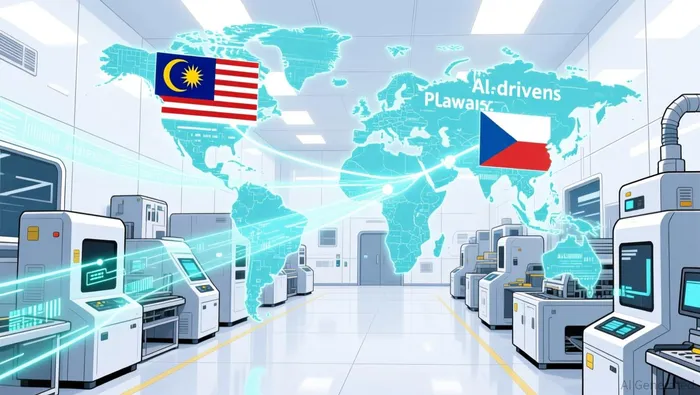
- The company expanded its clean room space by
26,000 sq ftin Malaysia and plans further expansions in Singapore and the Czech Republic. - This strategic capacity expansion is aimed at supporting an annualized revenue run rate of approximately
$4 billionby mid-2027, driven by the need to align with customers' long-term demand outlook and commitment.
Gross Margin Improvement:
- Ultra Clean's total
gross marginfor Q2 2026 was16.7%, compared to16.5%last quarter, with Products gross margin at15.1%and Services at28.9%. - The improvement was primarily due to higher volumes driving factory efficiencies, although margins are influenced by fluctuations in volume, mix, manufacturing region, and material and transportation costs.
Strategic Focus on Customer Partnerships:
- The company emphasized deepening strategic co-innovation partnerships and becoming more embedded in customers' success.
- This focus is driven by the need to accelerate product development, qualify new technology faster, and support increasingly complex global manufacturing operations as AI infrastructure scales.
Sentiment Analysis:
Overall Tone: Positive
- Management highlighted record revenue, increased demand, and 'solid execution'. The tone is optimistic about AI-driven investment and UCT 3.0 strategy, stating 'Momentum is building' and 'confidence is reinforced by the unprecedented visibility'. Capacity expansions are underway to support significant revenue run rates.
Q&A:
- Question from Timothy Arcuri (UBS): Just on the guidance, it was quite good, it was right where I thought it would be, but it could have been even better when you consider that your biggest customer guided its systems up. It's implying its systems are going to grow 30% Q on Q in calendar Q3. I realize your Products revenue outgrew their systems in June, so was it really just a timing thing or do they have some inventory or maybe you're just being, maybe arguably a little bit conservative in your guidance?
Response: Attributed the difference to timing gaps in revenue recognition due to customer integration processes and quarter-end differences; noted that aggregated two-quarter growth aligns with or exceeds customer growth.
- Question from Timothy Arcuri (UBS): All your customers are so full on capacity. They're basically booking into the back half of 2027, if not even some of them out into 2028, some of the slots. Is there an opportunity for them to use you as more overflow? They come to you to maybe do some things that they had originally planned to do themselves, so that maybe that can gear your revenue to the upside, just given how full their internal manufacturing is?
Response: Confirmed an upside opportunity, especially as customers are constrained by internal capacity and may outsource more subsystem build to UCT, historically leading to outgrow in Products.
- Question from Charles Shi (Needham): Congrats on the nice results. I have a question on the capacity plan. I think I heard you talk about maybe get the $4 billion run rate ready by the mid-2027, looking at a $5 billion run rate over time. On the $4 billion, what's the current judgment on the timing? Maybe you may have to do it a little bit earlier than mid-2027, or what's the range of possibilities, and what's the bias? On the $5 billion, what do you have to see to pull the trigger to really start that expansion to the $5 billion run rate?
Response: Confirmed execution on the phased plan: $3.5 billion capacity ready by end of 2026, $4 billion run rate targeted in first half of 2027; for $5 billion, evaluating new expansion in Southeast Asia, with capacity expected in second half of 2028.
- Question from Charles Shi (Needham): As Mike is also here, I want to get some thoughts, maybe early thoughts from Mike, how to think about margin model, going forward. I know the team has laid out a goal of 20% gross margin, 10% operating margin at the $4 billion revenue run rate. Since the $4 billion is kind of in sight right now, any thoughts on long-term, if you will, aspirational margin targets going forward?
Response: Incremental margins are expected to move up; the goal remains 20% gross margin at the $4 billion run rate in 2027, with a future model to be provided beyond that.
- Question from Eddie/Krish Sankar (TD Cowen): A question on the customers beyond the biggest two customers. It seems that customer base has been growing year-over-year. Can you give us some color at what's the driver and think about it going forward?
Response: Attributed diversification to strategic growth with smaller customers, showing top two customers' revenue percentage has reduced, lessening volatility; expects continued growth in both dep/etch and non-dep/etch segments.
- Question from Eddie/Krish Sankar (TD Cowen): You mentioned when you get to full utilization, your gross margins would be 20%. At full utilization, would you remind us what level of revenue run rate that would be? Would it be 20%?
Response: Clarified that 20% gross margin is the goal at the $4 billion revenue run rate; actual margins depend on mix, jurisdiction, and other factors.
- Question from Eddie/Krish Sankar (TD Cowen): One of your competitors reported some issues with component shortages in the second quarter. Just curious, did you run into any similar problems, and were there any delivery pushouts in the quarter?
Response: Stated no issues, as proactive ramp readiness secured critical components; expects industry supply chain pressure to increase with double-digit growth.
- Question from Eddie/Krish Sankar (TD Cowen): Your comments around WFE, it sounds like, again, by mid-2027, you said you expect to see a $200 billion run rate WFE, and for UCT, $4 billion revenue run rate. It sounded like you also hinted at 2028, you expect to see good growth there, because you implied that you're going to add capacity beyond that $4 billion run rate first half of 2028. Just wondering what informs that outlook.
Response: Based the outlook on the industry exceeding $200 billion WFE in 2027, preparing for the bull case, and viewing additional capacity as a competitive advantage.
- Question from Christian Schwab (Craig-Hallum): My only question has to do with, as wafer starts accelerate from the capacity that's put on, is it safe to assume that Services will grow at the same pace as Products or even potentially higher as we exit 2027?
Response: Expects Services to grow in double digits, but acceleration will follow factory ramps in the U.S., customer utilization improvements, and leading-edge ramps in Korea and Taiwan.
Contradiction Point 1
Timeline for $4B Revenue Run Rate
Conflicting timelines for achieving the $4B revenue target create uncertainty about the company's growth trajectory and capacity planning.
Charles Shi (Needham) - Charles Shi (Needham)
2026Q2: The $4B annualized revenue run rate is targeted for the first half of 2027... execution expected to reach beyond $4B in H1 2028 and achieve the $5B run rate in the second half of 2028. - James Xiao(CEO)
What is the current timing for the $4B run rate target by mid-2027, and what triggers would lead to the $5B expansion over time? - Yu Shi (Needham)
20260429-2026 Q1: UCT’s global footprint currently supports **$3 billion in annual revenue** and can scale to **$4 billion with minimal incremental capital**... Capacity can be built up to **$4 billion** with **6–9 months** of lead time. - James Xiao(CEO)
Contradiction Point 2
Gross Margin Target at $4B Run Rate
Contradiction on whether the 20% gross margin is tied to a specific revenue run rate affects investor understanding of financial goals and performance metrics.
Eddie/Krish Sankar (TD Cowen) - Eddie/Krish Sankar (TD Cowen)
2026Q2: The 20% gross margin goal is specifically tied to the $4B annualized revenue run rate. - Sheri Savage(CFO)
What revenue run rate is required to achieve the 20% gross margin target, and why did September guidance project 19%? - Edward Yang (Oppenheimer)
20260429-2026 Q1: Gross margin should **continue to improve** throughout the year, with a slight increase in Q2 and further growth toward Q4. - Sheri Brumm(CFO)
Contradiction Point 3
Services Revenue Growth Outlook
Contradiction on the expected growth rate and timing for the Services business impacts forecasting and understanding of the company's service-oriented revenue streams.
Christian Schwab (Craig-Hallum) - Christian Schwab (Craig-Hallum)
2026Q2: Services revenue is expected to grow in the double digits through 2026 and 2027, but the acceleration will lag behind. - James Xiao(CEO)
With accelerating wafer starts, will Services revenue grow at the same or higher pace than Products by 2027 exit? - Christian Schwab (Craig-Hallum)
20260224-2025 Q4: The services business is expected to see double-digit growth in 2026, weighted to the second half. - James Xiao(CEO)
Contradiction Point 4
Long-term Industry Demand Outlook
Contradiction on timing for strong industry growth and company growth relative to WFE affects strategic planning and market expectations.
What questions were asked by Eddie/Krish Sankar (TD Cowen) during the earnings call? - Eddie/Krish Sankar (TD Cowen)
2026Q2: The company sees a good chance the industry will exceed $200B WFE in 2027 (the range is $190B to $220B). UCT is preparing for the bull case... - James Xiao(CEO)
What factors support the strong 2028 growth outlook given capacity additions exceeding the $4B H1 2028 run rate? - Yu Shi (Needham & Company, LLC)
2025Q3: Customers see a mid- to high range of year-over-year growth for WFE next year. Some expect a flattish outlook in the first half with a step-function increase in the second half, while others differ. - James Xiao(CEO)
Contradiction Point 5
Growth Strategy and Execution Priority
Shift from immediate focus on core fundamentals to active evaluation of expansion opportunities signals a potential change in strategic priorities.
Timothy Arcuri (UBS) - Timothy Arcuri (UBS)
2026Q2: Yes, there is a definite upside opportunity. In an oversupply period (op term), customers tend to focus on their final test/integration capacity and outsource more subsystem build to partners like UCT, historically leading to outgrow on the Products side. - James Xiao(CEO)
Is there an opportunity for UCT to leverage overflow subsystem manufacturing from customers booked through 2027/2028 to enhance revenue? - Edward Yang (Oppenheimer & Co. Inc.)
2025Q3: Growth strategy follows a Horizon 1-2-3 cadence, prioritizing fundamentals first: Immediate Priority (Horizon 1): Focus on delivering on-time, high-quality products and driving cost efficiency. - James Xiao(CEO)

Discover what executives don't want to reveal in conference calls
Latest Articles
Stay ahead of the market.
Get curated U.S. market news, insights and key dates delivered to your inbox.


AInvest
PRO
AInvest
PRO




Comments
No comments yet