
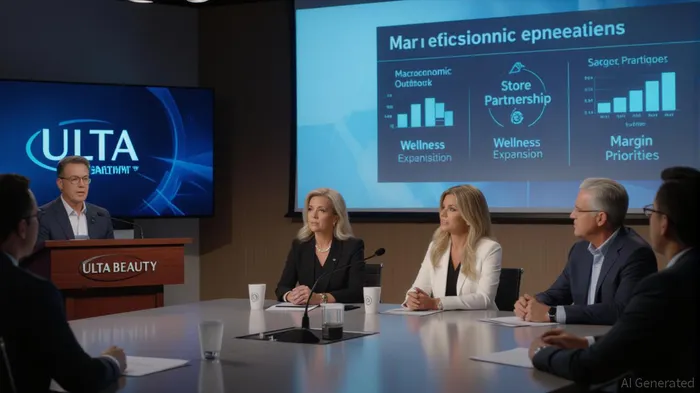
Ulta Beauty's Q2 2026 Earnings Call: Contradictions Emerge on Macroeconomic Outlook, Store Strategy, Target Partnership, Wellness Expansion, and Margin Priorities
 Aime Summary
The above is the analysis of the conflicting points in this earnings call
Date of Call: August 28, 2025
Financials Results
- Revenue: $2.8B, up 9.3% YOY (vs $2.6B last year)
- EPS: $5.78 per diluted share, up 9.1% YOY (includes ~$0.03 tax benefit)
- Gross Margin: 39.2%, up 90 bps YOY (vs 38.3% prior year)
- Operating Margin: 12.4%, down 50 bps YOY (vs 12.9% prior year)
Guidance:
- FY25 net sales expected at $12.0–$12.1B.
- FY25 comp sales growth 2.5%–3.5%; H2 comps flat to low single digits.
- FY25 operating margin 11.9%–12.0%; H2 operating margin 10.7%–10.9%.
- Operating profit to decline high-single-digit % YOY.
- FY25 diluted EPS $23.85–$24.30; tax rate ~24%.
- Gross margin to deleverage YOY on occupancy/supply chain, partly offset by lower shrink.
- SG&A to rise 13%–14%, with back-half spend elevated.
- H2 sales outlook raised; management remains cautious on consumer demand.
- Plan 50–56 new store openings per year over the next 2–3 years.
Business Commentary:
- Strong Financial Performance:
- Ulta Beauty reported
net salesof$2,800,000,000for the second quarter, up9.3%year-over-year, with operating profit at12.4%of sales. The growth was driven by
comp sales growthof6.7%, positive performance in all major categories, and a focus on operational excellence and brand building.Brand Engagement and Digital Initiatives:
- The company experienced
brand engagementgrowth,earned media valueincrease, and strongecommerceperformance, with half of orders fulfilled by stores. These improvements were attributed to enhanced real-time delivery content, personalized recommendations, and purposeful marketing strategies, such as the reimagined summer event and new exclusive brand activations.
International Expansion and Strategic Acquisitions:
- Ulta Beauty entered the UK market through the acquisition of Space NK, and new stores were opened in Mexico and plans for the Middle East are underway.
The strategy is part of UltaULTA-- Beauty's international expansion to capitalize on key growth opportunities in the global beauty market.
Wellness and New Brand Launches:
- The wellness category benefited from new brand launches and expanded store footprints, with a focus on self-care and supplements.
- This focus is aimed at leveraging Ulta Beauty's brand credibility and scale to enhance its position as a wellness destination, with plans to expand the category to become a billion-dollar business over time.
Sentiment Analysis:
- Stronger-than-planned quarter: net sales +9.3% to $2.8B, comps +6.7%, share gains, and loyalty members up 4% to 45.8M. Gross margin expanded 90 bps driven by lower shrink and promotional effectiveness. Management raised FY25 guidance for sales and EPS, citing momentum across channels and categories, while remaining cautious on H2 consumer trends.
Q&A:
- Question from Dana Telsey (Telsey Advisory Group): How sustainable is the 6.7% comp strength, and what is the path for operating margin given shrink improvement?
Response: Momentum should continue but H2 comps are guided to low-single digits; margins face H2 deleverage from inflation, moderating shrink benefit, timing of go-to-market investments, and higher incentive comp.
- Question from Michael Binetti (Evercore): Help us with back-half comp assumptions and margin leverage relative to the 12% longer-term margin goal.
Response: H2 comp outlook modestly raised but remains cautious; long-term targets unchanged; SG&A elevated by Space NK transaction costs and higher incentives—no new leverage breakpoint provided.
- Question from Adrienne Yih (Barclays): Describe the promotional backdrop and the wellness strategy and opportunity.
Response: Promotions were more disciplined with fewer/optimized offers; environment expected to remain rational. Wellness expanded to ~370 stores (+50 enhanced), ~150 brands/700 SKUs; viewed as a long-term ~$1B opportunity.
- Question from Simeon Gutman (Morgan Stanley): Philosophically, prioritize margin expansion or reinvest to sustain top-line momentum?
Response: Management prioritizes operating profit dollars and ROI, pacing investments to drive sustainable growth in a highly competitive category.
- Question from Steven Forbes (Guggenheim Securities): How are stores recovering from last year’s competitive cannibalization and what ensures recapture sticks?
Response: Competitive openings have slowed and impacted stores are recovering; loyalty/personalization will drive recapture, with less pressure than 2024 and potential to win back Target guests post-2026.
- Question from Olivia Tong (Raymond James): Contrast mass vs. prestige performance and update on newness pipeline.
Response: Both mass and prestige makeup grew; balanced newness across categories is driving traffic; cycling last year’s Ulta BeautyULTA-- collection exit aided mass; pipeline remains robust into next year.
- Question from Susan Anderson (Canaccord Genuity): Rationale for acquiring Space NK versus building Ulta stores abroad; any productivity differences?
Response: Space NK offers capital-light UK entry via a prestige, smaller high-street format; will operate standalone, preserving its model while sharing learnings; US remains priority with multiple international pathways.
- Question from Chris Horvers (JPMorgan): What’s driving share gains—less competitive encroachment or Ulta’s self-help and newness?
Response: Gains mainly reflect self-help: better execution, broad newness, and stronger cultural marketing; conversion and NPS up, lifting both mass and prestige.
- Question from Kate McShane (Goldman Sachs): What does the Target partnership conclusion mean for standalone real estate strategy?
Response: Store growth recalibrated to 50–56 openings annually over 2–3 years due to cost/availability dynamics, not the Target exit; focus remains on high-quality locations and member acquisition halo.
- Question from Oliver Chen (TD Cowen): How will the curated marketplace work with loyalty, and thoughts on affiliates/TikTok/Amazon?
Response: Invitation-only, curated marketplace; loyalty points accrue; returns via Happy Returns; expands assortment with margin accretion; Ulta will participate where the guest shops, including social platforms.
- Question from Mark Altschwager (Baird): Can initiatives offset the loss of high-flow-through Target royalty revenue after 2026?
Response: Target royalties have ~60%–65% flow-through; Ulta Unleashed initiatives are expected to replace lost royalties; long-term financial targets remain unchanged.

Descubre lo que los ejecutivos no quieren revelar en las llamadas telefónicas
Latest Articles
Stay ahead of the market.
Get curated U.S. market news, insights and key dates delivered to your inbox.
AInvest
PRO
AInvest
PRO



Comments
No comments yet