
Ukraine's Wartime Economic Resilience: A Goldmine for Investors in Eastern Europe's Defense and Infrastructure Sectors
 Aime Summary
When war erupts, economies often crumble. But in Ukraine's case, the story is different. Amid the chaos of Russia's invasion, Kyiv has transformed its wartime challenges into a blueprint for economic resilience—and for investors, this is a golden opportunity. Strategic governance reforms, a flood of international aid, and a regional arms race are reshaping Eastern Europe's defense and infrastructure landscapes. Let's break down how this volatility is creating high-conviction investment plays.
Ukraine's Governance Reforms: A Foundation for Resilience
Ukraine's government has rolled out a series of reforms that are nothing short of revolutionary. From streamlining tax collection to establishing anti-corruption bodies, these moves are stabilizing the economy and attracting capital. The International Monetary Fund (IMF) has backed this effort with a $15.6 billion Extended Fund Facility (EFF) program, ensuring macroeconomic stability while the country rebuilds. But the real magic lies in how these reforms are unlocking new investment avenues.
Take defense spending. Ukraine's National Recovery Plan (2022–2032) isn't just about survival—it's a roadmap for modernization. The government is prioritizing energy infrastructure, digital systems, and green energy projects. For example, the Ukraine Development Fund (UDF), modeled after BlackRock's expertise, is positioning the country to attract both public and private capital. This isn't just about patching holes in the power grid; it's about building a 21st-century economy from the ground up.
International Aid: Fueling a Regional Arms Race
The war has turned Eastern Europe into a hotbed of defense spending. NATO's 5% GDP target by 2035 (up from 2% in 2014) has sent shockwaves through the region. Poland, for instance, has already boosted its defense budget by 46% year-over-year, while Sweden and Finland have followed suit. This isn't just about buying tanks—it's about building entire ecosystems of defense infrastructure.
The European Union's Readiness 2030 package is a game-changer here. With a €150 billion loan instrument (SAFE) and a 1.5% GDP escape clause for defense spending, EU members are incentivized to invest in critical infrastructure. The focus isn't just on tanks and missiles but on cyber resilience, energy security, and supply chain diversification. For investors, this means opportunities in sectors like renewable energy, cybersecurity, and advanced manufacturing.
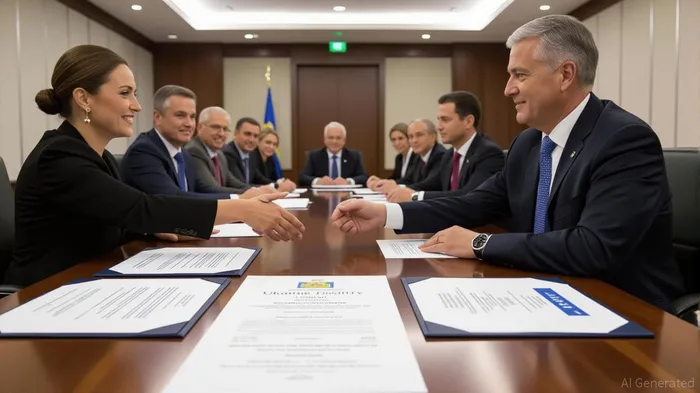
Infrastructure Projects: The New Gold Standard
Ukraine's reconstruction efforts are no longer hypothetical. The EU's Ukraine FIRST program, backed by the EBRD, EIB, and European Commission, has already allocated €30 million to accelerate infrastructure rebuilding. From energy grids to housing, these projects are designed to be shovel-ready. The Ukraine Investment Framework, with its €2.3 billion in loan guarantees and grants, is mobilizing up to €10 billion in private capital.
Here's where investors should lean in:
- Energy Infrastructure: Ukraine's push for a green transition is funding solar and wind projects. The European Flagship Fund for Reconstruction is targeting €265 million for renewable energy.
- Defense Tech: The EU's ASAP initiative is ramping up ammunition production in Europe, with a 40% capacity increase. This creates a ripple effect for suppliers of raw materials and logistics.
- Urban Renewal: With €520 million earmarked for municipal infrastructure, cities like Kyiv and Kharkiv are becoming hubs for construction and smart-city tech.
The Risks and the Rewards
No investment is without risk. Ukraine's economy is still fragile, and the war's duration remains uncertain. However, the sheer scale of international aid and the region's strategic importance make this a high-reward play. For starters, the $115 billion international aid package (2023–2027) includes $5.7 billion from the EU's Ukraine Investment Framework, which is expected to leverage over €18 billion in total.
Moreover, the geopolitical stakes are too high for this momentum to stall. NATO's 5% target isn't just a number—it's a political commitment. Eastern European nations can't afford to fall behind in this race. This creates a “buy-the-dip” scenario for investors, especially in defense contractors and infrastructure developers.
Where to Put Your Money
- Defense Contractors: Companies supplying armored vehicles, radar systems, or cybersecurity solutions to Ukraine or its allies (e.g., Leonardo, Lockheed Martin) are prime targets.
- Green Energy Plays: Firms with expertise in solar, wind, or grid modernization (e.g., Siemens Energy, NextEra Energy) stand to benefit from Ukraine's $265 million green transition fund.
- Regional Banks: Financial institutionsFISI-- with exposure to Eastern Europe (e.g., ING, BNP Paribas) are well-positioned to capitalize on the surge in infrastructure loans.
The Bottom Line
Ukraine's wartime resilience isn't just a story of survival—it's a masterclass in economic reinvention. By combining governance reforms with a torrent of international aid, Kyiv is creating a fertile ground for investors. Eastern Europe, once a backwater of global markets, is now a frontline of innovation and capital flows. For those willing to take the plunge, the rewards are as vast as the country's ambitions.
So, what are you waiting for? The next big thing in global investing is unfolding in real time—and it's happening in the heart of Europe.

Stay ahead of the market.
Get curated U.S. market news, insights and key dates delivered to your inbox.
AInvest
PRO
AInvest
PRO



Comments
No comments yet