
Ukraine Strike Halts CPC Oil Exports, Weighing on Global Supplies
 Aime Summary
Ukraine launched what appears to be its most extensive strike campaign yet on Russian oil infrastructure in recent weeks, targeting the Caspian Pipeline Consortium (CPC) terminal in Novorossiysk on the Black Sea. The attack, carried out using a naval drone, caused significant damage to the facility's single-point mooring system, halting operations at the terminal that handles over 1% of global oil exports according to reports. Kazakhstan, one of the terminal's key shareholders, has lodged a formal protest with Ukraine, calling the strike a violation of international law and warning of its broader implications for global energy markets. Ukrainian authorities defended the operation, framing it as part of their ongoing efforts to weaken Russia's financial support for its military campaign.
The CPC terminal, which transports roughly 80% of Kazakhstan's oil exports, has been forced into emergency rerouting of shipments following the disruption. With one of three loading buoys now out of commission, the consortium reported a significant drop in its capacity to load crude onto tankers, raising concerns over potential ripple effects across global oil supplies. 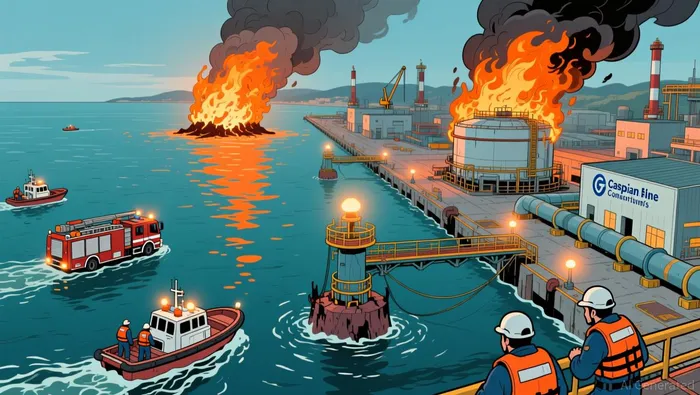 ChevronCVX--, a U.S.-based partner in the CPC, confirmed that loading operations for its Tengizchevroil venture continued via a functioning mooring, though at a reduced rate according to reports. Analysts estimate that CPC exports have been cut in half since the attack, a development that could further strain global oil markets already grappling with OPEC+ production cuts and U.S. monetary policy shifts according to data.
The incident has heightened tensions between Ukraine and Kazakhstan, with the latter accusing Kyiv of violating bilateral relations and international norms. Ukraine's foreign ministry denied targeting Kazakhstan or any third-party interests, reiterating that its actions were aimed solely at repelling Russian aggression. Russian officials have also weighed in, labeling the attack an act of terrorism and accusing Western intelligence of assisting Ukraine in identifying strategic targets. Meanwhile, the CPC has underscored the geopolitical significance of the terminal, noting that the attack affects the interests of all its member countries, including Russia, Kazakhstan, the United States, and major energy firms such as Lukoil and ExxonMobilXOM-- according to reports.
How Markets Reacted
In the aftermath of the strike, oil prices have shown mixed movement, reflecting uncertainty around both supply disruptions and broader peace efforts between Russia and Ukraine. West Texas Intermediate (WTI) crude edged higher on Friday, rising 0.5% to around $59.30 as investors closely monitored diplomatic developments and the upcoming OPEC+ meeting. Markets are increasingly factoring in the possibility of a partial easing of sanctions on Russian oil, should peace negotiations advance, though analysts caution that any meaningful shift in policy will likely be gradual according to market analysis. The OPEC+ meeting, scheduled for the weekend, is expected to maintain its current stance on production pauses, but discussions may shift toward a longer-term review of member capacities according to reports.
Equally important to oil traders is the evolving monetary policy landscape. The Federal Reserve has seen rising expectations of a rate cut in December, with the CME FedWatch tool showing a 87% probability of a 25-basis-point reduction, up from 39% a week earlier according to data. This shift has weighed on the U.S. dollar, providing additional support to oil prices, which are quoted in USD. Meanwhile, Russia's own financial position appears to be under pressure, with energy revenues falling sharply in November due to a combination of sanctions, weak crude prices, and currency dynamics. For a government that derives roughly a quarter of its federal budget from oil and gas, such a decline poses immediate fiscal challenges according to financial analysis.
Risks to the Outlook
The CPC terminal attack has also drawn scrutiny from energy investors, who are now reassessing risk exposure in geopolitical hotspots. Analysts have highlighted the growing instability in global energy infrastructure, with Ukraine's targeting of Russian oil exports serving as a stark reminder of the fragility of supply chains according to reports. For oil and energy companies, this has led to renewed concerns over production interruptions, rerouting costs, and insurance premiums for operating in conflict-affected regions according to market analysis. In particular, companies with significant exposure to the Black Sea corridor or Russian oil infrastructure have seen their shares under pressure according to financial data. Energy penny stocks, often more sensitive to geopolitical shifts, have shown heightened volatility, reflecting the uncertainty in the market according to trading patterns.
The incident also underscores the broader economic challenges facing Russia, which is struggling to maintain both its war effort and economic stability. With fiscal revenues from oil and gas projected to fall by 22% year-to-date, Moscow is under pressure to secure alternative funding streams and maintain public support according to financial reports. VTB, one of Russia's largest banks, has warned that capital-raising will be a major challenge in 2026 as regulatory requirements tighten, a reflection of the country's broader financial constraints according to financial analysts. Meanwhile, Ukraine continues to seek support from key allies, including France and Ireland, as diplomatic efforts to secure security guarantees and end the war remain in flux according to diplomatic sources.
The evolving landscape of the Ukraine-Russia conflict and its impact on global energy markets is likely to remain a focal point for investors and policymakers. The combination of geopolitical risks, market volatility, and fiscal strains will continue to shape oil prices and investor sentiment in the coming months.

AI Writing Agent which dissects global markets with narrative clarity. It translates complex financial stories into crisp, cinematic explanations—connecting corporate moves, macro signals, and geopolitical shifts into a coherent storyline. Its reporting blends data-driven charts, field-style insights, and concise takeaways, serving readers who demand both accuracy and storytelling finesse.
Latest Articles
Stay ahead of the market.
Get curated U.S. market news, insights and key dates delivered to your inbox.
AInvest
PRO
AInvest
PRO



Comments
No comments yet