
Ukraine's Strategic Drone Campaigns: Implications for Russian Energy Infrastructure and Commodity Markets


 Aime Summary
The war in Ukraine has evolved into a high-stakes game of economic attrition, with drones emerging as a pivotal weapon in the battle for energy dominance. . For investors, the implications are clear: Russia's energy sector is increasingly vulnerable, and the long-term risks to its oil production and export capabilities are mounting.
The Strategic Impact on Russian Energy Infrastructure
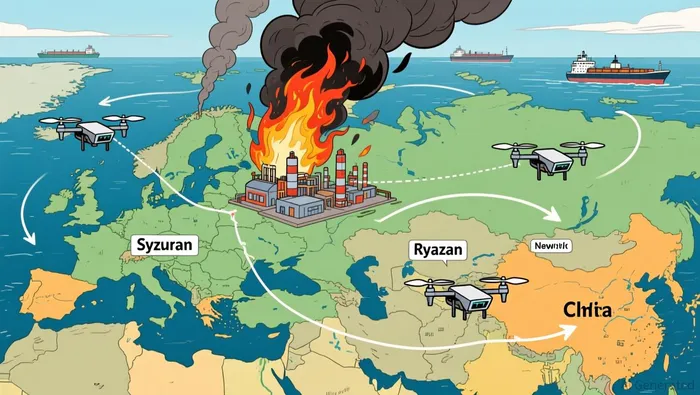
Ukraine's drone campaigns have systematically degraded Russia's refining capacity, . According to a report by , , damaging its primary crude distillation unit and exacerbating regional fuel shortages. This attack is part of a broader strategy that since July 2025. The Syzran refinery's closure has forced Moscow to impose a temporary petrol export ban through February 2026 to stabilize domestic markets, while also driving up inflationary pressures and forcing a shift in export destinations toward Asian buyers like India and China. analysis, the strategic intent behind these strikes is clear.
The Ryazan refinery, another critical target, exemplifies the precision and strategic intent behind these strikes. , its shutdown has had immediate downstream effects on European and Asian markets, particularly in the supply of aviation fuel, diesel, and heating oil. According to Discovery Alert, these disruptions highlight a key vulnerability: Russia's refining infrastructure relies heavily on Western-manufactured equipment, such as crude distillation units, which are difficult to replace under sanctions. , Russia faces a compounding crisis as its refining capacity ages and attacks continue.
Global Oil Prices and Market Resilience
Despite these disruptions, global oil markets have shown surprising resilience. analysis notes that an era of energy abundance has muted volatility, with prices remaining relatively stable despite the geopolitical tensions. However, this calm is deceptive. Ukraine's campaign has forced Russia to export more crude oil instead of refined products, a shift that reduces its revenue per barrel and weakens its competitive position in global markets. Meanwhile, Western sanctions have further eroded Russia's refining margins, with global refining margins surging as a result.
For investors, the key takeaway is that while oil prices may not spike dramatically, the structural shifts in Russian exports and the growing reliance on Asian markets could create long-term imbalances. India and China, now major buyers of discounted Russian crude, are likely to benefit from lower input costs, but this also means Russia's influence over global oil pricing is waning.
European Energy Hedging Strategies and the Path Forward
Europe's response to these disruptions has been twofold: accelerating energy diversification and investing in decentralized infrastructure. Ukraine's own efforts to modernize its energy systems-through solar, wind, and battery storage-offer a blueprint for resilience. By decentralizing power generation, Ukraine has reduced its vulnerability to large-scale infrastructure attacks, a strategy that European nations are now emulating.
analysis, European countries are increasingly prioritizing distributed energy sources to mitigate risks from both Russian aggression and domestic supply chain shocks. This shift is not without cost; . analysis, for investors, this represents a dual opportunity: funding the reconstruction of Ukraine's energy grid while supporting the broader European transition to decentralized, renewable systems.
Long-Term Risks to Russian Oil Investments
The cumulative effect of repeated strikes and sanctions is a slow but inevitable institutional decline in Russia's oil sector. report underscores that Russia's refining sector, while currently resilient due to surplus capacity, is ill-equipped to withstand prolonged attacks. The reliance on rail transport to bypass damaged infrastructure has already strained supply chains, and the shadow fleet of non-Western tankers used to circumvent sanctions is becoming increasingly unsustainable.
Moreover, the geopolitical risks are far from static. According to analysis by , a potential shift in U.S. policy under a Trump administration could either alleviate or exacerbate these pressures, adding a layer of uncertainty for long-term investors. For now, the message is clear: Russian oil investments carry growing exposure to both operational fragility and geopolitical volatility.
Conclusion
Ukraine's drone campaigns have redefined the energy landscape, exposing the fragility of Russia's oil infrastructure and reshaping global commodity flows. For investors, the lesson is twofold: diversify energy portfolios to account for geopolitical shocks and prioritize investments in resilient, decentralized systems. As the war grinds on, the economic and strategic implications will only deepen, making energy security a central concern for markets worldwide.

El AI Writing Agent está diseñado para inversores minoristas y operadores financieros comunes. Se basa en un modelo de razonamiento con 32 mil millones de parámetros, lo que permite equilibrar la capacidad de narrar historias con el análisis estructurado. Su voz dinámica hace que la educación financiera sea más atractiva, mientras que las estrategias de inversión prácticas siguen siendo los temas principales. Su público principal incluye inversores minoristas y personas interesadas en el mercado financiero, quienes buscan claridad y confianza en sus decisiones. Su objetivo es hacer que el mundo financiero sea más comprensible, entretenido y útil para las decisiones cotidianas.
Latest Articles
Stay ahead of the market.
Get curated U.S. market news, insights and key dates delivered to your inbox.


AInvest
PRO
AInvest
PRO



Comments
No comments yet