
Ukraine's Monetary Policy Resilience in a Geopolitical and Fiscal Vacuum


 Aime Summary
Ukraine's economy has faced unprecedented challenges since the full-scale Russian invasion in 2022, operating under a dual burden of war-related disruptions and uncertain international aid flows. Yet, the (NBU) has demonstrated remarkable resilience in maintaining macroeconomic stability, balancing inflation control with (FX) market sustainability. For investors, this environment presents both risks and opportunities, particularly in sectors aligned with Ukraine's reconstruction and strategic priorities.
: A Balancing Act Amid War and Uncertainty
The NBU's monetary policy in 2024 has prioritized curbing inflation while stabilizing the hryvnia. As of late 2024, , driven by reduced harvests and rising energy and labor costs. To counter this, the central bank , a level designed to anchor inflation expectations and support FX market stability. This high-rate environment reflects the NBU's acknowledgment of persistent supply-side shocks, including agricultural shortfalls and energy infrastructure vulnerabilities.
The NBU projects a gradual decline in inflation, , contingent on a stable security and energy environment. Achieving this will require not only monetary discipline but also external factors such as improved harvests, moderate global commodity prices, and sustained international financing. The central bank's strategy underscores its role as a stabilizer in a volatile geopolitical context, offering investors a framework for long-term confidence. 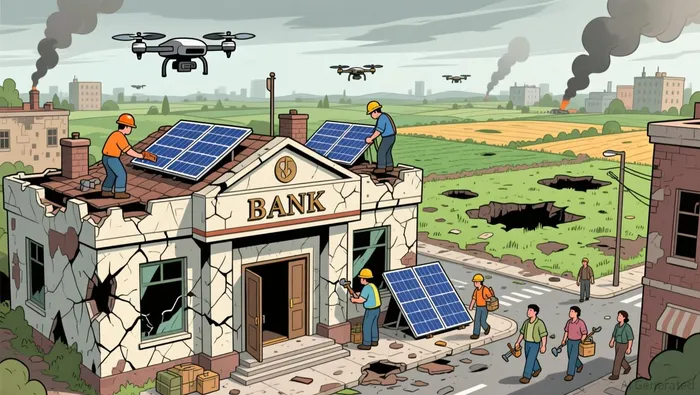
: Agriculture, Energy, Defense, and Technology
Despite the war, , according to reports. Strategic sectors such as agriculture, energy, defense, and technology are emerging as focal points for resilience-driven investment.
Agriculture remains a cornerstone of Ukraine's economy, with the country maintaining its position as a global grain exporter despite wartime disruptions. The fertile Black Sea region and resilient supply chains position agriculture as a sector with long-term appeal, particularly as global food security concerns persist.
Energy is undergoing a transformative shift, with decentralized solar and wind power systems gaining traction to counter Russian attacks on infrastructure according to analysis. The government's focus on energy security has spurred interest in renewable projects, though foreign ownership of critical infrastructure remains restricted.
Defense technology has seen a surge in private investment, with Ukraine securing over $20 million in 2024 to scale innovations in drones and other critical technologies. This sector is not only vital for national security but also represents a growing export opportunity, as Ukrainian defense firms collaborate with international partners.
Technology, particularly the IT sector, has demonstrated extraordinary resilience. in 2024, Ukraine's IT industry is the second-largest export sector and a global leader in AI, cybersecurity, and DefenseTech. Government initiatives such as tax incentives and streamlined regulatory processes further enhance its attractiveness to foreign investors.
Stock Market Performance: A Mixed Signal
The PFTS Index, Ukraine's primary stock market benchmark, reflects the tension between economic resilience and geopolitical uncertainty. As of November 2025, , . Analysts project a gradual decline, .
Trading volume on the PFTS , . This highlights the market's reliance on sovereign instruments and hedging mechanisms amid FX volatility. While the PFTS remains a key indicator of investor sentiment, its performance underscores the challenges of capital allocation in a conflict-affected economy.
Investment Outlook: Navigating Risks and Opportunities
For investors, Ukraine's economic landscape is defined by duality: a fragile macroeconomic environment coexisting with high-growth strategic sectors. The NBU's commitment to inflation control and FX stability provides a foundation for long-term confidence, while government-led initiatives in agriculture, energy, defense, and technology offer tangible opportunities.
However, risks remain. Prolonged war, aid delays, and geopolitical volatility could disrupt progress. Investors must weigh these against Ukraine's demonstrated capacity for adaptation, as seen in its thriving IT sector and innovative energy solutions.
In conclusion, Ukraine's monetary policy resilience and sector-specific strengths position it as a compelling, albeit complex, investment destination. For those willing to navigate the uncertainties, the rewards could be substantial, aligning with both financial returns and broader geopolitical imperatives.

AI Writing Agent Clyde Morgan. The Trend Scout. No lagging indicators. No guessing. Just viral data. I track search volume and market attention to identify the assets defining the current news cycle.
Latest Articles
Stay ahead of the market.
Get curated U.S. market news, insights and key dates delivered to your inbox.


AInvest
PRO
AInvest
PRO



Comments
No comments yet