
UK Wage Growth Signals Persistent Inflationary Pressures: Positioning for Prolonged Rate Hikes
 Aime Summary
The latest UK wage growth figures, released by the Office for National Statistics (ONS) on 17 July 2025, reveal an annual increase of 5.0% in regular and total pay for the three months ending in May. This data underscores stubborn inflationary pressures, with nominal wage growth outpacing even the recent uptick in inflation (3.6% in June). For investors, the implications are clear: the Bank of England (BoE) is likely to maintain its hawkish stance, prolonging the era of rising interest rates. Here's how to position portfolios for this environment.
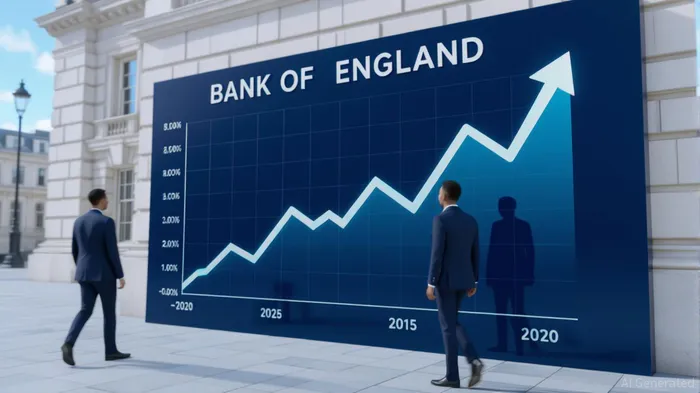
The Data's Inflationary Signal
While the 5.0% wage growth marks a slight slowdown from April's revised 5.4%, it remains elevated compared to pre-pandemic trends. Crucially, real-term adjustments reveal the true inflation battle. Using the CPIH (including housing costs), real regular pay grew by just 1.1%, while CPI (excluding housing) gave a slightly better 1.8%—still far below the nominal figures. This gap highlights how inflation erodes purchasing power, reinforcing the BoE's mandate to control price pressures.
Sectoral disparities amplify the challenge. Sectors like construction (5.9% regular pay growth) and retail/wholesale (7.7%) are driving the trend, likely due to labor shortages and rising input costs. Even the public sector's 5.5% growth outpaces the private sector's 4.9%, suggesting systemic pressures across the economy.
Why the BoE Will Stay Hawkish
The BoE has consistently tied its policy to wage growth, as Governor Andrew Bailey noted: “Sustained wage inflation is the single most critical risk to price stability.” With wage growth outpacing productivity gains, the risk of a wage-price spiral remains alive. The BoE's latest inflation report (May 2025) projected core inflation (excluding energy and food) to stay above 4% through 2026—a far cry from its 2% target.
Investors should brace for at least two more rate hikes by early 2026, pushing the policy rate to 5.75% or higher. Even if inflation moderates, the BoE's credibility hinges on demonstrating resolve.
Investment Implications: Reduce Fixed Income, Embrace Inflation-Hedging Assets
- Fixed-Income Risk: Bond prices and yields are inversely linked. As rates rise, long-dated government bonds (e.g., UK Gilts with maturities >10 years) face significant price declines. The UK 10Y Gilt Yield has already climbed to 4.5%, and further hikes will amplify volatility.
Action: Shift toward short-term bonds (e.g., 1-3 year maturities) or floating-rate notes, which adjust with interest rates.
Inflation-Linked Securities: Assets tied to inflation metrics thrive in this environment. The iShares UK Inflation-Linked Government Bond ETF (ILGS), which tracks Gilts adjusted for CPI, offers protection against rising prices. Similarly, real estate investment trusts (REITs) and commodities (e.g., gold, energy) can hedge against inflation.
Equity Sector Rotation: Sectors benefiting from higher rates include financials (banks, insurers), which see wider net interest margins, and energy, where companies pass on cost increases. Avoid consumer discretionary stocks reliant on stable consumer spending.
Cash and Short-Term Instruments: Holding cash or short-term Treasury bills becomes more attractive as rates rise, offering safer returns than long-dated bonds.
Key Risks to Monitor
- Labor Market Slack: The ONS noted a 0.4% annual decline in payroll employment in May 2025, though this was revised upward. Rising unemployment could ease wage pressures.
- Global Shocks: A U.S. recession or China's slowdown could dampen UK exports, reducing inflation.
- Policy Missteps: Over-tightening risks a sharper economic slowdown, but the BoE's data-dependent approach reduces this likelihood.
Conclusion
The UK's wage growth data confirms that inflation is deeply embedded in the economy. Investors must prepare for prolonged monetary tightening, favoring strategies that mitigate fixed-income risk while capitalizing on inflation-linked assets. As the BoE's battle against inflation intensifies, agility in portfolio positioning will be key to preserving—and growing—capital.


Stay ahead of the market.
Get curated U.S. market news, insights and key dates delivered to your inbox.


AInvest
PRO
AInvest
PRO



Comments
No comments yet