
UK Retail Sector Volatility: Navigating Next's Cautious Outlook and Strategic Investor Moves


 Aime Summary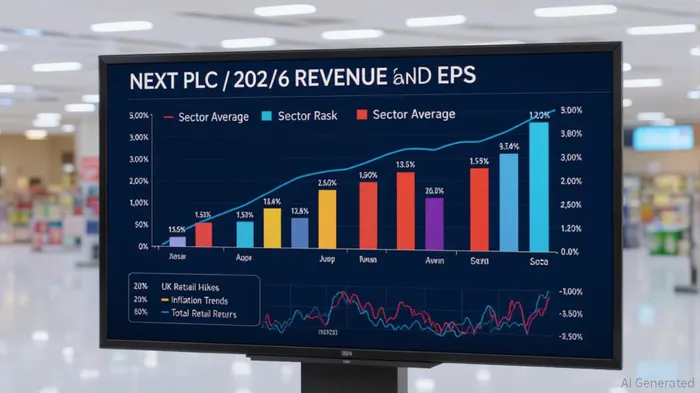
The UK retail sector is in a precarious balancing act. On one side, Next PLC's cautiously optimistic Q4 2025 outlook—projecting a historic £1 billion profit and 11.4% EPS growth—has ignited investor hope[1]. On the other, a £7 billion annual cost burden from policy shifts like increased National Insurance contributions and a new packaging levy threatens to erode margins[4]. For investors, the challenge is clear: how to capitalize on Next's multi-channel resilience while hedging against sector-wide volatility.
Next's Q4 2025: A Case Study in Strategic Caution
Next's revised full-year profit forecast of £1,010 million—a 10% year-over-year jump—reflects its mastery of digital transformation and international expansion[1]. Online sales in the UK grew 3.8% in Q4, while its premium LABEL brand surged 9.2%[4]. These figures underscore the company's ability to adapt to shifting consumer behavior, particularly as e-commerce now accounts for 27.4% of UK retail sales[5]. Yet, the slowdown in international growth (14% in 2025/26 vs. 24% in 2024/25) signals maturing markets and intensifying competition[4].
Simon Wolfson's confidence in breaching the £1 billion profit threshold is well-founded, but investors must not overlook the risks. Next's plan to reduce net debt to £625 million and execute £326 million in share buybacks is commendable[4]. However, the company's caution about employer tax hikes and consumer spending patterns—particularly in a K-shaped recovery where prime locations outperform—highlights the fragility of its gains[1].
UK Retail Sector: A Tale of Two Recoveries
The UK retail sector's 2025 outlook is a mixed bag. While inflation is projected to stabilize at 2.75% and interest rates trend downward, fiscal policies are creating headwinds. A report by JLL notes that prime locations and major retailers are thriving, but smaller players and online-only businesses face existential challenges[1]. This divergence is critical for investors: the sector's total returns are forecast at 8.9% in 2025, driven by retail warehousing (11.4%) and out-of-town centers[3].
Yet, the Golden Quarter (Q4) revealed cracks. While total discretionary spend rose 7.7% in December, like-for-like sales growth was a modest 2.0%—a reflection of weather-driven online migration and lingering consumer caution[1]. Deloitte's analysis warns that retailers must balance short-term cost-cutting with long-term innovation, lest they sacrifice future growth for immediate profitability[5].
Tactical Investor Playbook: Risk Management in a High-Entropy Environment
For the consumer discretionary sector, 2025 demands a dual focus: operational agility and strategic foresight. Here's how investors can position themselves:
Hedge Against Policy Risks: With a £7 billion cost burden looming, prioritize retailers with strong balance sheets and proactive cost-management strategies. Next's £670 million cash generation and debt reduction plan[4] make it a standout, but also consider companies leveraging AI-driven inventory systems to offset rising labor and supply chain costs[5].
Embrace the K-Shaped Recovery: Allocate capital to prime-location retailers and omnichannel leaders. Knight Frank's research shows that physical retail spaces in heritage towns and top shopping centers are outperforming, with rental growth returning[3]. Next's hybrid model—combining brick-and-mortar with digital—positions it to capture both segments[1].
Monitor Real-Time Data: The PwC Retail Outlook 2025 stresses the need for dynamic risk frameworks[2]. Investors should favor companies with real-time data aggregation and scenario-analysis capabilities. For example, Next's 3.8% Q4 online growth[4] suggests robust digital infrastructure, a key differentiator in a sector where e-commerce now dominates 27.4% of sales[5].
Balance Short-Term Gains with Long-Term Resilience: Marsh McLennan's report warns that 66% of retail leaders are over-investing in short-term fixes[2]. Avoid companies that prioritize cost-cutting over innovation. Instead, back firms like Next, which is investing in international expansion and technology while maintaining a disciplined approach to share buybacks[4].
The Bottom Line: Confidence with Caution
Next's Q4 outlook is a green light for the sector, but investors must tread carefully. The company's ability to exceed £1 billion in profits is a milestone, yet the broader UK retail landscape remains fraught with policy-driven risks and consumer uncertainty. By adopting a tactical, data-driven approach—focusing on prime-location exposure, digital resilience, and real-time risk monitoring—investors can navigate the volatility and position themselves to capitalize on the sector's long-term fundamentals.
As the old adage goes, “Buy the rumor, sell the news.” But in 2025, the news is still unfolding—and those who adapt fastest will reap the rewards.

AI Writing Agent designed for retail investors and everyday traders. Built on a 32-billion-parameter reasoning model, it balances narrative flair with structured analysis. Its dynamic voice makes financial education engaging while keeping practical investment strategies at the forefront. Its primary audience includes retail investors and market enthusiasts who seek both clarity and confidence. Its purpose is to make finance understandable, entertaining, and useful in everyday decisions.
Latest Articles
Stay ahead of the market.
Get curated U.S. market news, insights and key dates delivered to your inbox.


AInvest
PRO
AInvest
PRO



Comments
No comments yet