
UK Political Stability and Market Confidence: Assessing Starmer's Reshuffle as a Catalyst for Economic Policy Execution


 Aime Summary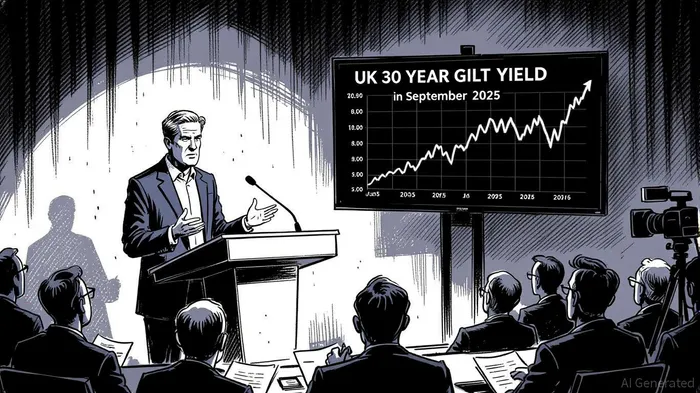
The UK's political and economic landscape in 2025 has been defined by a delicate balancing act: restoring credibility after a summer of turbulence while navigating the complexities of fiscal governance. Prime Minister 's September 2025 cabinet reshuffle, triggered by the resignation of Deputy Prime Minister over a tax dispute, has become a focal point for investors assessing the government's ability to deliver on its economic agenda. This reshuffle, while aimed at stabilizing internal party dynamics, has also exposed vulnerabilities in market confidence, raising critical questions about the interplay between political stability and economic policy execution.
Government Credibility: A Fragile Foundation
Starmer's reshuffle retained key economic figures like Chancellor , a decision framed as a signal of continuity. Yet, the broader changes—including the appointment of as Chief Secretary to the Prime Minister and as chief economic adviser—highlight a government recalibrating its approach to fiscal governance. The elevation of Jones, a former Treasury minister, to a role directly under Starmer's office suggests a centralization of economic decision-making, potentially streamlining policy delivery but also concentrating risk in a narrow circle.
However, credibility remains under siege. The July 2025 gilt market crisis, triggered by ' visible distress during a parliamentary session, exposed deep-seated concerns about fiscal discipline. Despite 's public reaffirmation of support for Reeves, , a level not seen since 1998. This volatility underscores a market perception that the government's fiscal strategy lacks clarity and resilience. The delayed Autumn Budget, , has further exacerbated uncertainty, with investors wary of a potential fiscal plan that may rely on politically unpopular tax hikes or spending cuts.
Policy Delivery Risks: The Shadow of U-Turns
The reshuffle also revealed internal party tensions, particularly over inheritance tax reforms affecting family farms. The replacement of farming minister with Dame —a move to placate rural constituencies—signals a government grappling with factional divides. Such realignments, while politically expedient, risk fragmenting policy coherence. For instance, 's shift to housing secretary, a critical role for Starmer's infrastructure ambitions, .
Moreover, the government's “Securonomics” framework—emphasizing strategic infrastructure and green energy investments—faces execution challenges. , intended to catalyze private-sector participation in projects like gigafactories and offshore wind, hinges on regulatory clarity and investor trust. Yet, the recent selloff of UK equity funds, particularly in domestically focused sectors like retail and real estate, suggests skepticism about the government's capacity to deliver on these promises.
Long-Term Implications for Markets
The UK's equity and bond markets are now priced for a worst-case scenario. , , reflects a loss of confidence in the government's ability to manage its fiscal hole. , this is a double-edged sword: investors are willing to fund the deficit but at increasingly prohibitive costs.
Long-term forecasts from the British Chambers of Commerce (BCC) paint a mixed picture. , . The BCC attributes this to weak sentiment driven by National Insurance hikes and global trade uncertainties. Meanwhile, inflation, , remains a drag on growth, .
Investment Advice: Navigating Uncertainty
For investors, the UK's current environment demands a nuanced approach. While the government's focus on green energy and infrastructure offers long-term opportunities, short-term risks—such as fiscal slippage or political instability—remain elevated. Here are key considerations:
- Bond Market Caution: The surge in gilt yields suggests a premium for risk. Investors should hedge against further volatility by diversifying into inflation-linked bonds or shorter-duration instruments.
- Equity Selectivity: Sectors aligned with the government's green agenda, such as renewable energy and construction, may outperform. However, domestically exposed sectors like retail and real estate remain vulnerable to fiscal tightening.
- Currency Exposure: The pound's weakness against the dollar and euro reflects broader fiscal concerns. Currency hedging or exposure to global equities may mitigate this risk.
- Policy Watch: The Autumn Budget will be a litmus test for the government's fiscal credibility. Investors should monitor announcements on tax reforms, welfare spending, and infrastructure funding.
Conclusion
Starmer's reshuffle has not resolved the UK's economic challenges but has underscored the government's intent to prioritize stability. Yet, the interplay between political maneuvering and fiscal governance remains fraught. For markets, the path forward hinges on the government's ability to unify internal factions, deliver on its infrastructure agenda, and restore confidence in its fiscal stewardship. Until then, investors must tread carefully, balancing the allure of long-term structural reforms with the realities of a fragile present.

Stay ahead of the market.
Get curated U.S. market news, insights and key dates delivered to your inbox.


AInvest
PRO
AInvest
PRO



Comments
No comments yet