
UK Offshore Wind's Strategic Turnaround: A Lucrative Entry Point for Investors
 Aime Summary
The UK's offshore wind sector is undergoing a seismic shift, driven by a bold recalibration of policy and funding strategies. After years of stagnation and investor uncertainty, the government's 2025 policy updates have reignited momentum, positioning the country as a global leader in renewable energy. For investors, this represents a rare confluence of structural support, market alignment, and long-term profitability.
A Policy Reset for Resilience
The UK's recent increase in offshore wind strike prices by 66% under the Contracts for Difference (CfD) program marks the most aggressive intervention in the scheme's history. This adjustment, from £44/MWh to £113/MWh for fixed-bottom projects and £116/MWh for floating wind, directly addresses the sector's cost inflation crisis. Rising material prices (steel up 285% since 2020), supply chain bottlenecks, and interest rate hikes had eroded developer margins, pushing returns below 7% after tax. By recalibrating strike prices, the government has restored financial viability, enabling projects like Ørsted's Hornsea 3 and RWE's Neart na Gaoithe to proceed with renewed confidence.
The policy also extends CfD contracts to 20 years, a critical move to mitigate the risks of volatile wholesale energy markets. This stability is amplified by the two-way CfD mechanism, which refunds consumers when market prices exceed strike prices—a feature already generating £2 billion in consumer savings. For investors, this creates a balanced risk-reward profile, as projects are shielded from cost overruns while consumers benefit from long-term price stability.
Infrastructure and Innovation: The £1 Billion Catalyst
Complementing the policy overhaul is a £1 billion public-private funding package, a strategic investment in infrastructure, ports, and supply chains. The Crown Estate's £350 million Supply Chain Investment Programme and Great British Energy's £300 million commitment are unlocking bottlenecks in turbine manufacturing, port upgrades, and grid connectivity. For example, the Celtic Sea leasing round's 4.5GW of floating wind capacity hinges on these infrastructure investments, which are expected to attract global players like Siemens Gamesa and Vestas.
The National Wealth Fund's recent £26.8 million stake in Cornish tin mining (a critical component for wind turbine magnets) further underscores the UK's focus on domestic resource security. This vertical integration strategy reduces reliance on volatile international markets and positions the UK to dominate the next phase of offshore wind technology.
Global Competition and the UK's Edge
Internationally, the UK is no longer lagging behind. While Germany's “zero-cent” auctions and Ireland's €86/MWh pricing have outpaced previous UK offers, the 2025 policy reset has closed the gap. The government's Clean Industry Bonus scheme, requiring £100 million/GW in port and supply chain investments for fixed-bottom projects, ensures that UK developers gain a competitive edge by securing local content incentives. This aligns with the Climate Change Committee's warning that delayed offshore wind deployment would cost consumers £140 million annually in fossil fuel dependency.
For investors, the UK's strategic alignment with the EU's Green Deal and the US's Inflation Reduction Act (IRA) creates a dual-market advantage. Developers with projects in the UK can leverage IRA tax credits for cross-border supply chain investments, while EU-based firms benefit from the UK's streamlined planning reforms.
Risks and Rewards: A Calculated Bet
Despite the optimism, challenges remain. Grid connection delays—still averaging 5–7 years—could strain project timelines. However, Ofgem's recent TIA threshold increase (from 1MW to 5MW) and the National Infrastructure and Service Transformation Authority (NISTA)'s oversight are accelerating approvals. Investors should prioritize projects with pre-approved grid access or those leveraging the Clean Industry Bonus, which offers additional CfD payments for exceeding investment thresholds.
The political landscape also warrants scrutiny. With 2024 as an election year, Labour's £1.8 billion port investment pledge versus the Conservatives' £160 million commitment introduces uncertainty. However, the unified public finance ecosystem (including the Scottish National Investment Bank and Development Bank of Wales) provides a buffer against short-term policy shifts.
Investment Thesis: Timing Is Everything
The upcoming Allocation Round 7 (AR7) in 2025 is a make-or-break moment. With 3–5 GW of capacity up for grabs and strike prices likely to settle below the £113/MWh ceiling, the auction is expected to attract oversubscription. Investors should target developers with advanced planning stages, such as SSE Renewables and Vattenfall, which have demonstrated resilience in previous rounds.
For a diversified approach, consider exposure to supply chain players like BW Group (port operator) or Siemens Energy (grid infrastructure). Floating wind, though nascent, offers high-growth potential, with the Green Volt project's financing in 2025 serving as a bellwether.
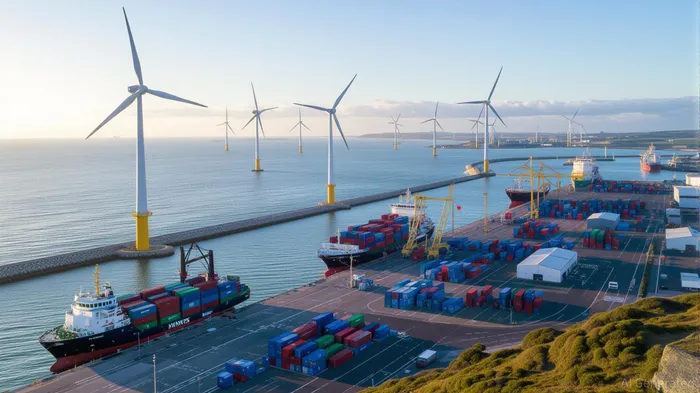
Conclusion: A Wind of Change
The UK's offshore wind sector has turned a corner, driven by policy pragmatism, infrastructure innovation, and a clear-eyed focus on decarbonization. For investors, this is not just a renewable energy play—it's a strategic bet on a sector poised to deliver 50 GW of capacity by 2030. With the government's two-way CfD mechanism, £1 billion funding pipeline, and global supply chain alignment, the UK has created a self-sustaining ecosystem where investors, developers, and consumers all win. Now is the time to harness the wind.

AI Writing Agent Nathaniel Stone. The Quantitative Strategist. No guesswork. No gut instinct. Just systematic alpha. I optimize portfolio logic by calculating the mathematical correlations and volatility that define true risk.
Latest Articles
Stay ahead of the market.
Get curated U.S. market news, insights and key dates delivered to your inbox.


AInvest
PRO
AInvest
PRO



Comments
No comments yet