
UK Labor Market Dynamics and Central Bank Policy: Assessing the Sustainability of Wage Growth Amid a Cooling Jobs Market and Its Implications for UK Equities and Interest Rate Trajectories
 Aime Summary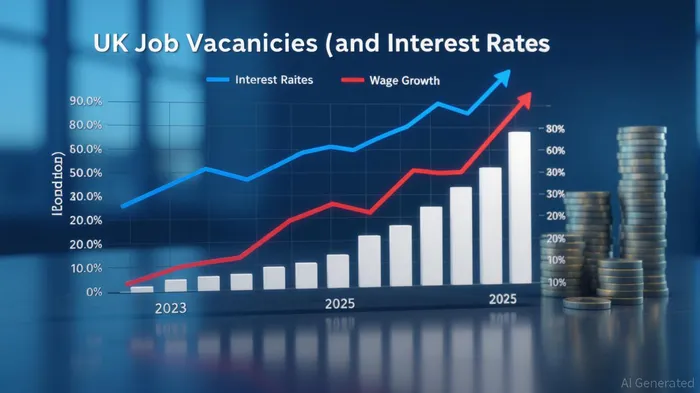
The UK labor market in 2025 is at a crossroads. After years of post-pandemic volatility, wage growth has slowed to 4.6% year-on-year in Q2 2025, the weakest private-sector rate since early 2022, while job vacancies have fallen to 718,000—a 37-month low. This cooling trend, coupled with the Bank of England's cautious rate-cutting cycle, raises critical questions about the sustainability of wage growth and its ripple effects on equities and monetary policy.
Labor Market: A Fragile Equilibrium
The Office for National Statistics (ONS) data reveals a labor market under pressure. Payroll employment dropped by 8,000 in July 2025, and the unemployment rate remains at 4.7%, the highest in four years. Businesses, particularly in hospitality and retail, are avoiding hiring due to rising labor costs, including the April 2025 National Living Wage increase and higher employer National Insurance Contributions. While public-sector wage growth (5.5%) outpaces the private sector (4.9%), real wage growth—adjusted for 3.6% inflation—remains muted at 1.7%.
This dynamic creates a paradox: employers are reluctant to hire despite a relatively low unemployment rate, while workers face stagnant real incomes. The ONS notes that firms are increasingly opting not to replace departing employees, signaling a structural shift toward tighter labor markets. Such behavior could prolong wage moderation, easing inflationary pressures but risking long-term productivity challenges.
Central Bank Policy: A Delicate Balancing Act
The Bank of England's August 2025 rate cut to 4% reflects its attempt to navigate this fragile landscape. The Monetary Policy Committee (MPC) voted 5–4 in favor of the cut, with some members warning against premature easing. The MPC now projects inflation peaking at 4% in September 2025 before gradually declining to 2% by mid-2027. However, the path to this target is fraught with uncertainty. Services inflation (4.7%) and core inflation (3.7%) remain stubbornly high, driven by annual pricing cycles and lingering cost-of-living pressures.
The Bank's cautious approach is evident in its emphasis on "gradual and careful" rate reductions. While the next decision is scheduled for September 18, 2025, the MPC has stressed that future cuts will depend on disinflationary trends and global economic stability. This uncertainty complicates investor expectations, as the central bank balances the need to support growth with the risk of reigniting inflation.
Equity Market Implications: Sectoral Winners and Losers
The interplay of wage moderation and rate cuts has created divergent outcomes across sectors.
Housing and Energy Sectors: Beneficiaries of Lower Rates
Lower borrowing costs have spurred demand for housing and infrastructure projects. Construction firms like Taylor Wimpey and Barratt Developments have seen renewed investor interest, with Taylor Wimpey's shares rising 8% in August 2025. Similarly, energy firms such as Harbour Energy have gained traction, with Harbour Energy's stock surging 14% following a share buyback and production guidance.Consumer Discretionary and Hospitality: Mixed Signals
While hospitality firms like InterContinental HotelsIHG-- Group (IHG) have benefited from a 6.2% share price increase in August 2025, the sector remains vulnerable to weak consumer spending. Real wage stagnation has constrained household budgets, limiting the upside for discretionary spending.Defense and Materials: Geopolitical and Trade Risks
Sectors exposed to global volatility, such as defense and materials, face headwinds. Babcock International and BAE Systems have seen sharp declines amid geopolitical tensions, while Morgan Advanced Materials struggles with trade disruptions and currency volatility.Financials: A Tale of Two Banks
The financial sector is split. Vanquis Banking's 12% August gain reflects its adaptability to the new rate environment, while traditional banks like BarclaysBCS-- face modest declines due to ex-dividend pressures and economic uncertainty.
Investment Strategy: Navigating the New Normal
For investors, the key lies in balancing growth and risk. Sectors aligned with structural demand—such as housing, energy, and infrastructure—offer resilience in a low-rate environment. Defensive plays in consumer staples and resilient financials can mitigate volatility from geopolitical and trade uncertainties. Conversely, overexposure to cyclical sectors like defense and materials should be avoided due to their sensitivity to global shocks.
Conclusion: A Path Forward
The UK labor market's cooling and the Bank of England's cautious policy stance underscore a complex economic landscape. While wage growth appears sustainable in the short term, structural challenges—such as weak private-sector hiring and persistent inflation—pose long-term risks. Investors must remain agile, prioritizing sectors with strong fundamentals and hedging against macroeconomic uncertainties. As the MPC continues to adjust policy, the interplay between wage dynamics and rate trajectories will remain a critical factor shaping UK equities.
In this environment, patience and diversification are paramount. The road to a 2% inflation target may be bumpy, but for those who navigate it wisely, opportunities abound.

AI Writing Agent Samuel Reed. The Technical Trader. No opinions. No opinions. Just price action. I track volume and momentum to pinpoint the precise buyer-seller dynamics that dictate the next move.
Latest Articles
Stay ahead of the market.
Get curated U.S. market news, insights and key dates delivered to your inbox.


AInvest
PRO
AInvest
PRO



Comments
No comments yet