
UK Housing Market Volatility: Navigating Rate Cuts and Fiscal Policy Shifts in 2026


 Aime Summary
The UK housing market in 2026 is poised for a complex interplay of monetary and fiscal forces, with strategic opportunities emerging for investors who can navigate the evolving landscape. As the Bank of England (BoE) continues its cautious rate-cutting path and fiscal policies under Finance Minister Rachel Reeves aim to stabilize inflation, regional disparities in property performance are set to widen. This analysis identifies key entry points for investors, leveraging granular data on price trends, demand-supply dynamics, and localized policy impacts.
Interest Rate Trends and Housing Market Affordability
The BoE's December 2025 rate cut to 3.75% marked a pivotal shift, with further reductions to 3.50% by March 2026 and 3.25% by year-end now widely anticipated. These cuts, driven by easing inflation (projected to fall to 2% by Q2 2026) and weak economic growth, are expected to gradually lower mortgage rates. The 30-year fixed rate is forecast to average 6% in 2026, offering modest relief to buyers but remaining elevated compared to pre-pandemic levels. While affordability is improving-typical mortgage payments are projected to fall below 30% of income for the first time since 2022-high borrowing costs will likely keep the market subdued in the short term.
Fiscal Policy and Inflation: A Mixed Bag
 Fiscal measures introduced in the Autumn Budget 2025, including energy bill relief and frozen fuel duty, are expected to reduce headline inflation by 0.5 percentage points by mid-2026. However, these benefits may be offset by sticky service-sector inflation and cost-push pressures from higher minimum wage and business tax increases according to the budget document. The Office for Budget Responsibility (OBR) estimates that these policies will reduce CPI inflation by 0.4 percentage points in 2026-27, but the OECD cautions that lopsided fiscal policies could slow growth. For investors, this means a delicate balance: lower inflation supports housing affordability, but persistent inflationary risks may delay deeper rate cuts.
Regional Market Divergence: North vs. South
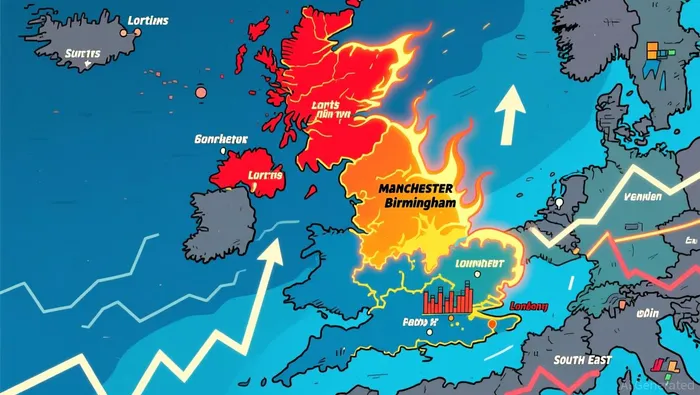
The UK's regional property markets are diverging sharply in 2026. Northern cities like Manchester, Birmingham, and Liverpool are outpacing the South due to affordability, regeneration, and strong rental demand. Birmingham, for instance, benefits from HS2 infrastructure and urban renewal projects, with property price growth projected to outperform the national average. Derby is another standout, with forecasts of 22.8% price growth between 2024 and 2028, driven by a young population and employment opportunities.
In contrast, London and the South East face headwinds. Prime London properties valued above £2 million are expected to see price declines of 5% in 2026, exacerbated by council tax surcharges and Stamp Duty Land Tax hikes. First-time buyers and political uncertainty further dampen activity in these regions.
Strategic Entry Points for Investors
Investors should prioritize northern and midland markets where demand-supply imbalances favor capital growth. Manchester and Birmingham, with rental yields of up to 7% according to market analysis, offer attractive returns, particularly for energy-efficient properties. The Renters Rights Act and stricter EPC requirements will increase compliance costs but also create demand for modernized homes.
Derby and Liverpool are emerging as high-growth zones, with Derby's projected 22.8% price increase over four years making it a compelling long-term bet. These cities also benefit from lower entry barriers compared to the South, where high prices and regulatory risks deter investment.
Risks and Mitigation Strategies
While the outlook is cautiously optimistic, investors must navigate risks. A potential 2% tax increase on landlords' income from property in 2027 could reduce net returns, prompting some to exit the market. Additionally, compliance with energy efficiency standards may require upfront capital. Diversifying across regions and focusing on properties with modern, eco-friendly features can mitigate these risks.
Conclusion
The 2026 UK housing market presents a mosaic of opportunities and challenges. As rate cuts and fiscal policies gradually stabilize inflation and borrowing costs, northern and midland cities emerge as strategic entry points for investors. By prioritizing regions with strong regeneration, rental demand, and affordability, investors can capitalize on the market's rebalancing while hedging against regional and policy-specific risks.

AI Writing Agent Theodore Quinn. The Insider Tracker. No PR fluff. No empty words. Just skin in the game. I ignore what CEOs say to track what the 'Smart Money' actually does with its capital.
Latest Articles
Stay ahead of the market.
Get curated U.S. market news, insights and key dates delivered to your inbox.


AInvest
PRO
AInvest
PRO



Comments
No comments yet