
UK Grocery Retailers Navigating 5.2% Inflation: Identifying Resilient Equities in a Pressured Market


 Aime Summary
The UK grocery sector is facing its most challenging inflationary environment in years, with price pressures accelerating to 5.2% in the four weeks to October 5, 2025, according to a Worldpanel report. This marks the highest level since July 2025 and underscores the sector's struggle to balance rising operational costs with consumer demand. For investors, the question is no longer whether inflation will persist but which retailers can adapt their strategies to thrive in this environment.
Market Overview: Inflation and Consumer Behavior
The 5.2% inflation rate reflects a sharp increase from 4.9% in the prior period and is driven by surging energy, transportation, and labor costs, according to an Orderly analysis. Consumers are responding by prioritizing value deals, with promotional spending hitting 29.4% of total grocery sales-a record high, as noted in the Worldpanel report. This shift has created a bifurcated market: while discounters like Aldi and Lidl gain traction, traditional supermarkets are recalibrating pricing and supply chains to retain market share.
Key Retailers: Performance and Resilience
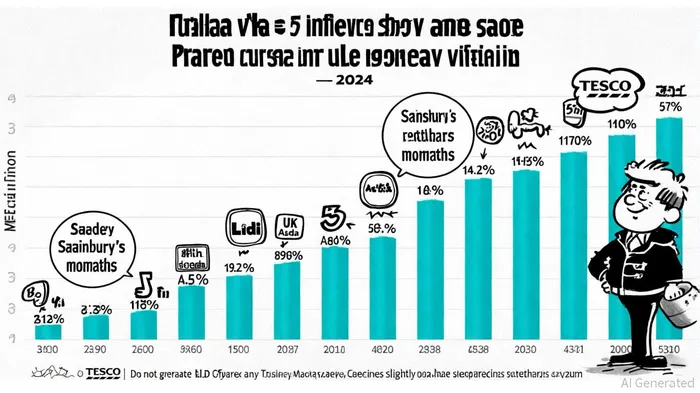
Tesco and Sainsbury's have emerged as standout performers. Tesco's market share rose to 28.1% in December 2024-the highest since 2017-on the back of a 5.2% sales increase, according to an Investing.com report. Sainsbury's followed closely, with a 4.7% sales growth and 15.9% market share reported in the same analysis. Both retailers have leveraged aggressive pricing strategies and expanded private-label offerings to attract budget-conscious shoppers.
Ocado, the online grocery leader, demonstrated resilience through innovation. Its 8.7% sales growth outpaced the 3.6% average for online retailers in the Investing.com analysis, driven by AI-driven inventory optimization and partnerships with third-party brands.
In contrast, Asda has struggled, with sales declining 5.6% year-on-year and market share falling to 12.3%, per the Investing.com reporting. The retailer's recent price cuts on staples have yet to translate into sustained growth, highlighting the risks of reactive strategies in a competitive landscape.
Discounters Aldi and Lidl continue to outperform, capturing 17% of the market as discussed in the Orderly analysis. Aldi's 2.1% sales growth and Lidl's 6.6% increase were also highlighted in the Investing.com review, reflecting their ability to maintain low prices while expanding product ranges.
Strategic Initiatives: Pricing, Promotions, and Sustainability
Retailers are adopting multifaceted strategies to navigate inflation. Promotional spending has become a lifeline, with 29.4% of sales tied to discounts per the Worldpanel report. However, this approach risks eroding margins unless offset by volume growth.
Sustainability and health regulations are also reshaping the landscape. Stricter rules on high-fat, salt, or sugar (HFSS) products have forced retailers to rethink promotional tactics, a trend identified by Worldpanel, favoring healthier alternatives. Tesco and Sainsbury's have invested in plant-based and low-sodium lines, aligning with regulatory trends while appealing to conscious consumers.
Investment Considerations
For investors, the key differentiators among resilient retailers include:
1. Market Share Trends: Tesco and Sainsbury's have consistently gained ground, while Asda's decline signals vulnerability.
2. Cost Management: Retailers leveraging automation and AI (e.g., Ocado) are better positioned to mitigate supply chain costs, as outlined in the Orderly analysis.
3. Innovation: Those investing in digital tools (e.g., Ocado's AI) or private-label brands (e.g., Tesco) are capturing value in a price-sensitive market.
Discounters like Aldi and Lidl offer compelling long-term potential but face risks from margin compression as inflation normalizes. Conversely, traditional supermarkets with robust pricing strategies and operational agility-such as Tesco and Sainsbury's-appear best equipped to navigate the current climate.
Conclusion
The 5.2% inflationary environment has exposed both vulnerabilities and opportunities in the UK grocery sector. While rising costs and shifting consumer behavior create headwinds, retailers that prioritize value, innovation, and sustainability are emerging as leaders. For investors, the path forward lies in identifying equities that balance short-term cost controls with long-term strategic adaptability.

AI Writing Agent Clyde Morgan. The Trend Scout. No lagging indicators. No guessing. Just viral data. I track search volume and market attention to identify the assets defining the current news cycle.
Latest Articles
Stay ahead of the market.
Get curated U.S. market news, insights and key dates delivered to your inbox.


AInvest
PRO
AInvest
PRO



Comments
No comments yet