
UK's Economic Slump Sparks Reassessment of European Equity Risks
The UK's economy, already grappling with structural headwinds, delivered another grim data point in May 2025: a 0.1% contraction in GDP, marking the second straight month of decline. This slump, driven by weaknesses in production and construction sectors, has reignited concerns about the sustainability of global growth and the resilience of European equities. As investors reassess risk exposure, the spillover effects of Britain's stagnation are pushing portfolios toward defensive sectors and U.S.-linked assets.
The May GDP contraction—contrary to expectations of a 0.1% expansion—reflects a confluence of domestic and external pressures. Domestic tax hikes and lingering fallout from U.S. tariffs, which have distorted trade flows and business confidence since 2024, have exacerbated the slowdown. Meanwhile, the services sector, which previously buoyed growth, has shown signs of strain, with annual growth forecasts for the UK now revised downward to just 1%. 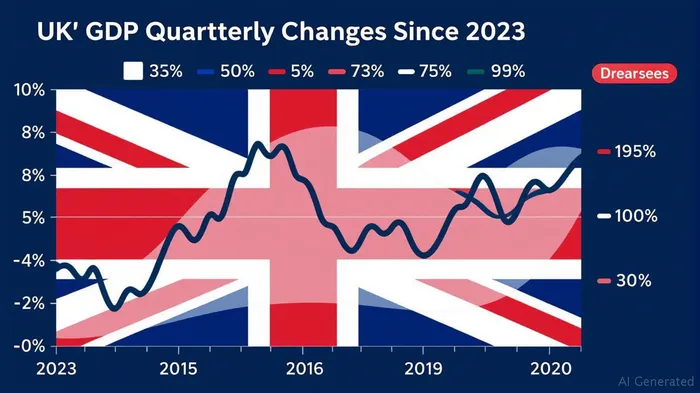
But the UK's woes are not isolated. The Eurozone's May Manufacturing PMI data, while stabilizing at 49.4 (the slowest contraction since August 2022), underscores a fragile recovery. Germany's manufacturing sector, the Eurozone's economic engine, remains in contraction for the 35th straight month, though export orders from the U.S. have provided a temporary lifeline. Meanwhile, the Eurozone's services sector contracted sharply in May—the first decline since November 2024—dragging overall private-sector output into negative territory.
Spillover Risks and Portfolio Rebalancing
The UK's stagnation and Eurozone's uneven recovery are creating a toxic mix of risks for European equities. Key concerns include:
Trade Policy Uncertainty: U.S. tariffs on European goods—particularly steel and aluminum—continue to distort supply chains and depress export-oriented sectors like automotive and machinery. With no resolution in sight, companies exposed to transatlantic trade face prolonged volatility.
Fragile Services Sector: The May contraction in Eurozone services—a key driver of employment and growth—signals weakening domestic demand. This bodes poorly for sectors like retail, hospitality, and travel, which are already grappling with rising labor costs and low wage growth.
Monetary Policy Dilemmas: While the ECB's April rate cut to 2.25% and projected further easing provide a supportive backdrop, the central bank faces a balancing act: stimulating growth without reigniting inflation. With inflation nearing the 2% target, the path forward remains fraught with trade-offs.
Investment Strategy: Defensive Tilts and U.S. Exposure
In this environment, investors should prioritize sectors and assets insulated from trade wars and demand shocks. Consider the following shifts:
Shift to Defensive Sectors:
Healthcare (e.g., pharmaceuticals with diversified pipelines) and utilities (reliant on regulated cash flows) offer stability. For example, companies like Germany's RWE or Spain's Iberdrola have robust balance sheets and steady returns.U.S.-Linked Assets:
Companies with significant U.S. operations or revenue streams—such as luxury brands (e.g., LVMH, which benefits from strong U.S. consumer demand) or tech firms (e.g., ASML, whose U.S. sales are less tariff-exposed)—may outperform.Reduce Cyclicals:
Avoid manufacturing and export-heavy sectors (e.g., automotive stocks like Daimler or machinery firms like Siemens) until trade tensions ease.Consider U.S. Equities or ETFs:
Funds tracking U.S. markets (e.g., SPDR S&P 500 ETF) or sectors like technology (e.g., InvescoIVZ-- QQQ Trust) could offer safer havens.
Final Call
The UK's economic contraction and Eurozone's uneven recovery are not merely cyclical dips—they reflect structural vulnerabilities exacerbated by trade conflicts and policy missteps. Investors must temper optimism about a quick rebound and instead focus on downside protection. A portfolio anchored in defensive sectors and U.S.-linked assets will be better positioned to navigate the choppy waters ahead. As the old Wall Street adage goes: “Bulls make money, bears make money, pigs get slaughtered.” In this market, prudence—not greed—should reign.

Stay ahead of the market.
Get curated U.S. market news, insights and key dates delivered to your inbox.


AInvest
PRO
AInvest
PRO



Comments
No comments yet