
UK Banks Face Credit Divergence: Secured Spreads Narrow as Unsecured Risk Widens


The first quarter of 2026 presents a clear divergence in the UK credit landscape. On one side, lenders are signaling a broad expansion in credit availability. On the other, household financial stress is intensifying, creating a setup that demands careful portfolio calibration.
The quantitative picture for secured credit is one of deliberate easing. According to the Bank of England's Credit Conditions Survey, the net percentage balance for secured credit availability expectations rose to 15.5 in Q1 2026, up from 9.2 a year ago. This marks a significant shift, with lenders anticipating further increases in the coming months. Yet this expansion in supply is not meeting a corresponding surge in demand for the core secured product: mortgages. Net mortgage borrowing in January decreased to £4.1 billion, down from £4.5 billion in December. This contraction, below the recent six-month average, suggests borrowers are pulling back despite easier terms.
The stress is most visible in unsecured consumer credit. While overall consumer borrowing held steady, the underlying data reveals strain. Average credit card balances remained elevated, up 4.8% year-on-year in January. More telling is the payment behavior: the typical customer paid down 33.9% of their balance, a figure that was 6.7% lower than in January 2025. This combination-higher balances coupled with a declining payment rate-signals persistent affordability challenges. The trend is accelerating, with the number of accounts missing two payments jumping 14.3% month-on-month.
For a portfolio manager, this divergence is the core investment story. It represents a classic misalignment between credit supply and demand fundamentals, often a precursor to higher default rates and wider spreads. The setup suggests that while the initial risk of a credit crunch has eased, the underlying quality of the loan book is deteriorating. This creates a potential source of alpha for those who can hedge against this specific type of credit risk or position for a widening in unsecured lending spreads.
Quantifying the Divergence: Risk vs. Availability
The tension between reported credit availability and deteriorating household finances is now quantifiable. Lenders are signaling looser terms, but the underlying risk profile of their loan books is shifting. This divergence is the central risk for a portfolio manager, as it creates a potential disconnect between reported credit conditions and the true quality of the asset.
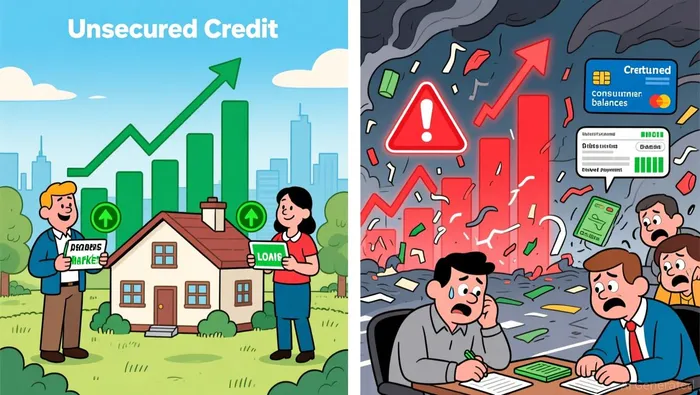
On the availability side, the data shows a deliberate easing. The net percentage balance for secured credit availability expectations rose to 15.5 in Q1 2026. indicating lenders expect further increases. More specifically, the criteria for household loans have loosened slightly, with a net balance of 5.4 in the past quarter. This suggests banks are extending credit to a broader set of borrowers, potentially including those with weaker financials. Yet this expansion in supply is not translating into stronger demand for the core secured product, as mortgage borrowing contracted in January.
The real risk lies in the segmented credit environment this creates. The Bank of England survey shows a clear split in spreads: secured household lending spreads narrowed in Q1 while unsecured lending spreads widened. This divergence is critical. It indicates that the perceived risk in the secured market-mortgages-is being discounted, while the risk in the unsecured market-credit cards and personal loans-is being repriced higher. For a portfolio, this suggests a weakening correlation between UK bank stocks and broader equities. When credit risk becomes segmented, the traditional beta of bank stocks can break down, as the performance of individual lenders becomes more dependent on their specific exposure to these two distinct credit segments.
The bottom line is a heightened risk of higher-than-expected credit losses. The setup is a classic misalignment: easier credit terms are being offered even as household balance sheets show clear strain. Average credit card balances remain 4.8% higher year-on-year while the typical payment rate is 6.7% lower than a year ago. If economic growth slows, this combination could quickly lead to a spike in defaults, particularly in the unsecured book where spreads are already widening. For a disciplined portfolio, this divergence is a red flag that calls for active hedging or selective positioning away from lenders with the highest exposure to this deteriorating consumer risk.
Portfolio Construction and Risk-Adjusted Return
The expanding secured lending book presents a nuanced picture for portfolio construction. On one hand, the narrowing of spreads on secured household loans suggests improved pricing and potentially higher near-term profitability. On the other, the widening of unsecured lending spreads indicates a clear risk shift that could pressure overall portfolio Sharpe ratios. For a disciplined investor, the key is to navigate this segmented risk environment.
The spread divergence is the most critical signal. Spreads on secured household lending narrowed in Q1, a trend expected to continue unchanged in Q2. This implies lenders are pricing in lower perceived risk for mortgages, likely reflecting the easing in credit availability and stable demand. However, this positive development is offset by the opposite movement in unsecured credit, where spreads widened in Q1 and are forecast to widen further. This creates a portfolio with two distinct risk engines: a relatively stable, but potentially saturated, secured book versus a riskier, repriced unsecured book. The net impact on portfolio volatility and return depends on the relative size of these exposures.
Policy-driven volatility adds another layer. The Bank of England has held the Bank Rate at 3.75% since March, citing higher energy costs from the Middle East conflict as a near-term inflation risk. This decision caps the potential for a near-term rate cut, which would have pressured bank net interest margins. The policy stance is now one of wait-and-see, with the MPC closely monitoring for second-round effects. This creates a period of relative stability but also uncertainty, as the next move hinges on a volatile external shock. For a portfolio manager, this means the traditional interest rate sensitivity of bank stocks may be muted in the near term, but the risk of a sudden policy pivot remains.
The key catalyst to watch is the May 2026 MPC meeting. The committee will reassess inflation and growth dynamics in light of the ongoing conflict's impact. Any shift in the policy outlook, even a pause in the hold, could trigger significant repricing in bank stocks and credit spreads. A hawkish tilt would likely pressure the already narrow secured spreads, while a dovish shift could provide a tailwind. In the meantime, the portfolio's risk-adjusted return profile is being shaped by this divergence. The secured book offers a potential source of alpha through stable spreads, but the unsecured book introduces a higher-beta risk that could drag down overall Sharpe ratios if defaults accelerate. The optimal strategy likely involves hedging the unsecured exposure or tilting toward lenders with the most balanced credit book.

The Newsroom represents the intersection of human expertise and machine intelligence. Composed of seasoned editors with decades of combined experience in global markets, we utilize AI as a powerful research assistant to enhance our coverage. We maintain a "Human-in-the-loop" policy: no article is published without professional human verification, ensuring that every insight is accurate, nuanced, and actionable for our readers.
Latest Articles
Stay ahead of the market.
Get curated U.S. market news, insights and key dates delivered to your inbox.


AInvest
PRO
AInvest
PRO



Comments
No comments yet