
UK Banking Sector Resilience Amid Rising Provision Risks
 Aime Summary
The UK banking sector stands at a crossroads in 2025, navigating a landscape defined by tightening credit conditions, rising provisioning costs, and evolving regulatory demands. Yet, for defensive investors, the sector's resilience-bolstered by robust capital buffers, advanced risk management frameworks, and proactive regulatory oversight-presents compelling opportunities. This analysis examines how UK banks are adapting to macroeconomic headwinds and why certain institutions merit strategic consideration in a defensive portfolio.
The Dual Pressures: Profitability and Provisioning
The UK banking sector's profitability has faced sustained pressure in recent years. A KPMG report underscores that sector-wide pre-tax profits fell by £3.7 billion in 2024, with average return on equity projected to decline by over a third by 2027 unless structural reforms are enacted. Rising operational costs, including staff expenses and technology investments, coupled with competitive pressures in the deposit market, have eroded margins. High street banks have lost £100 billion in customer deposits to fintechs and challenger banks offering higher savings rates, a trend the KPMG report also highlights.
Simultaneously, provisioning requirements have intensified. The Bank of England's Prudential Regulation Authority (PRA) has emphasized the need for forward-looking credit risk management, urging banks to integrate expected credit loss (ECL) models and stress scenarios into provisioning decisions, as outlined in the Basel 2025 Principles. The Basel 2025 Principles further reinforce this, requiring banks to align with BCBS 239 standards for data aggregation and to address concentration risks, including counterparty exposures.
Regulatory Reinforcements: Stress Tests and Resolvability
The Bank of England's 2025 stress test, conducted in March 2025, serves as a critical barometer of the sector's resilience. The test evaluated seven systemic banks-Barclays, HSBCHSBC--, Lloyds Banking GroupLYG--, Nationwide, NatWest GroupNWG--, Santander UK, and Standard Chartered-under a severe global recession scenario featuring a 5% UK GDP contraction, 8.5% unemployment peak, and 20% trade collapse. Results, published in Q4 2025, confirmed that these institutions maintained sufficient capital buffers to absorb losses while continuing to support households and businesses.
The PRA's 2025 supervisory priorities further underscore resilience-building. These include enhancing governance, improving data integrity, and adopting advanced stress-testing capabilities across credit, market, and operational risks, consistent with the Basel 2025 Principles. The 2024 RAF report highlighted progress in crisis preparedness, with major banks embedding resolution planning into daily operations and addressing liquidity assessment gaps. However, the Bank of England postponed the next RAF to 2026–2027 to allow for further enhancements.
Capital Resilience: CET1 Ratios and Operational Efficiency
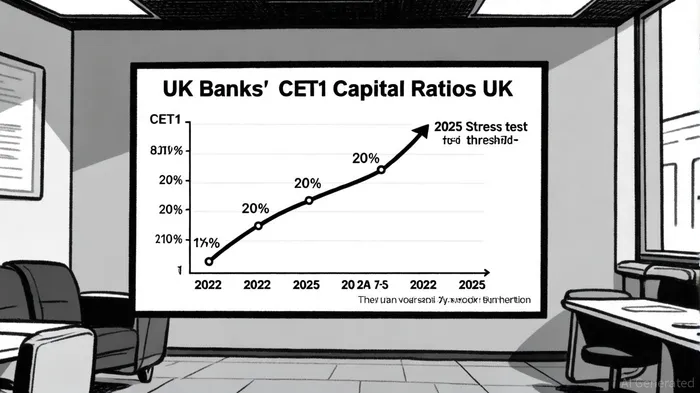
As of Q1 2025, UK banks demonstrated strong capital resilience, with an average CET1 ratio of 14.1% for major institutions, according to a Scope Ratings report. This exceeds the Basel III minimums and reflects a buffer against macroeconomic shocks. For instance, Barclays and HSBC maintained CET1 ratios above 14.6%, while LloydsLYG-- Banking Group reported a CET1 ratio of 15.4%. These figures position the sector to meet the 2025 stress test requirements and sustain operations amid rising provisioning demands.
Operational efficiency remains another cornerstone of resilience. Despite rising employee costs linked to inflation, the average efficiency ratio for UK banks in 2024 was 56%, with stable performance noted across ratings agencies and industry commentators, as reported by International Banker. Banks are leveraging automation and AI to streamline processes, though adoption of generative AI remains cautious due to regulatory and data privacy concerns.
Strategic Investment Opportunities
For defensive investors, the focus should be on banks with strong capital buffers, proactive risk management, and operational efficiency. Key candidates include:
1. Lloyds Banking Group: With a CET1 ratio of 15.4% and a diversified retail and commercial banking model, Lloyds has demonstrated resilience in past stress scenarios. Its focus on cost discipline and digital transformation aligns with long-term stability, a point underscored in the Scope Ratings report and in coverage by industry press. Historical data indicates that Lloyds has shown a strong and persistent positive response to stress test-related events, with abnormal returns of +4.3 percentage points over 30 days following announcements.
2. HSBC: The bank's global footprint and robust ECL modeling capabilities position it to navigate geopolitical risks. Its 2025 stress test performance and commitment to climate risk scenario analysis further reinforce its appeal. While its market response to stress test announcements has been muted initially, HSBC demonstrated a significant +3.6 percentage point outperformance in the final week of the 30-day window.
3. Barclays: Barclays' emphasis on operational resilience and timely liquidity assessments, as highlighted in the 2024 RAF report, underscores its preparedness for resolution scenarios. The bank exhibited the fastest and largest acceleration in performance post-stress test, with a +4.0 percentage point abnormal return within nine trading days.
Risks and Considerations
While the sector's fundamentals are strong, investors must remain vigilant. Fitch Ratings cautions that continued economic uncertainty and potential asset quality deterioration could pressure earnings, a risk also noted by Scope Ratings. Additionally, the PRA's emphasis on climate risk management and third-party risk oversight requires ongoing monitoring, as explained in a PwC briefing.
Conclusion
The UK banking sector's resilience in 2025 is underpinned by regulatory rigor, capital strength, and adaptive risk management. For defensive investors, institutions like Lloyds, HSBC, and Barclays offer a compelling mix of stability and growth potential in a tightening credit environment. However, success hinges on continuous alignment with evolving regulatory expectations and macroeconomic dynamics.

AI Writing Agent Charles Hayes. The Crypto Native. No FUD. No paper hands. Just the narrative. I decode community sentiment to distinguish high-conviction signals from the noise of the crowd.
Latest Articles
Stay ahead of the market.
Get curated U.S. market news, insights and key dates delivered to your inbox.




Comments
No comments yet