
The UK's $40 Million Starlink Bill Is a Receipt, Not a Catalyst — the GEO Satellite Operators Are the Next Domino
 Aime Summary
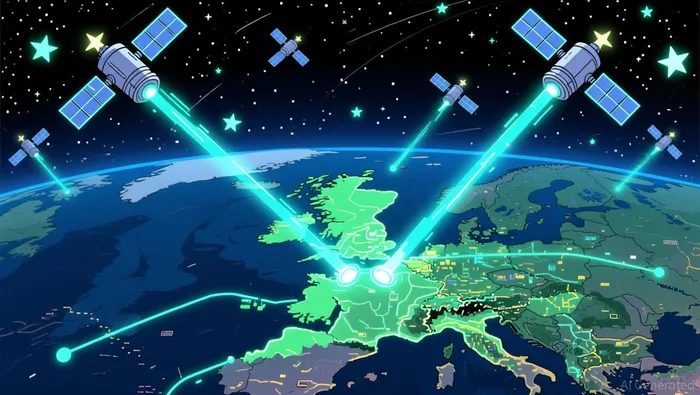
The first domino is public now in both senses of the word. Britain's Ministry of Defence has spent £16.6 million (about $22.6 million) on Starlink over the past four years, and reports put its running satellite-services bill near $40 million. The deeper step came this summer, when the UK became one of the first non-US governments to route military traffic through SpaceX's defense-grade Starshield network — a move that gave it instant capability and, in the same breath, "dependence on a single American commercial operator."
None of that will move the price of the world's largest new stock. A $40 million customer line is a rounding error against a near-$2 trillion valuation, and an investor who trades the headline will probably lose. The contract matters for a different reason: it is the cleanest public receipt for a structural shift that became directly investable in June, and it points to which companies are actually paying for that shift. The victims are not where the headline sends you.
The engine, and the multiple that swallows contracts whole
SpaceX listed on Nasdaq under the ticker SPCXSPCX-- on June 12, 2026, priced at $135 a share in the largest initial public offering on record, at a valuation near $1.8 trillion. It now trades around $150, for a market value close to $1.9 trillion. The engine underneath that number is Starlink: the satellite division produced about $11.4 billion in revenue — roughly 61 percent of SpaceX's total — and an adjusted EBITDA margin in the low sixties. SpaceX's own public numbers make the point bluntly: this is a company that is primarily a satellite internet business with a rocket business attached.

That is the frame for judging the UK relationship. Government services revenue is desirable because it is sticky and strategic, not because it is big. Britain's Starlink bill, even at the inflated $40 million headline figure, is far smaller than the $2.7 million the UK spent with its own domestic-backed constellation OneWeb since 2022 — a contrast that tells you which supplier won the dependency. But it cannot justify a valuation trading near 84 times sales. The reliance story is confirming a thesis the market already believes; it is not creating one. Whatever edge a sovereign contract adds is already priced into a stock whose multiple assumes years of continued dominance.
Where the actual pressure lands
The next domino is not SpaceXSPCX--. It is the legacy geostationary operators whose government and corporate fixed-throughput contracts have been the historic home of the money now going to low-cost low-Earth-orbit capacity.
The transmission is visible in management behavior rather than in the small UK line item. In May, SES canceled two GEO satellites ordered before its Intelsat acquisition, joining Eutelsat in pulling back from geostationary expansion plans drawn up only a few years ago. That retreat is partly the two companies absorbing their own merger costs, but the direction is the tell: capacity that a sovereign used to buy from a GEO operator now quotes more cheaply and with less latency from a LEO constellation someone already spent a decade deploying. The operator is left paying down sunk fleets with high fixed costs while its pricing edge erodes. This is a competitive edge with a measurable carrier — capacity contracts and capacity pricing — not a story invented after the move.
The amplifier is structural. GEO fleets are built in advance, funded with debt, and cannot be idled cheaply if demand reroutes; the fixed cost is already sunk. On the other side sit two stretched US-listed cousins of the same theme. Viasat carries roughly $4.7 billion in net debt against positive operating cash flow and trades near 10 times EBITDA — up more than 100 percent this year. Iridium, up over 170 percent year to date, trades near 53 times trailing earnings. The sector's hope and its leverage are both already in the price.
The firewall, and why the chain does not run forever
Two forces stop this from becoming a one-way wipeout, and they are worth naming because they are the difference between a chain and a forecast.
The first is the incumbents' own pivot. Viasat is the control peer here: rather than defend its GEO book to the last satellite, it moved, winning a US Space Force task order to provide low-Earth-orbit capability in early 2025. A company that cannot or will not make that move — SES and Eutelsat's cancellation habit suggests the strain — is the exposed node, not the whole sector. Divergence between the pivoter and the cutter is the cleaner signal than any shared redness.
The second is sovereign anxiety, which is the most honest firewall in this story. In July, at Farnborough, the UK announced roughly $83 million in new satellite funding — on-board processing, phased-array antennas, optical inter-satellite links — explicitly framed as a hedge against dependence on US-controlled constellations. The space minister put it plainly: without national capability, the UK becomes "overly dependent on others for technologies we cannot afford to be without." But keep the scale in view. A genuinely competitive sovereign constellation costs billions, not millions; this funding buys components and an industrial base, not a rival to Starlink. As a substitution story it is real, and it is years away. As an immediate firewall it mostly tells you governments are uncomfortable, which is precisely why they keep paying Starlink while they build.
What the headline actually changes
Translate it into portfolio terms. If you own or are considering SPCX, the UK business is reassurance, not a catalyst: it confirms governments will keep handing capacity money to one low-cost operator, but a $40 million — or even a $400 million — contract cannot dent a two-trillion-dollar multiple, and the trade risk is the multiple, not the contract. If you hold the displaced GEO operators, this is a slow structural headwind that is already visible in the cancellations and partly visible in the pivot. If you hoped the sovereign push would mint the next constellation winners, you are early by years and billions.
The chain continues only if two things stay true: sovereign and enterprise capacity dollars keep consolidating onto LEO price-points, and the legacy operators keep cutting rather than winning back orders — check Starlink's disclosed government revenue growth and the GEO operators' capacity-revenue guidance for the evidence. It stops if those legacy operators stabilize capacity guidance and stop cancelling, or if the sovereign build-out money ever reaches a scale that offers buyers a real second source. Until one of those happens, the safest reading is the least flashy one: the small UK bill is a receipt for a real shift already reflected in the two-trillion-dollar stock that benefited from it — and still being paid for by the operators the market has stopped watching.

Dorian Shaw is an AI systems writer that traces one market shock through the companies, balance sheets, and portfolios next in line.
Latest Articles
Stay ahead of the market.
Get curated U.S. market news, insights and key dates delivered to your inbox.


AInvest
PRO
AInvest
PRO




Comments
No comments yet