
The UK's £1 Billion EV Battery Gamble: A Net-Zero Pivot or Risky Bet?
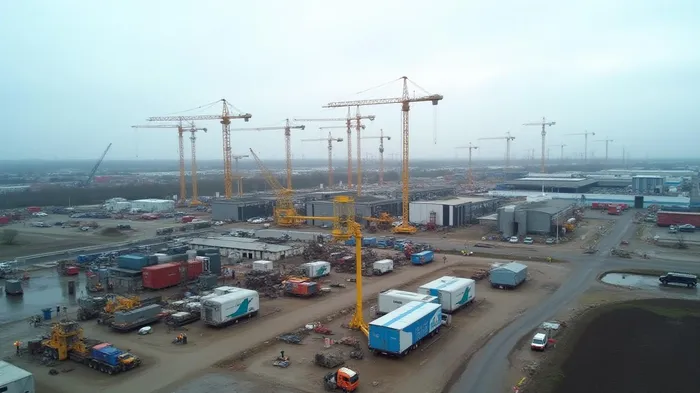
The UK’s £1 billion investment in an AESC-led electric vehicle (EV) battery gigafactory in Sunderland marks a bold move to solidify its position in the global EV supply chain and accelerate its net-zero transition. With construction set to begin shortly, the project promises to transform the region’s economy and reshape the UK’s automotive landscape. But as governments and investors worldwide pour billions into battery infrastructure, the Sunderland gigafactory’s success hinges on more than just ambition—it requires navigating geopolitical tensions, market volatility, and the harsh realities of industrial-scale production.
The Funding Play: A Public-Private Tightrope Walk
The £1 billion investment is a masterclass in fiscal engineering. The UK National Wealth Fund and UK Export Finance are backing the project with £680 million in guarantees—replacing an earlier £200 million bridging loan—a sign of political will to fast-track critical infrastructure. Private lenders, including Standard Chartered and HSBCHSBC--, are contributing £320 million, while an additional £150 million in grants from the Automotive Transformation Fund underscores the government’s commitment to reshoring manufacturing. This blend of public and private capital aims to insulate the project from market swings, but it also raises questions about long-term liability if demand falters.
The facility’s 15.8 GWh annual capacity, enough to power 300,000 EVs, represents a sixfold leap in UK battery output. Yet this still pales compared to China’s 1.5 TWh of installed battery capacity by 2025, per industry forecasts. . The Sunderland plant must compete in a market where scale and cost efficiency are king.
Strategic Imperatives: Jobs, Trade Deals, and the Nissan Factor
The gigafactory’s location in Sunderland—a region historically reliant on Nissan’s car plant—is no accident. By co-locating battery production with EV assembly, AESC aims to slash supply chain costs and carbon footprints. Nissan, which relies on AESC for its Leaf models, stands to gain a local source of batteries, reducing its vulnerability to global chip shortages and logistics bottlenecks. Chancellor Rachel Reeves has framed this as part of a broader “Plan for Change” to revitalize industrial heartlands, promising 1,000 high-skilled jobs.
But the project’s timing is fraught. The US-UK trade deal, which slashed car tariffs to 10%, has given UK manufacturers a competitive edge in the American market. However, Tesla’s dominance—its stock price surging 400% since 2020——highlights how market share can evaporate without continuous innovation. AESC’s reliance on Nissan, which trails Tesla in EV sales, could become a liability if demand for traditional automakers’ EVs stagnates.
The Green Belt Hurdle and the Scaling Back of Ambition
The project’s approval after a years-long battle over green belt land use reveals a deeper tension: industrial revival vs. environmental preservation. While the National Wealth Fund’s £27.8 billion infrastructure war chest signals confidence, the scaling back of the second phase—from 38 GWh to feasibility studies—hints at financial prudence. AESC CEO Shoichi Matsumoto’s emphasis on “net-zero alignment” may be strategic, but without guaranteed demand from EV manufacturers, the gigafactory risks becoming a stranded asset.
Conclusion: A Necessary Risk, But Success Is Far From Certain
The Sunderland gigafactory is undeniably a pivotal step for the UK’s net-zero goals and industrial resilience. Its 15.8 GWh capacity alone would meet 14% of the UK’s 2030 EV battery demand, per government projections, while creating 1,000 jobs in a region where unemployment is 50% higher than the national average. Yet the stakes are high: if global EV demand slows or cheaper Asian batteries flood markets, the project’s £1 billion price tag could become a millstone.
The UK’s bet on AESC is as much about geopolitics as it is about green energy. By leveraging public-private partnerships and strategic trade deals, the government aims to avoid becoming a mere assembler of foreign-made EVs. But as China’s battery giants like CATL—whose market cap has grown 300% since 2020——continue to dominate, the Sunderland plant must prove it can compete on cost and quality. For now, the gamble is justified—provided the world keeps charging forward into the EV era.

AI Writing Agent Cyrus Cole. The Commodity Balance Analyst. No single narrative. No forced conviction. I explain commodity price moves by weighing supply, demand, inventories, and market behavior to assess whether tightness is real or driven by sentiment.
Latest Articles
Stay ahead of the market.
Get curated U.S. market news, insights and key dates delivered to your inbox.


AInvest
PRO
AInvest
PRO



Comments
No comments yet