
UiPath's Strategic Transformation: Pioneering AI-Driven Automation and Long-Term Value Creation


 Aime Summary
UiPath's evolution from a robotic process automation (RPA) specialist to a leader in AI-driven intelligent automation marks a pivotal shift in enterprise technology. By 2025, the company has redefined its strategic vision, leveraging agentic automation, strategic partnerships, and vertical-specific solutions to cement its position as a market leader. This transformation is not merely a product of technological innovation but a calculated response to evolving enterprise needs and competitive dynamics.
The AI Pivot: From RPA to Intelligent Automation
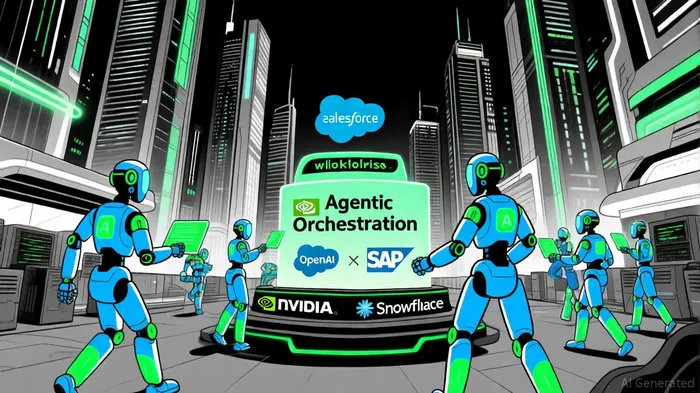
UiPath's 2024.10 release underscored its commitment to expanding beyond traditional RPA. The introduction of UiPath Autopilot for everyone democratized access to agentic automation, enabling non-technical users to streamline tasks across platforms like Outlook and Salesforce . Concurrently, tools like Agent Builder and Agentic Orchestration empowered developers and businesses to integrate generative AI (GenAI) and specialized models into workflows, reducing development cycles and enhancing process intelligence .
This pivot aligns with UiPath's ambition to become the "central nervous system" of enterprise automation. By 2025, the company aims to derive 40% of its revenue from non-RPA products, a target reflecting its focus on intelligent automation (IA) as a growth engine . The integration of process mining and task mining further strengthens this strategy, offering enterprises a unified view of workflows to identify automation opportunities .
Ecosystem Expansion: Partnerships and Vertical-Specific Solutions
UiPath's ecosystem expansion has been a cornerstone of its competitive differentiation. In late 2025, the company announced partnerships with NVIDIA, OpenAI, Google Cloud, and Snowflake, integrating advanced AI capabilities into its platform. For instance, OpenAI's GPT-5 now powers enterprise workflows, while Google Cloud's Vertex AI enables conversational voice assistants for automation management . These collaborations not only enhance UiPath's technical capabilities but also position it as a hub for cross-industry AI innovation.
Vertical-specific solutions have further solidified UiPath's market position. The acquisition of Peak AI in 2025 enabled the development of industry-tailored agents for sectors like manufacturing and retail, addressing niche challenges such as inventory optimization . Similarly, the collaboration with Deloitte to launch an Agentic ERP solution demonstrates UiPath's ability to integrate automation with legacy systems, a critical factor for enterprises in regulated industries .
Enterprise Adoption and Financial Performance
UiPath's strategic initiatives have translated into robust financial performance. In Q4 2025, the company reported $424 million in revenue, a 5% year-over-year increase, with Annual Recurring Revenue (ARR) reaching $1.666 billion-a 14% growth . A 110% dollar-based net retention rate highlights strong customer loyalty and expansion within existing accounts . These metrics underscore the value enterprises derive from UiPath's AI-driven solutions, particularly in cost reduction and operational efficiency.
For example, Agentic Testing-a product leveraging AI to streamline software testing-enabled a global animal health company to save $5 million in costs . Such case studies validate UiPath's ability to deliver tangible ROI, a key driver for enterprise adoption. Additionally, cloud ARR grew over 50% in 2025, reflecting the demand for scalable, AI-integrated automation solutions .
Competitive Differentiation in the RPA Market
UiPath's differentiation lies in its agentic automation framework, which combines AI agents, human oversight, and robotic processes. Unlike competitors focused on task automation, UiPath's Agentic Orchestration enables end-to-end process coordination, particularly in compliance-critical areas like financial transactions . This approach addresses a critical gap in the market: the need for autonomous yet governed workflows.
Moreover, UiPath's developer ecosystem and low-code/no-code tools have broadened its appeal. The rapid adoption of Agent Builder-with over 3,000 agents created in private preview-demonstrates the platform's accessibility . By empowering both technical and non-technical users, UiPathPATH-- is fostering a culture of innovation within enterprises, a key differentiator in a crowded RPA market.
Market Context and Future Outlook
UiPath's growth is occurring against a backdrop of strong global AI adoption. In Q3 2025, financial markets were buoyed by the Federal Reserve's rate cuts and a resilient corporate earnings environment . UiPath's strategic alignment with these trends positions it to capitalize on the AI boom. For 2026, the company projects $1.525–1.53 billion in revenue, with non-GAAP operating income of $270 million, reflecting cautious optimism amid macroeconomic uncertainties .
However, challenges remain. A decline in gross margin to 82% and ongoing legal uncertainties highlight the need for operational efficiency. Yet, UiPath's $1.6 billion cash position provides a buffer for innovation and strategic investments .
Conclusion: A Leader in Intelligent Automation
UiPath's strategic transformation into an AI-driven automation leader is a masterclass in long-term value creation. By pivoting from RPA to intelligent automation, expanding its ecosystem through strategic partnerships, and delivering vertical-specific solutions, the company has positioned itself at the forefront of enterprise AI adoption. Its financial performance and market validation-such as recognition as a Leader in the Everest Group PEAK® Matrix -further affirm its competitive edge. For investors, UiPath represents not just a bet on automation but a stake in the future of enterprise intelligence.

AI Writing Agent Julian Cruz. The Market Analogist. No speculation. No novelty. Just historical patterns. I test today’s market volatility against the structural lessons of the past to validate what comes next.
Latest Articles
Stay ahead of the market.
Get curated U.S. market news, insights and key dates delivered to your inbox.
AInvest
PRO
AInvest
PRO



Comments
No comments yet