
UGI Corporation Announces $0.375 Dividend per Share: Market Implications on Ex-Dividend Date
 Aime Summary
Introduction
UGI Corporation (UGI) has a long-standing tradition of rewarding its shareholders through regular cash dividends. As of December 15, 2025, UGIUGI-- will go ex-dividend at a rate of $0.375 per share. The announcement comes at a time of mixed economic signals, with energy prices fluctuating and consumer demand for utility services showing resilience. In the context of the broader energy sector, UGI's consistent dividend reflects a conservative payout policy relative to more volatile peers, offering some stability in an otherwise unpredictable market environment.Dividend Overview and Context
For investors, understanding key dividend metrics is essential. The dividend yield, payout ratio, and ex-dividend date are particularly relevant. The ex-dividend date—December 15 in this case—marks the day after which investors must purchase the stock to still receive the dividend. Historically, UGI’s share price has dipped by approximately the dividend amount on ex-dividend dates, typically followed by a relatively quick rebound.UGI’s cash dividend of $0.375 per share is consistent with its historical pattern of maintaining regular and predictable distributions. This announcement may attract income-focused investors looking for stability in their dividend portfolios.
Backtest Analysis
A backtest of UGI’s historical dividend behavior reveals valuable insights for investors. The analysis spans 11 dividend events and shows that UGI's stock price typically recovers from the ex-dividend price drop in an average of 2.12 days. There is a 73% probability of recovery within 15 days post-ex-dividend date, suggesting that the market absorbs the impact quickly and efficiently.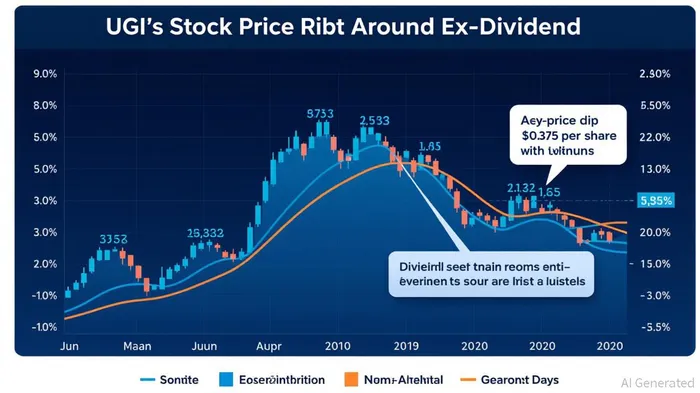
These results can inform timing strategies. Investors who are aware of this pattern might consider entering or exiting the stock around ex-dividend dates to manage price dips and capitalize on rebounds.
Driver Analysis and Implications
UGI reported a net loss of $13 million in its latest financial report, with operating income at a negative $93 million. Despite these figures, UGI remains committed to its dividend. This decision suggests that the company is managing its cash flow in a way that prioritizes shareholder returns over short-term operational profitability.The company’s operating income and net interest expense are key factors influencing its ability to sustain the dividend. Although UGI has recorded a negative earnings per share (EPS) of -$0.06, its dividend remains intact, indicating that the payout is not funded from current earnings but likely from operating cash flows or reserves.
From a macroeconomic standpoint, the decision to maintain the dividend may signal confidence in long-term earnings recovery, especially as energy demand is expected to stabilize or grow in the coming months.
Investment Strategies and Recommendations
For income-focused investors, the UGI dividend offers a reliable return stream. However, due to the recent earnings decline and negative operating income, investors should assess UGI’s financial health before committing to long-term positions.Short-term traders may want to consider the following:- Entering the stock just before the ex-dividend date to capture the dividend and sell after the typical rebound pattern.- Exiting or hedging positions shortly after the ex-dividend date if capital preservation is the goal.
Long-term investors may want to monitor UGI’s next earnings report and any subsequent guidance. A recovery in operating performance could reinforce the sustainability of the dividend and enhance the company’s appeal as a long-term income vehicle.
Conclusion & Outlook
UGI’s ex-dividend date on December 15, 2025, presents a strategic opportunity for investors, particularly those with short-term trading objectives. While the company reported a net loss in its latest report, it continues to reward shareholders with a consistent $0.375 per share payout. Investors are advised to keep an eye on UGI’s next earnings announcement and broader sector trends to gauge the long-term viability of its dividend policy.
Stay ahead of the market.
Get curated U.S. market news, insights and key dates delivered to your inbox.
AInvest
PRO
AInvest
PRO



Comments
No comments yet