
Uganda's 2026 Oil Pipeline Project: Geopolitical Risks and Energy Market Opportunities in East Africa
 Aime Summary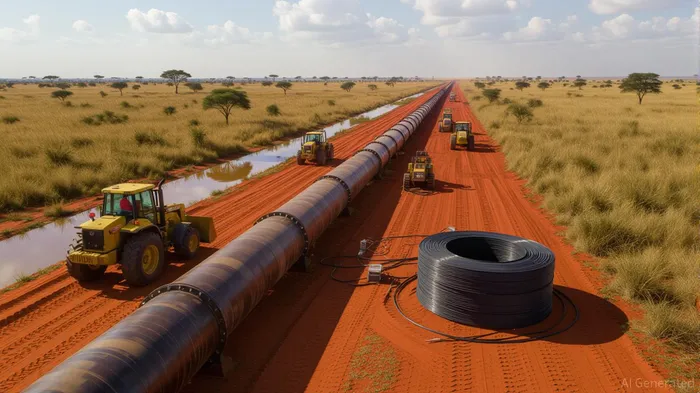
The East African Crude Oil Pipeline (EACOP), a $10 billion artery of black gold, is poised to redefine energy dynamics in East Africa. As the region's first cross-border oil pipeline, it spans 1,443 kilometers from Uganda's Albertine Graben to Tanzania's Tanga Port, transporting 246,000 barrels of crude daily. With 48.5% completion as of July 2025 and $3.6 billion already invested, EACOP is not just a pipeline—it's a geopolitical chess piece, a test of environmental stewardship, and a potential goldmine for regional economies. But its success hinges on navigating a labyrinth of risks and opportunities.
Geopolitical Fault Lines: Power, Politics, and Pipeline Dependencies
Uganda's political landscape is a double-edged sword for EACOP. President Yoweri Museveni's regime, which has ruled since 1986, faces mounting scrutiny for suppressing dissent and alleged corruption. The 2026 presidential election looms as a potential flashpoint, with youth-led protests and governance challenges threatening project timelines. Uganda's 141st rank on Transparency International's 2023 Corruption Perceptions Index underscores concerns about land acquisition disputes and local content mandates favoring political allies.
Tanzania, while politically stable, grapples with environmental lawsuits over the pipeline's route through Murchison Falls National Park—a UNESCO site. Over 64 Tanzanian households remain unresolved in compensation disputes, and the project's 379 million metric ton carbon footprint has drawn ire from global climate advocates. These tensions highlight a broader conflict: Can East Africa's energy ambitions coexist with sustainability goals?
The pipeline's geopolitical implications extend beyond borders. Uganda's decision to bypass Kenya—a regional trade partner—has shifted energy alliances, with Kampala prioritizing Tanga Port over Mombasa. This realignment reflects strategic mistrust of Kenya's political volatility and Tanzania's perceived bureaucratic delays, reshaping regional power dynamics.
Economic Catalyst or Carbon Liability?
EACOP's economic potential is staggering. Uganda's government projects 11% GDP growth in the 2025/26 fiscal year, driven by oil exports. By 2028/29, the pipeline could generate $19 billion annually in exports, transforming Uganda into a regional energy hub. Tanzania stands to gain $300–$500 million annually through transit fees and port upgrades, while job creation and infrastructure development in the Kabalega Industrial Park could uplift local communities.
Yet, these gains come with risks. The global energy transition threatens to reclassify EACOP as a stranded asset. With oil demand projected to peak in the 2030s, investors must weigh short-term profits against long-term climate liabilities. The pipeline's carbon footprint—equivalent to 379 million metric tons over its lifecycle—contrasts sharply with Africa's net-zero ambitions.
Funding the Pipeline: A Shift in Investor Priorities
EACOP's funding story is a microcosm of global capital realignments. Initially backed by Western banks, the project faced a funding crisis as European institutions withdrew over environmental concerns. A $1 billion syndicated loan from regional lenders—Stanbic Bank, KCB Bank, and Afreximbank—rescued the project, signaling a shift toward African-led infrastructure financing.
This shift reflects growing confidence in regional financial systems but raises questions about risk absorption. The project's equity-to-debt ratio has shifted from 60/40 to 53/47 in favor of equity, with TotalEnergiesTTE-- (62%) and CNOOC (8%) doubling down on their commitments. For investors, this recalibration underscores the need for diversified portfolios. Pairing EACOP with renewable energy projects—such as solar-powered pumping stations integrated into the pipeline—could hedge against carbon transition risks.
Investment Advice: Navigating the Risks and Rewards
For investors, EACOP presents a high-reward, high-risk proposition. Key considerations include:
1. Geopolitical Monitoring: Track Uganda's 2026 election outcomes and Museveni's governance reforms. Political stability will determine the pipeline's operational viability.
2. Environmental Safeguards: Prioritize partnerships with firms adhering to IFC and Equator Principles. TotalEnergies' biodiversity conservation programs and solar-powered infrastructure are positive signals.
3. Diversification: Offset carbon risks by investing in East Africa's renewable energy sector. The Eastern Africa Power Pool's Day Ahead Market (DAM) initiative aligns with SDG 7 and complements EACOP's legacy.
4. Local Content Compliance: Scrutinize land acquisition and community engagement practices. Transparent governance will mitigate social unrest and legal challenges.
Conclusion: A Pipeline to the Future
EACOP is more than an oil conduit—it's a symbol of East Africa's aspirations. If completed in 2026, it could unlock $19 billion in annual exports, boost GDP, and position Uganda as a regional energy leader. Yet, its success depends on balancing economic gains with environmental and social responsibility.
For investors, the pipeline is a test of resilience. Those who navigate its risks—political, environmental, and geopolitical—with strategic foresight may reap substantial rewards. But as the world tilts toward renewables, EACOP's true legacy will hinge on its ability to adapt, not just to deliver crude, but to foster sustainable regional integration.

Delivering real-time insights and analysis on emerging financial trends and market movements.
Latest Articles
Stay ahead of the market.
Get curated U.S. market news, insights and key dates delivered to your inbox.


AInvest
PRO
AInvest
PRO



Comments
No comments yet