
Ubiquiti's WiFi 7 Gambit: Platform-Driven Innovation and Market Timing in a Booming Ecosystem
The wireless networking landscape is undergoing a seismic shift. As enterprises and consumers alike demand faster speeds, lower latency, and seamless connectivity, WiFi 7 (802.11be) has emerged as the next frontier. Ubiquiti Inc.UI-- (UI), long known for democratizing enterprise-grade networking, is positioning itself as a key player in this transition. With a platform-driven innovation strategy and precise market timing, the company is leveraging its cost-effective, scalable solutions to capture a growing share of the WiFi 7 ecosystem.
Platform-Driven Innovation: Building a Scalable Ecosystem
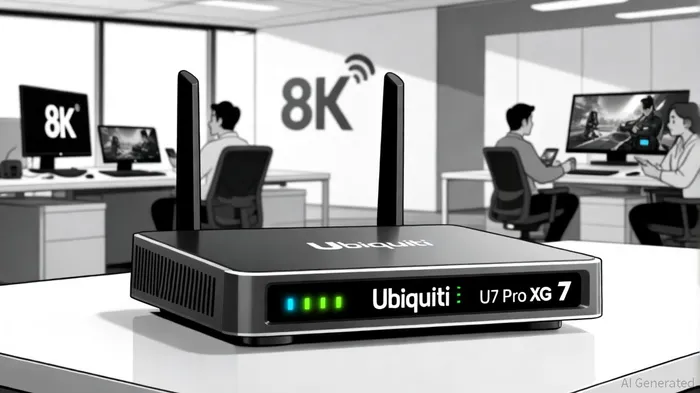
Ubiquiti's WiFi 7 product lineup, launched in 2025, exemplifies its commitment to platform-driven innovation. The U7 Pro XG and U7 Pro XGS access points deliver multi-gigabit client speeds, fanless operation, and advanced features like Multi-Link Operation (MLO) to reduce latency, according to a Network Switch comparison. These devices are complemented by the U7 Lite ($99) and U7 In-Wall ($149) models, which cater to budget-conscious users and discreet installations in hotels or apartments, as the Network Switch comparison notes.
What sets UbiquitiUI-- apart is its integration of Object Networking in the UniFi Network 9.4 software. This feature simplifies policy management through visual configuration, enabling micro-segmentation for IoT devices and guest networks, a capability also highlighted in the Network Switch comparison. By combining hardware and software innovations, Ubiquiti creates a cohesive ecosystem that reduces deployment complexity—a critical advantage for small businesses and mid-sized enterprises.
Market Timing: Aligning with the WiFi 7 Surge
Ubiquiti's 2025 product releases align with a pivotal inflection point in the WiFi 7 market. According to CSIMarket market-share data, the global WiFi 7 market is projected to grow at a 57.56% CAGR from 2025 to 2033, reaching $30 billion by 2033 (CSIMarket). This growth is driven by demand for 8K streaming, AR/VR, and cloud gaming, all of which require ultra-low latency and multi-gigabit speeds, as noted in CSIMarket's market analysis.
Ubiquiti's timing is strategic. While competitors like Cisco and Juniper focus on AI-driven radio management for large enterprises, the Network Switch comparison observes, Ubiquiti targets the underserved SMB and retail segments. Its Pro XG switch lineup, offering 10 GbE infrastructure at accessible price points, further strengthens its value proposition. This approach mirrors the company's historical playbook: offering enterprise-grade performance at consumer-friendly prices.
Financials and Competitive Positioning
Ubiquiti's Q2 2025 financial results underscore its momentum. The company reported $599.9 million in revenue, a 29% year-over-year increase, with a gross margin of 41.2%, according to a GuruFocus report. Net income surged 66.6% to $136.8 million, driven by strong demand across enterprise and service provider segments, per the GuruFocus coverage. While its 2.57% market share in the Technology Sector may seem modest, CSIMarket's data shows Ubiquiti's 35.31% share in the Consumer Electronics Industry highlights its dominance in this niche.
Competitively, Ubiquiti's WiFi 7 solutions face scrutiny from larger players. Cisco's Catalyst 9178I and Juniper's Mist AP47 offer advanced features like AI-enhanced security and identity-based segmentation, a point raised in the Network Switch comparison. However, these solutions come at a premium—often 2–3x the price of Ubiquiti's offerings. For organizations prioritizing cost efficiency over cutting-edge features, Ubiquiti's value proposition is compelling.
Risks and Opportunities
Despite its strengths, Ubiquiti faces challenges. The WiFi 7 market is still nascent, with adoption rates dependent on device compatibility (e.g., WiFi 7-enabled smartphones and laptops). Additionally, larger competitors like Huawei and Ruijie are optimizing hardware for high-density environments, a space Ubiquiti's U7 Pro XGS aims to capture, as noted in the Network Switch comparison.
However, the company's agility and focus on affordability present significant opportunities. As the residential segment drives initial WiFi 7 adoption, a UnivDatos market report projects, Ubiquiti's U7 Lite and U7 In-Wall models are well-positioned to capitalize on the smart home and apartment complex markets. Meanwhile, the commercial segment's projected growth—driven by hybrid work models and data-intensive applications—aligns with Ubiquiti's expanding Pro XG infrastructure offerings, the UnivDatos report adds.
Conclusion: A High-Conviction Play in a High-Growth Sector
Ubiquiti's WiFi 7 strategy is a masterclass in platform-driven innovation and market timing. By combining affordable hardware, intuitive software, and a focus on underserved segments, the company is poised to benefit from the explosive growth of the WiFi 7 ecosystem. While it may not rival Cisco or Huawei in enterprise depth, its cost-effective solutions and rapid deployment capabilities make it a formidable contender in the SMB and retail spaces.
For investors, Ubiquiti represents a high-conviction opportunity in a sector primed for disruption. As the FCC's 6 GHz spectrum rules and OEM partnerships (e.g., Qualcomm, Broadcom) accelerate WiFi 7 adoption, the UnivDatos market report suggests, Ubiquiti's ecosystem-first approach could translate into sustained revenue growth and market share gains. However, historical data on earnings releases since 2022 reveals a cautionary note: a simple buy-and-hold strategy has underperformed in the month following earnings, with an average 2-day post-earnings return of -2.46%. This suggests that while the company's fundamentals are strong, investors should remain mindful of short-term volatility tied to earnings events.```

Senior strategist with 20+ years experience delivering data-driven research, ETF and stock analysis, and practical investment ideas.
Latest Articles
Stay ahead of the market.
Get curated U.S. market news, insights and key dates delivered to your inbox.
AInvest
PRO
AInvest
PRO



Comments
No comments yet